
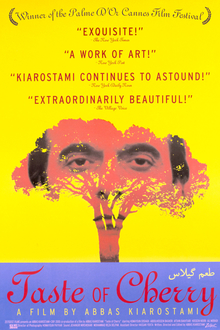
Behind the film
- Year
- 1997
- Director
- Abbas Kiarostami
- Writers
- Abbas Kiarostami
- Genres
- Drama, Road movie
- Production
- Ciby 2000
- Country
- Iran
- Cast
- Homayoun Ershadi
About the film
Contains story spoilers, including the ending.
Taste of Cherry puts Mr. Badii behind the wheel and lets a series of uneasy conversations carry the story. Homayoun Ershadi plays a man driving around the outskirts of Tehran, offering strangers money for a task he is reluctant to explain. Abbas Kiarostami leaves the reason for his despair outside the film. There is no family history to assemble into a diagnosis, and no earlier catastrophe that supplies an easy answer. Instead, Badii has to approach people who know nothing about him and ask for an extraordinary kind of help. He speaks of friendship while trying to arrange his own disappearance. That tension makes the encounters uncomfortable: the people entering his car have their own lives, obligations and limits, and the money cannot make his request feel ordinary. His face and pauses must carry what a more explanatory drama might put into dialogue or a flashback.
Badii wants someone to visit a grave he has prepared and establish whether he is still alive. A young Kurdish soldier recoils from the proposal and runs away. An Afghan seminarian objects on religious grounds. Bagheri, an older taxidermist who needs money for his sick child, agrees, but he also offers Badii a different account of despair. He remembers a time when he wanted to die and the taste of mulberries interrupted that intention. He took fruit home to his wife and began noticing pleasures he had stopped attending to. His argument stays close to things a person can touch, taste or see. Badii later returns to ask him to make quite sure he is dead before burying him. The practical request leaves room for uncertainty within a plan that initially sounded settled; even the arrangements depend on somebody looking closely and responding.
The surrounding hills give these conversations a harsh physical setting. Dry roads, muted colours and natural light place Badii in a landscape that can seem as depleted as his speech. Cinema Iranica's discussion of the film connects those visual choices with the character's sense of emptiness. The image keeps the story close to soil and open space, rather than enclosing his crisis in a bedroom or a hospital. Workers, construction and passing strangers remain part of this environment, so his private decision takes place amid other people's activity. The Kurdish and Afghan passengers also bring different experiences into what could have been a sealed portrait of one Iranian man. Their presence makes the journey socially particular even while its questions travel beyond Tehran. The car lets Badii move through that world without quite becoming part of it, meeting people temporarily before carrying on along another dusty road.
Kiarostami described the film's central concern as the possibility of living and the freedom to choose to remain alive. That explanation matters because Badii's destination can make every preceding scene seem directed toward a single inevitable outcome. The director leaves space for a different movement inside the same conversations: staying alive can remain a choice even when somebody is speaking about death. His working method also gave the exchanges room to develop. Discussing his use of nonprofessional performers, he explained that describing a scene could produce dialogue he had not anticipated, rather than requiring everyone to reproduce fully written lines. That approach helps explain the conversational texture of his cinema without turning the characters into mouthpieces for one correct answer. The people in the car can offer objections, memories and suggestions, while Badii remains difficult to read. We hear attempts at persuasion without receiving a final explanation of his mind.
The apparent simplicity of those car scenes hides a carefully controlled construction. In a public discussion, Kiarostami explained that the camera could be fixed beside a window or on the bonnet, even when reflections partly obscured a face. Some exchanges were recorded with performers talking to him rather than to one another. The finished conversation therefore brings together responses that were not always spoken across the same car seat. He also described choosing Bagheri's performer for an ordinary, unforced manner of speaking, and rehearsing the scripted material with him. Those choices keep the older man's account rooted in a person rather than an abstract debate. The restraint extends to sound: Kiarostami spoke about avoiding music that would take control of an audience's emotions. The film gives voices and the surrounding world room to be heard before its closing change in mood and medium.
At night, Badii lies in the hole while thunder and rain replace the daylight journeys. Darkness follows. Then the film moves to video images of Kiarostami, Ershadi and the crew on the hillside, with soldiers and trees in bloom. Ershadi's presence belongs to the making of the film; it does not settle what happened to Badii. The change opens a space between a character's possible death and the life continuing around the production. That sequence was a deliberate part of the film, even though its removal became a question during the original release. In correspondence reproduced by Jonathan Rosenbaum, Kiarostami confirmed his intention to retain the ending and discussed screenings with and without it in Italy. Keeping it means the last image cannot simply serve as confirmation of the plan. The story ends by changing the terms on which we have been watching, leaving the morning in Badii's grave unseen.