
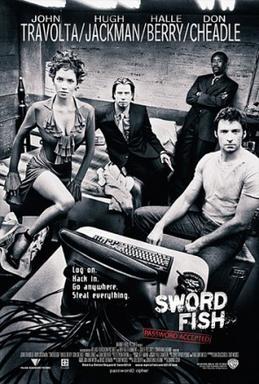
Behind the film
- Year
- 2001
- Director
- Dominic Sena
- Writers
- Skip Woods
- Genres
- Heist, Action
- Production
- Village Roadshow Pictures, Silver Pictures
- Country
- United States, Australia
- Cast
- John Travolta, Hugh Jackman, Halle Berry, Don Cheadle, Vinnie Jones, Sam Shepard, Drea de Matteo, Astrid Veillon
About the film
Contains story spoilers.
Stanley Jobson cannot use computers under parole or see his daughter Holly. Ginger recruits him for Gabriel Shear, who wants a worm to steal billions for Black Cell. Stanley inserts a backdoor to reverse the transfer. Gabriel's men abduct Holly, forcing Stanley into the robbery. After a hostage's bomb explodes, Stanley transfers the funds and gets Holly back, but his backdoor traps him again. Gabriel makes him restore the money, then apparently kills Ginger. A helicopter lifts the hostages' bus onto a rooftop. Stanley destroys Gabriel's getaway helicopter, only to recognise the supposed dead Gabriel as a corpse he saw earlier. Ginger's undercover identity was false; she wore a bulletproof vest and helped Gabriel escape. Stanley keeps quiet and gains custody of Holly. In Monte Carlo, Gabriel and Ginger collect the money, then watch a terrorist's yacht explode; a report identifies the third such attack in weeks.
The bank and coffee shop facing each other were built around an intersection on Ventura's Main Street, standing in for West Los Angeles. The production occupied the corner for nearly four weeks. Production designer Jeff Mann turned a rented bookstore into the coffee shop, choosing an expensive corporate appearance. Filming had begun in Bend, Oregon, with Gabriel's helicopter flying above Senator Reisman as he fishes. That scene took several days, with the crew repeatedly crossing the swift river. The Los Angeles car chase used an imported British TVR; Hugh Jackman said he spent five full days training for the driving.
Mann's flying-bus plan required a separate solution for the landing. He consulted Erickson Sky Crane, whose work included firefighting and transporting heavy equipment. Its stabilising rig counterbalanced suspended loads to keep them from twisting. The filmmakers judged the flight through downtown Los Angeles feasible, but liability and insurance concerns prevented a landing on a real roof. Mann built a replica rooftop in the mountains above Chatsworth, choosing a site with clear views west and south. A computer model of the bus's route let the effects team explore viewpoints from buildings along the way and plan camera positions before filming.
Film Stories notes that the opening explosion begins with a single screenplay cue: 'KABOOM'. Visual-effects supervisor Boyd Shermis described turning that event into a moving viewpoint through extreme slow motion. The live components were filmed separately at different frame rates. Still cameras had to point towards several targets, with moving elements making their placement and timing more complicated. Shermis commissioned Frantic Films to map camera positions, speed and the movement of objects in a detailed computer preview. Eight weeks of high-speed video tests with small explosions helped establish where cameras should aim and how many were needed. Reel EFX supplied its Multicam system, mounting computer-controlled still cameras on a winding exterior rig. The Canon camera bodies used rebuilt shutters and internal parts, with small onboard computers keeping them synchronised. The exterior and continuing interior portions used separate camera arrays. Engineer Tom Costan recalled that the firing sequence had to follow the computer preview throughout. His team spent substantial setup time finding aiming points that matched the planned shot. He contrasted this with their usual practice of adapting the finished scene or revising the preview to suit what the cameras captured.
Director Dominic Sena said he chose Jackman because he could not predict exactly how the actor would play Stanley. Producer Joel Silver proposed Halle Berry after working with her on earlier films. Sena described their casting together as coincidence. He recalled usually getting the performances he needed within three or four takes, and characterised the shoot as relatively easy. Finishing the picture was more exhausting. Shortly before release, colour correction and final sound mixes were still under way; Sena said he had worked seven days a week during the previous month and slept about three hours a night.
Composer Christopher Young had been hired during preproduction but said other commitments delayed writing until postproduction. He met Paul Oakenfold to discuss their approach, yet the schedule remained uncertain. Young recalled Joel Silver calling to say they would spot the film the next day and delivery was due in three weeks. He wrote roughly four and a half to five minutes of music daily for ten consecutive days, followed by rewrites. Oakenfold supplied source music and assembled the song album; Young wrote the orchestral underscore and developed synthesiser material with Gerard Marino. One action cue began with an Oakenfold dance track, added orchestra, then let the orchestra take over while retaining part of the dance texture. Young wanted more opportunities to combine their approaches. He said time pressure also left his thematic ideas insufficiently developed. Recutting continued during recording, with the filmmakers arriving late in the day to review cues. Comments from Sena, Silver and the picture editor generated further revisions as the shape of the film kept changing.