
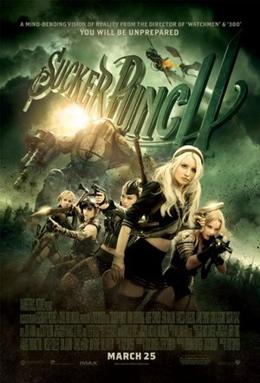
Behind the film
- Year
- 2011
- Director
- Zack Snyder
- Writers
- Zack Snyder, Steve Shibuya
- Runtime
- 109 minutes (theatrical version)
- Genres
- Action, Fantasy, Thriller, Girls with guns
- Production
- The Stone Quarry, Legendary Pictures, Warner Bros. Entertainment
- Country
- United States
- Cast
- Emily Browning, Abbie Cornish, Jena Malone, Vanessa Hudgens, Jamie Chung, Carla Gugino, Oscar Isaac, Scott Glenn
About the film
Contains story spoilers, including the ending.
Sucker Punch places Baby Doll's escape inside several kinds of captivity. The institution becomes a brothel in her imagination, and performances there open into battles against giant samurai, soldiers, a dragon and robots. These are nested fantasy spaces rather than successive countries she physically visits. The objects needed to get out connect the battles to the women's efforts in the brothel. Anna Mullins's study of the film describes a further frame around those worlds: the opening begins on a theatre stage before the camera moves into Baby Doll's bedroom. Later, Sweet Pea appears on another stage in a position that mirrors Baby Doll's. The repeated staging makes the act of imagining visible before the fantasy action begins, with Sweet Pea's narration accompanying a story initially centred on someone else.
After her mother's death and her sister's death during a confrontation at home, Baby Doll is committed by her stepfather. He pays orderly Blue to arrange a lobotomy using a forged signature. In the brothel fantasy, Baby Doll meets Sweet Pea, Rocket, Amber and Blondie. A Wise Man tells her to find a map, fire, a knife and a key, plus something requiring sacrifice. She distracts the men by dancing while the others collect the objects. The missions become battles in her mind, but losses cross those layers: Rocket dies protecting Sweet Pea, and Blue kills Amber and Blondie after discovering the plan. Baby Doll takes his key after stabbing him. Back in the institution, her lobotomy is completed. Dr. Gorski discovers the forged authorisation, Blue is arrested and implicates the stepfather. The procedure cannot be undone by exposing the crime that arranged it.
Baby Doll realises that getting both remaining women past the men at the exit will be impossible. She offers herself as the distraction that allows Sweet Pea to leave, treating that choice as the final sacrifice the Wise Man described. Sweet Pea reaches a bus, where a driver resembling the Wise Man helps her past police questions. The ending changes who carries the possibility of a life outside: Baby Doll's rescue of another woman takes the place of her own escape. The Cinemaholic's explanation connects that shift to Sweet Pea's voice at the beginning and end. It also proposes that the women and the final journey might belong to a single mind. That is an interpretation of the framing; the story does not supply a simple declaration that the characters are one person.
The theatrical version moves from Baby Doll's capture back to the institution and the lobotomy. The longer home-video cut includes an additional encounter with the High Roller in the brothel world before that return. Film Cred's discussion distinguishes the two versions and considers how the extra scene changes the meaning of Baby Doll's submission to what awaits her. The added encounter therefore belongs to the extended cut, rather than an event missing from a plot account of the theatrical release. In both versions, her sacrifice and Sweet Pea's escape sit beside the loss of Rocket, Amber and Blondie. Completing the objects does not produce a safe exit for the whole group, and winning a battle in a fantasy does not remove the power of the men holding them.
Zack Snyder described the film to IndieLondon as an investigation of genre and his own action style. He drew the scenes carefully before shooting and said that some sequences approached parody through their awareness of familiar conventions. The giant samurai carrying a machine gun was his example of an image that feels familiar even when no obvious earlier scene matches it. He also spoke about balancing irony with scenes that could hold emotional involvement. Music helped establish that approach before filming: he distributed a selection of songs to the cast and crew to suggest a mood, and several of those choices reached the finished film. His account describes the intention behind the collisions of action imagery and music, without settling what the ending means for every viewer.
The cast prepared for the action together. Emily Browning told the Comic-Con press conference that training lasted about three months and included martial arts, weapons work and strength exercises; she and Abbie Cornish also trained with swords. Snyder wanted them to experience a routine closer to an athlete's than an actor's. Jena Malone connected that shared exertion to the strengths and relationships they could bring to the characters. Filming against unfinished backgrounds required another kind of preparation. Jamie Chung described images and clips on set that showed what the scenes were supposed to become. Carla Gugino compared Snyder's developed material to a production bible that the performers could question directly because its creator was directing them. The imaginary worlds had visual references even when the creatures themselves were absent.
Cinematographer Larry Fong described the effects work as a collaboration extending through the final colour adjustments. The photographed image still needed a strong composition and appearance before the additions arrived; he rejected the idea that someone later simply replaced his work with an unrelated look. Fong also spoke about the psychological darkness beneath the action premise. His attention to that relationship joins the film's elaborate combat images to the distress that sends Baby Doll into them, rather than treating the fantasy material as an independent adventure.