
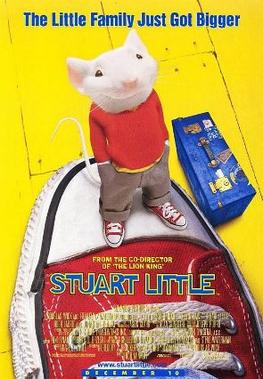
Behind the film
- Year
- 1999
- Director
- Rob Minkoff
- Writers
- M. Night Shyamalan, Greg Brooker
- Genres
- Comedy, Family
- Production
- Columbia Pictures, Red Wagon Entertainment
- Country
- United States
- Cast
- Michael J. Fox, Geena Davis, Hugh Laurie, Jonathan Lipnicki, Nathan Lane
About the film
Contains story spoilers, including the ending.
Rob Minkoff's Stuart Little places a talking mouse inside a human family, combining live actors with a computer-created central character. Geena Davis and Hugh Laurie play the parents, while Jonathan Lipnicki plays their son George. Stuart has Michael J. Fox's voice; Nathan Lane supplies the voice of Snowbell, the household cat. The parents welcome their adopted child, but George and Snowbell need more convincing. George's disappointment makes Stuart's search for a place in the household a sibling story as well as an adventure. Snowbell's resentment opens a different danger when his feline acquaintances become involved. Adapted from E. B. White's book, the 1999 film has a screenplay by M. Night Shyamalan and Greg Brooker, with Sony Pictures Imageworks providing its visual effects.
The Little home is welcoming in ways that do not make it safe for someone Stuart's size. A pile of pyjamas buries him, and the laundry carries him into the washing machine. Snowbell nearly swallows the new arrival before the parents insist that Stuart is a member of the family. Around these mishaps, the film builds a brightly furnished version of New York, with the Littles' small house facing Central Park and a skyline that becomes especially imposing from the mouse's viewpoint. Production designer Bill Brzeski gives the miniature spaces their own domestic details, including a mouse dwelling at a golf course with paper-cup lamps and baseball cards used as wall decorations. Stuart's world shifts between human possessions that dwarf him and objects rearranged to fit his scale.
A model sailboat gives George and Stuart something practical to do together. Stuart encourages George to finish the boat for a race, moving their relationship beyond George's first refusal to recognise him as a brother. At the event, the remote control is broken, and Stuart takes the helm himself. What would normally be a toy becomes a vessel he can actually sail, making his small size useful during a challenge that George cannot solve from the shore. He wins the race against the opposition that includes George's bully Anton. George's acceptance follows this shared success, so the family celebration grows out of a specific change in their relationship. Building and racing the boat lets them act as partners before the story asks whether that new bond can survive separation.
The celebration is interrupted by Reggie and Camille Stout, two mice claiming to be Stuart's birth parents. The Littles reluctantly let him leave with them, only to learn from the orphanage that his biological parents are dead. The Stouts are impostors involved in Smokey's scheme, and they eventually admit the deception to Stuart. He heads back toward the Little house while his adoptive family searches for him. A return home is complicated by Snowbell, who falsely tells Stuart that the family is celebrating his absence. The lie sends him away again even though the Littles are trying to find him.
Snowbell's change of heart becomes concrete when he faces the other cats. He acknowledges that the Littles love Stuart and that he lied about their feelings, then tries to stop Smokey's plan. When the gang insists that Stuart is merely a mouse, Snowbell recognises him as family. Stuart responds by pointing to the cat's willingness to protect someone he does not even like. The confrontation leads to a chase among the park's trees and branches, where the alliance has to hold under immediate threat. After escaping the cats, Stuart returns to the Littles and credits Snowbell with saving him. The ending gives the household's earlier rule against eating a family member an active counterpart: Snowbell now helps defend the mouse he once wanted gone.
Creating Stuart required an expressive character who could also appear to occupy the same rooms as the actors. The digital mouse appears in roughly five hundred shots, while animatronic substitutes were used sparingly. His fur and layered clothes had to move credibly, including when they became wet, and the effects team also created the Stouts. Real cats supplied another part of the animal cast, with animated mouth work making their speech possible. For Stuart's performance, animators worked with many facial shapes and controls for his hands, tail and whiskers. His tail could drag when he was sad or flick when agitated, while drooping whiskers reinforced concern. Costume designer Joseph Porro supplied small-scale patterns and fabric references that the team translated into digital garments. The work joined acting choices to material details rather than treating fur, clothing and expression as independent decorations.
The human cast had to rehearse relationships with a leading character who would be added later. A maquette or puppet helped establish how the actors should hold Stuart, and laser pointers indicated his position. Reference balls recorded how light behaved at the point where the mouse would appear, giving artists information about illumination and shadows. Matching the computer camera to the photographed camera then kept Stuart's perspective consistent with the set. His movement also drew on filmed reference performances by Bill Irwin, alongside inspiration from Michael J. Fox's voice and Buster Keaton's films. Observation of a live rat supplied information about noses, cheeks, blinking and eyelids. The resulting performance combined recognisable animal anatomy with the timing and gestures needed for a small character participating in human conversations.
Many of the effects are small contacts between Stuart and his surroundings. Lead effects animator Rob Bredow's work included wrinkles and depressions in the bed sheet beneath him, plus water and toothpaste droplets while he brushed his teeth. In the washing-machine sequence, computer-generated ripples, drips and bubbles enhanced practical water, and handprints appeared against the glass. The sailing material added water around the boat and a synthetic sail for Stuart to slide down. A tear also changed the fur on his face by making it clump. These details give ordinary surfaces a response to the mouse's presence. A mattress yielding under his weight or water moving around him supplies physical evidence of the same character whose voice and gestures carry the family story.