
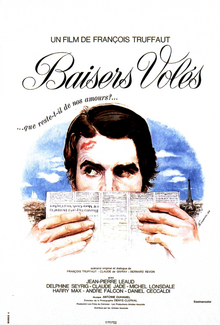
Behind the film
- Year
- 1968
- Director
- François Truffaut
- Writers
- François Truffaut, Claude de Givray, Bernard Revon
- Runtime
- 1h 27m
- Genres
- Romantic comedy, Drama
- Production
- Les Films du Carrosse
- Country
- France
- Cast
- Jean-Pierre Léaud, Delphine Seyrig, Claude Jade, Michael Lonsdale, Harry-Max, André Falcon, Daniel Ceccaldi, Marie-France Pisier
About the film
Contains story spoilers.
Stolen Kisses brings François Truffaut's Antoine Doinel back as a young man newly released from military service. Antoine has been discharged for indiscipline: he spends his time reading and writing to Christine Darbon rather than settling into army routine. He has written to Christine repeatedly during his service, sometimes more than once a day, without receiving replies. He rushes from the barracks to freedom and then to Christine's family home, where her parents welcome him even though Christine is away. Their affection helps him find a job as a night clerk at a Paris hotel. Antoine treats the position as another pause in his unsettled life, spending much of the shift reading, until Christine returns and their old attraction begins again.
The hotel job ends in a farce. Antoine helps a private detective and a husband discover that the husband's wife is in a room with another man. The husband wrecks the room, and Antoine is blamed for the disturbance and loses his post. The detective, Henri, takes a liking to him and brings him into the Blady agency. Antoine is a poor fit for orderly work: he follows people without always keeping track of why, and his attention wanders when Christine is near. He even crosses paths with Colette, the young woman he pursued in the earlier Doinel story, now married and with a child. Their brief meeting makes clear that Antoine's romantic past has continued without waiting for him.
The agency's most unusual client is Georges Tabard, a shoe-store owner who cannot understand why people seem to dislike him. Antoine goes undercover as a stock clerk, though he has little retail experience and is clumsy around the shop. He is supposed to find out what the employees think of Georges, but the assignment brings him into contact with Georges's wife, Fabienne. Antoine is captivated by her poise and maturity; she recognises his infatuation and chooses to seduce him. His fascination turns a detective job into a personal fantasy. He decides Christine is not someone he admires and breaks up with her, treating a temporary attraction as proof that he has discovered what he really wants.
The consequences arrive quickly. The agency begins to suspect that Fabienne is having an affair, and Antoine has to admit that the investigation has become part of the affair itself. He is fired, and Henri, his mentor at the agency, dies around the same time. Antoine's next occupation is as a television repairman, another job that reveals more confidence than skill. He avoids Christine, while she remains close enough to learn about his new work. A careless drive in the repair van ends with Antoine crashing into the car of Christine's father. No one is hurt, and her father forgives him, but the accident gives Christine a way to restart their relationship on her own terms.
Christine deliberately damages her television and calls Antoine's company while her parents are away. He spends hours trying to fix a set that only needs a tube, and their private meeting becomes a reconciliation. The next morning Antoine proposes without a speech, and Christine accepts. Their engagement does not turn Antoine into a settled romantic hero. Later, while they walk in a park, a man who has been following Christine approaches and describes his love for her as permanent, unlike the temporary love of temporary people. Christine thinks he is insane. Antoine agrees, although the stranger’s intensity invites comparison with his own earlier behaviour. The joke leaves the couple together but asks what kind of commitment Antoine can actually offer.
Truffaut wanted to film Léaud again and developed the detective job with his screenwriters after finding an advertisement in a telephone directory. The occupation offered opportunities for comedy in a French setting. Antoine’s work requires him to observe other people, but he repeatedly gets drawn into their lives or distracted by his own desires. The investigation of Tabard’s unpopularity becomes especially awkward because his employee has fallen in love with his wife. The string of jobs keeps changing what Antoine can see and whom he can meet, without giving him the detachment his detective work requires.
The film carries the Doinel story into Antoine’s adult life. He first appeared as a boy in The 400 Blows, and the short Antoine and Colette followed his teenage crush; here, he has freedom without much steadiness. The opening frames the locked gates of the Cinémathèque française, dedicated to Henri Langlois after his dismissal prompted protests. A hotel, agency, shoe shop and Paris streets become stages for the next shift in Antoine’s work and romances. Charles Trenet’s song plays at the start and end. A coffee scene with Fabienne slows the action: she understands his infatuation before he realises she knows. Pauses and small gestures hold that uneven knowledge in place, letting a polite conversation become an uncomfortable encounter.