
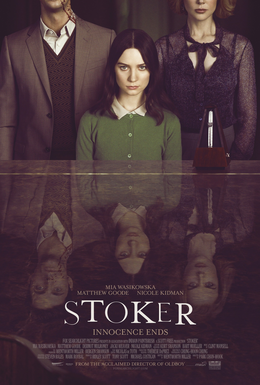
Behind the film
- Year
- 2013
- Director
- Park Chan-wook
- Writers
- Wentworth Miller, Erin Cressida Wilson
- Runtime
- 1h 39m
- Genres
- Teen, Coming-of-age, Thriller, Drama
- Production
- Scott Free Productions
- Country
- United Kingdom, United States
- Cast
- Mia Wasikowska, Matthew Goode, Nicole Kidman, Dermot Mulroney, Jacki Weaver, Lucas Till, Alden Ehrenreich, Judith Godrèche
About the film
Contains story spoilers.
India Stoker turns eighteen as her father Richard dies in an apparent car accident. At his funeral, his brother Charlie appears and soon moves in with India and her mother Evelyn. Evelyn welcomes him; India distrusts him. The housekeeper disappears, and Charlie kills great-aunt Gwendolyn before she can expose his past. India discovers the housekeeper's body and letters that reveal Charlie's years in an institution. He admits killing his younger brother Jonathan out of jealousy, then murdering Richard after Richard tried to keep him away from the family. India agrees to leave with him, but when Charlie attacks Evelyn, India shoots him dead, saving her mother. She buries him and drives away in his car. Sheriff Howard stops her for speeding. India tells him she wanted his attention, then kills him: leaving home has not ended her violence.
Mia Wasikowska approached India through ordinary teenage feelings that develop in a darker direction. She recalled Park Chan-wook describing a coming-of-age story and a twisted fairy tale, while leaving her uncertain whether India would become a hero or an antihero. That uncertainty gave the role somewhere to go beyond its guarded beginning. Wasikowska connected India's emergence to an egg motif running through the house: rounded chairs resemble eggs, while a group of white plates around a yellow centre repeats the shape behind India's head. Park had described the character to her as a chick breaking out of its shell. The piano duet offered a different way to loosen India's reserve. Wasikowska said the scene allowed the usually closed character to be swept along, and performing it with the music playing gave her something she did not always have during filming. The apparent American setting was also deliberately unsettled. In Wasikowska's account, Park wanted the place and period to remain nonspecific, allowing the family home to belong to a less definite time than its surroundings might first suggest.
Park's restraint was a deliberate choice. Speaking about the film's violence and other extreme material, he said he had considered viewers around India's age and wanted them to find beauty in the film rather than be driven away by it. He did not attribute that decision to making the production outside Korea. He also allowed different readings of India's development to stand together. Revenge could explain Charlie's resentment towards his brothers and India's response to her father's murder. A story of becoming was equally valid to him, with metamorphosis central to his filmmaking. Park described the possibility of reading the film as the beginning of India's story, although he had no sequel planned. These were alternatives he welcomed, without choosing one interpretation to settle the character's future.
Cinematographer Chung Chung-hoon treated the dining room as a place where the family's relationships could be expressed through movement. For Charlie and Evelyn's dance, the camera travels around the table and moves closer to them, following the emotional relationship between the two. He varied the contrast between the pair as India sees them and the other shots, giving India's face a greenish blue tone to suggest confusion and isolation. Rehearsal helped turn the scene into the simple, strong image Park wanted. The mansion required the same attention to feeling: Chung sought ways for its spaces to carry the actors' friction, jealousy and attraction. Finding a house that suited Park took time, and Chung worked with production designer Thérèse DePrez to realise the images planned before filming. A tight schedule made preparation an ongoing task during the production. He and Park reviewed storyboards every night after shooting, checking what came next. Chung also described taking particular care over the screenplay and characters, studying each line so that the film's structure could be approached scene by scene.
Sparse dialogue was one reason Park chose Wentworth Miller's screenplay. He wanted a quiet film in which each spoken word carried more weight. A piano, footsteps or falling leaves could convey meaning alongside the images, giving individual moments room that constant conversation would occupy. He also regarded the links between past and present, reality and fantasy, as essential to the characters. In his explanation, those things merge rather than remain separate. The film's nonlinear construction follows that understanding of people whose earlier experiences continue to shape their present lives.
Clint Mansell joined the film after Park attended the last of three concerts he gave at Largo in Los Angeles. Mansell was taking a break from scoring and had not yet been offered the work. The concert led to a meeting and a screening of the film Park was editing. Mansell accepted, and five weeks later the score was being recorded. His work also connected with Emily Wells, whose song appears at the film's end. After exchanging ideas from a distance, Wells reworked one of the film's themes, extending their collaboration beyond the recording room.