
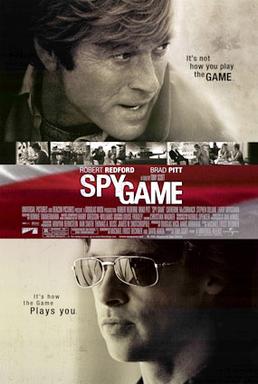
Behind the film
- Year
- 2001
- Director
- Tony Scott
- Writers
- Michael Frost Beckner, David Arata
- Runtime
- 2h 1m
- Genres
- Action, Action thriller, Spy, Flashback
- Production
- Beacon Pictures, Universal Pictures
- Country
- United States
- Cast
- Robert Redford, Brad Pitt, Catherine McCormack, David Hemmings, Stephen Dillane, Marianne Jean-Baptiste, Charlotte Rampling, Benedict Wong
About the film
Contains story spoilers, including the ending.
Spy Game places Nathan Muir's last day at the CIA beside the history of his friendship with Tom Bishop. Robert Redford plays the veteran operative, while Brad Pitt plays the younger man he recruited and trained. Tony Scott's 2001 thriller moves between their work in Vietnam, Berlin and Beirut and the headquarters meeting where Muir must explain that relationship. Bishop has been arrested in China after an unauthorized attempt to free a prisoner. Muir therefore has to recover more than the details of an old case. The colleague he has become estranged from is still alive, but the time available to intervene is almost gone. Retirement ceases to be a clean break from the work they shared.
The flashbacks put Bishop's growing doubts beside Muir's practiced acceptance of the job. Training in Berlin includes the instruction to abandon a defector, who is killed the following day. By Beirut, Bishop's involvement with a British aid worker adds another personal attachment to a profession Muir treats through orders and expendable contacts. The two men disagree about what can be done to people in the name of a mission. Those disagreements explain why their later separation matters when Bishop is captured. Muir's predicament in Washington also reverses their earlier positions. The man who taught Bishop to follow the rules now needs to slip around his own colleagues, obtaining information and arranging outside help while appearing to provide an account of the past. His retirement savings and freedom are among the things he risks.
Elizabeth Hadley, played by Catherine McCormack, is the prisoner Bishop went to recover. Muir had arranged her exchange to the Chinese for a detained American diplomat, then concealed what had happened from Bishop. Learning why Bishop is in China forces him to confront a consequence of that decision. He forges authorization for Operation Dinner Out and uses his savings to arrange a temporary power cut at the prison. A SEAL team rescues both Bishop and Hadley. The operation succeeds; Bishop's execution is prevented. Hearing its name lets Bishop recognize Muir's involvement because Dinner Out refers back to a birthday gift he arranged for his mentor in Lebanon. Muir leaves headquarters before the news reaches the officials he has been misleading. The closing rescue answers the immediate danger, while Muir's part in Hadley's imprisonment keeps the friendship tied to a betrayal that his intervention cannot undo.
Scott described the conference-room material as a chess game between people who mostly remain seated and talk. That was his answer to the problem of sustaining interest in a thriller built around recollection and questioning. The rescue is being organized from a room in Washington, far from the man in danger, so decisions about what Muir reveals become part of the action. Scott also named Three Days of the Condor as a reason the project appealed to him. Redford had starred in that earlier espionage film, making the connection part of the casting as well as the subject. For the helicopter rescue, Scott said he studied video of an actual rescue in Panama and used it as a model.
The film gives its different periods distinct appearances. The headquarters scenes use comparatively natural colours, while the Vietnam material emphasizes brown and dark green; Berlin is darker. These changes separate Muir's present circumstances from the places he describes without requiring the story to remain in chronological order. The contrast also keeps the office from visually standing in for every memory. Scott can return from a foreign operation to the same meeting, where the people listening still want an explanation and Muir still needs time. Dialogue and action consequently occupy different stretches of the film, with explosions and helicopters belonging to the operations alongside the verbal pressure of the debriefing. The locations are linked by the two men, even as the picture's colour changes around them.
Cinesite's effects work included enhancing reflections during an interrogation and extinguishing a grid of lights in a night landscape. The company also supplied muzzle flashes, sparks, bullet holes, dust and debris across its two dozen shots. These are additions to the physical places and violent events within the story. The night-light work belongs to a film where an interruption of electrical power is also part of Muir's rescue plan, giving ordinary infrastructure a practical role in the escape.
Composer Harry Gregson-Williams recalled being confused by an early cut before Scott reduced the material around Hadley. Her relationship with Bishop remained necessary, but the finished structure gave her less screen time. He also described Scott's strong preference for extensive music. One long cue ran for about eight minutes before a return to the CIA interior briefly brought quiet. Gregson-Williams helped decide where music would enter, yet later said he would have argued for using less if they repeated the process. The Beirut music came from a more specific discovery: a singer without previous film or studio experience, working over a straightforward Western string accompaniment. Recordings made during the location shoot provided phrases and sounds that the composer wanted to recreate. He credited that singer's freedom, rather than his own earlier experience teaching in Alexandria, with making the difference to those passages.