
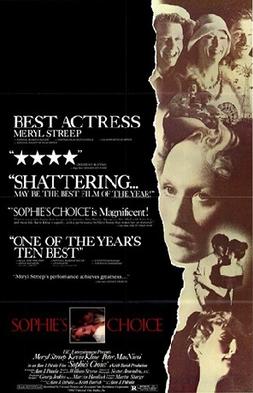
Behind the film
- Year
- 1982
- Director
- Alan J. Pakula
- Writers
- Alan J. Pakula
- Runtime
- 2h 24m
- Genres
- Drama, Flashback
- Production
- ITC Entertainment
- Country
- United States
- Cast
- Meryl Streep, Kevin Kline, Peter MacNicol, Rita Karin, Josh Mostel, Robin Bartlett, Günther Maria Halmer, Eugene Lipinski
About the film
Contains story spoilers.
In 1947, Stingo leaves Virginia for Brooklyn hoping to become a novelist and rents a room in a pink boarding house across from Prospect Park. His upstairs neighbors draw him into their orbit: Nathan Landau, a brilliant-seeming Jewish researcher whose confidence can turn suddenly cruel, and Sophie Zawistowska, a Polish immigrant with a numbered tattoo and a guarded manner. Stingo first encounters them as an intense couple, affectionate one moment and fighting the next. He is young, observant and inexperienced enough to mistake proximity for understanding; their invitation into the household gives him a place to belong while making him an audience to a relationship he cannot yet read.
Sophie gradually tells Stingo how she came to America, but her stories shift as trust grows and as the film revisits them. She first describes the deaths of her father and husband under Nazi rule and her imprisonment at Auschwitz. Stingo later learns that her father was not an anti-Nazi martyr: he was a fervent antisemite whose speeches Sophie typed. She loved him, yet understood the violence in his politics. Her wartime lover, Józef, was involved with the Polish resistance; Sophie refused to join him because she feared for her children.
In her fuller account, Sophie’s connection to the resistance brings her to Auschwitz. There, her German and secretarial skills lead to a position serving commandant Rudolf Hoess, who moves her into a room in his cellar. A prisoner asks her to seduce him and smuggle out a radio in return for a chance to save her son, Jan. Sophie fails to steal the radio, and Hoess breaks his promise. The attempted rescue ends in another loss and Sophie tries to kill herself. Sophie is a fictional character in Styron’s novel and Pakula’s adaptation, set alongside the historical commandant.
Stingo listens with sympathy, but he also wants Sophie to become the answer to his own loneliness and desire. Nathan’s moods keep rearranging the household: he can be tender and theatrical, then jealous and abusive, accusing Sophie of infidelity and humiliating her in front of Stingo. When Nathan disappears, Sophie and Stingo imagine a future together. His brother Larry then tells Stingo that Nathan has paranoid schizophrenia, uses cocaine and has lied about his scientific credentials. That revelation clarifies the instability Stingo has witnessed, but it does not make Nathan’s violence harmless or turn Sophie’s attachment into a puzzle Stingo can solve for her.
After Nathan returns, the three briefly resume their earlier closeness. A fresh accusation drives Sophie and Stingo to flee to Washington, where Stingo proposes marriage and offers a farm life in Virginia. Sophie refuses to marry him and tells him the last part of her past: at Auschwitz, an officer forced her to choose which child would be killed immediately, threatening to kill both if she refused. She chose to save her son Jan, and her daughter Eva was taken to her death. The title’s “choice” is coercion under Nazi power, not a free moral decision. Sophie’s guilt has shaped how she sees every later possibility, even when Stingo offers tenderness and a new beginning.
Sophie and Stingo sleep together, but she leaves him a note and returns to Nathan. Later Stingo finds that Sophie and Nathan have poisoned themselves; they lie together beside a book of Emily Dickinson poems. He grieves, then leaves Brooklyn for the South, carrying the knowledge that affection could not rescue either of them. The ending is devastating partly because it refuses the neat recovery Stingo hopes to write into his own life.
The film builds its movement through confession and delayed information rather than a continuous wartime chronicle. The pink boarding house is lively with neighbors, street sounds and the three characters’ talk; those familiar sounds can tip Sophie’s attention toward Poland and the camp. Supervising sound editor Chic Ciccolini described how a children’s street scene and an ice-cream truck’s bells help usher one conversation into a flashback, while distant trains and other sounds carry the horror of the camp beyond what the image shows. Alan J. Pakula’s restrained cutting lets Sophie open her story gradually, and Meryl Streep, Kevin Kline and Peter MacNicol give the shifting triangle distinct energies: Sophie’s guarded warmth, Nathan’s dazzling volatility and Stingo’s earnest attention.
The visual contrast is just as deliberate. The wartime images have drained, desaturated colors, while the Brooklyn conversations bring the camera close to Sophie’s carefully composed face. Stingo can hear her account, but the image keeps returning to the woman telling it rather than letting the past become a detached history lesson. Her pauses and changes of expression sit beside Nathan’s much larger gestures, particularly when he pretends to conduct Beethoven’s Ninth Symphony. That performance required an unusual adjustment: the recording used on set proved too expensive to license, so music editor Norman Hollyn altered the timing of the replacement recording to fit Kline’s movements. A cutaway also helped reconnect the picture and music. The scene’s apparent spontaneity depends on that precise work, just as the sounds outside Sophie’s window quietly help move her story between Brooklyn and Poland.