
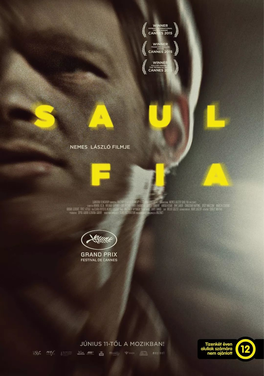
Behind the film
- Year
- 2015
- Director
- László Nemes
- Writers
- László Nemes, Clara Royer
- Runtime
- 107 minutes
- Genres
- Drama, War
- Production
- Laokoon Filmgroup
- Country
- Hungary
- Cast
- Géza Röhrig, Sándor Zsótér, Levente Molnár, Urs Rechn, Christian Harting, Marcin Czarnik, Björn Freiberg, Jerzy Walczak
About the film
Contains story spoilers, including the ending.
Son of Saul follows Hungarian Jewish prisoner Saul Ausländer through Auschwitz-Birkenau in 1944. László Nemes directs the 2015 drama, co-written with Clara Royer, with Géza Röhrig playing Saul. After a boy survives a gassing and is killed by a doctor, Saul tries to arrange his burial. Abraham disputes Saul's claim that the child is his son. The search for a rabbi draws Saul away from preparations for a revolt, and he loses gunpowder entrusted to him. When the uprising begins, he escapes carrying the body. Braun, the man he has brought along as a rabbi, cannot recite the Kaddish. Saul loses the body while crossing a river. In a forest shed, he smiles at a peasant boy who soon runs away. Guards approach and gunfire follows, leaving Saul's fate unresolved.
The camera stays close to Saul within a narrow, almost square frame. The film runs 107 minutes and contains 85 shots, photographed on 35mm film. Nemes developed this approach with his cinematographer, editor and sound designer working closely together. Röhrig was initially considered for a different part before Nemes decided he should lead the film. The director wanted someone whose presence could hold attention without having to explain everything about the character. Röhrig had acted in Hungary when younger, but had spent about two decades away from acting after moving to the United States. His preparation concentrated on reading and understanding the prisoners' work: the tools they used, their techniques, and the routines of different shifts. He described trying to inhabit the immediate task rather than examining his character's feelings from a distance. Nemes also deliberately excluded explanatory backstory. Keeping Saul within a day and a half meant that his past could remain inaccessible, even while the camera accompanied his movements. Röhrig recalled the work as physically and mentally exhausting.
Cinematographer Mátyás Erdély described the long takes as a problem of coordination shared by the whole cast and crew. The light sometimes needed to change within a shot, while the camera and the people behind Saul moved through complicated arrangements. Extensive rehearsal established the timing. Erdély said that shooting on film helped everyone concentrate, and that each detail of a shot had been discussed beforehand. The background's softness was also a decision: the crew determined how clearly an object or action should appear. Saul's search remained the organising point for what the audience could see. Erdély and the production designer visited Auschwitz-Birkenau during their preparation. Two photographs taken by Sonderkommando members supplied specific references for the scene in which prisoners secretly photograph the camp. That scene connects the prisoners' effort to carry evidence beyond the camp with a production approach built around carefully restricted visibility. The framing leaves much of the surrounding activity secondary to Saul.
Sound carries activity that the image keeps indistinct. Nemes wanted commands, voices and other noises to suggest the larger machinery around Saul without making the track elaborate for its own sake. He described a deliberately rough sound and an environment containing more than the camera reveals. The dialogue uses eight languages. Working with Yiddish coach Mendy Cahan, the filmmakers paid attention to differences in speech associated with different regions, including the accents of Hungarian and Ukrainian speakers. Short exchanges could therefore carry traces of where a prisoner came from. The actors also worked on physical behaviour under the rules imposed within the camp. Nemes described lowered eyes, removing hats to salute and speaking quietly while walking. He asked for a restricted range of emotion from characters who had already spent time there. Rehearsal allowed the team to remove gestures or words that felt excessive while remaining close to the script. These instructions put speech and bodily movement inside the same limited present as Saul's search, rather than giving the characters lengthy speeches to explain themselves.
Nemes and Erdély chose handheld movement to avoid the smooth floating quality of a Steadicam. They kept the camera at eye level and selected a 40mm Zeiss Master Prime after comparing lenses during preparation. The out-of-focus areas mattered to the choice as much as the sharpness of the subject. Nemes described using practical lighting within an interconnected set, pursuing the appearance of a workplace rather than a beautifully lit scene. Fires were created on set. The subdued brown and green palette drew on references including Come and See, Shoah and Saul Leiter's photographs. Much of the timing of cuts was decided during shooting, although Nemes said the edit still required difficult decisions. His cinematographer participated in discussions from the screenplay stage, questioning how the story should be told. Nemes also identified uncertainty as central to the film's approach: what is visible, what a person knows and what may happen next. That principle leaves the boy's identity disputed within the story. Saul acts on a conviction that the other prisoners cannot accept as a settled fact.