
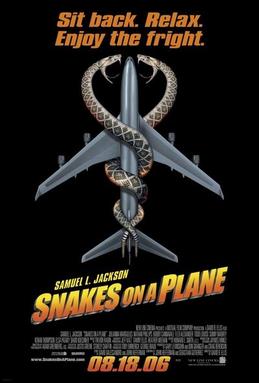
Behind the film
- Year
- 2006
- Director
- David R. Ellis
- Writers
- Sebastian Gutierrez
- Genres
- Action, Comedy horror, Crime thriller, Thriller
- Production
- New Line Cinema, Mutual Film Corporation
- Country
- United States
- Cast
- Samuel L. Jackson, Julianna Margulies, Rachel Blanchard, Kenan Thompson, David Koechner, Elsa Pataky, Nathan Phillips, Bobby Cannavale
About the film
Contains story spoilers, including the ending.
Snakes on a Plane puts a murder witness aboard a flight whose other passengers have become expendable to the man pursuing him. Sean Jones has seen Eddie Kim kill a prosecutor in Hawaii, and Neville Flynn escorts him to Los Angeles to testify. Kim has a crate of venomous snakes hidden in the hold. Once released, they spread into the cabin and damage the aircraft. Flynn and flight attendant Claire organise the survivors as the pilots are lost. Ground investigators trace the snakes and arrange antivenom. With nobody qualified left to fly, rapper Three G's bodyguard Troy takes the controls, relying on flight-simulator experience. He lands the plane after Flynn clears the snakes through broken windows. Sean survives a final attack thanks to his protective vest, and later takes Flynn surfing in Bali. The witness reaches safety, but the attempt on his life has endangered an entire flight.
That wider threat came out of a change to Kim's motive. Co-writer Sebastian Gutierrez recalled rewriting a version in which the snakes were intended to kill only the witness. He thought it made more sense for the villain to try to destroy the aircraft and everyone aboard. Kim's willingness to sacrifice strangers gives the passengers a common enemy even though most have nothing to do with his crime. Gutierrez described aiming for a more plausible motive inside an outrageous premise. The actors, in his account, needed to treat the danger seriously without becoming overwrought or acknowledging the audience with a wink. The joke is already present in the situation and the title. The people caught inside it still have to behave as though their lives are at risk.
Gutierrez joined when a budget and director were already in place, with a brief to work on character and dialogue. He wanted a suspenseful tone rather than camp, despite the difficulty of writing a film with such a blunt name. He also described the snakes interfering with the aircraft itself, rather than somehow selecting the right victim. That approach lets the threat spread beyond a series of individual attacks: the passengers depend on a machine that the creatures can also damage. The confined setting supplies both the immediate danger and the obstacle to escape.
Keeping that danger alive involved letting real snakes do ordinary things. Handler Jules Sylvester described using their existing habits to get them across a floor or into a bag. Harmless species could stand in for more dangerous ones, while mechanical and computer-generated snakes supplied actions the live animals would not perform. Sylvester brought hundreds to Canada and used a smaller group at any one time so the animals could have breaks. Their natural movement gave the film something tangible to build around, but a snake calmly crawling through a set was only part of the required illusion. Ellis also built complications into the journey: he described the release happening halfway between Hawaii and Los Angeles, with damaged electronics and a storm preventing an easy escape. These were obstacles in his disaster story, keeping the passengers trapped with the animals while Flynn searched for another way to help them.
Visual-effects supervisor Erik Henry divided the digital work between CafeFX and Hybride, assigning prominent individual snakes to one and much of the general chaos to the other. Each company developed particular species and appearances. The challenge included keeping a long body in contact with whatever it crossed without stretching it unnaturally. Henry said the creatures sometimes struck farther or moved faster than real snakes because they had to serve specific moments of danger. When live snakes fell onto people without looking threatening enough, digital work could increase the menace. Ellis also gave Henry roughly seventy shots in which to decide where the creatures should appear and what they should do. Henry and the effects companies studied the footage and added snakes around the existing action. Post-production expanded after the studio asked for a scarier, R-rated film, giving the team more time to add effects. The finished feature contained about four hundred effects shots, extending the attack through the cabin beyond what the live animals could supply.
Troy belongs to the flight's ordinary social world before he becomes its unlikely pilot. Kenan Thompson described him as a childhood friend of Three G's who now works as a bodyguard, alongside another member of the rapper's security. Thompson found humour in protecting a man much taller than himself. His account of filming also makes clear how much activity surrounded the actors: the constructed plane had storm and lightning effects, and snakes dropped onto him during a take. He brushed them off and ran. He wanted to keep a sense of humour while working inside a large-scale thriller, a combination that fits a character whose relaxed presence eventually gives way to an urgent responsibility.
Maria has a different reason to stay alert. Elsa Pataky described her as a young mother travelling with her baby, trying to find and protect the child when the snakes attack. Her account places that fear among a recognisable mixture of passengers, from a complaining traveller to a wealthy woman with a dog and a famous rapper. Pataky said she was comfortable around the snakes and enjoyed working with them, even while playing someone frightened for her child. She remembered Ellis's enthusiasm for the premise and Jackson being kind to the younger performers. Maria's immediate concern gives the crowded cabin a specific family relationship within the larger survival emergency.