
Behind the film
- Year
- 1992
- Director
- Emile Ardolino
- Writers
- Paul Rudnick
- Runtime
- 1h 40m
- Genres
- Musical, Comedy
- Production
- Touchstone Pictures
- Country
- United States
- Cast
- Whoopi Goldberg, Maggie Smith, Kathy Najimy, Wendy Makkena, Mary Wickes, Bill Nunn, Harvey Keitel, Joseph Maher
About the film
Contains story spoilers, including the ending.
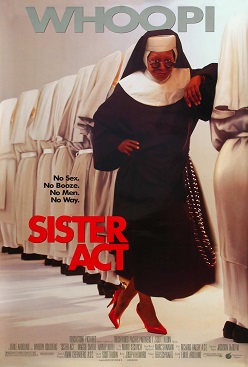
Sister Act places a nightclub singer inside a community whose rules leave little room for her usual way of life. Whoopi Goldberg plays Deloris Van Cartier in Emile Ardolino's 1992 comedy, with Maggie Smith as the Mother Superior who reluctantly accepts her. Harvey Keitel's Vince LaRocca is the threat outside the convent. Deloris's borrowed identity offers protection, but also requires a job, a habit and obedience to a woman accustomed to setting the terms. Becoming the choir director lets Deloris use a skill she already possesses. The convent is therefore both a hiding place and an unfamiliar stage, where songs from her working life can acquire a different purpose.
Deloris first resists the convent's food, chores and discipline, then befriends Mary Patrick, Mary Lazarus and the shy Mary Robert. Mother Superior assigns her to the choir to keep her occupied. Deloris discovers Mary Robert's strong voice and changes the group's style, drawing people into the church and supporting its repairs. Mother Superior worries about the changes and plans to resign when the sisters reject a traditional programme for the Pope. A corrupt detective exposes Deloris's whereabouts, and Vince's men abduct her with Mary Robert. Deloris helps the novice escape, allowing her to alert the others. The sisters go to Reno to rescue their friend, now knowing who she really is. Vince corners them at the casino, but his men refuse to shoot a woman dressed as a nun. Souther arrives and wounds Vince before the mobsters are arrested. Mother Superior thanks Deloris and decides to stay. Deloris directs the choir for the Pope, returning to the church by choice after the need for concealment has ended.
Paul Rudnick's starting point was a comic disguise: a showgirl who witnesses a gangland killing and must dress as a nun while hiding. He imagined a satire of reassuring nun films, with the heroine's show-business instincts disrupting their conventions. The project was initially developed for Bette Midler before Goldberg took the lead. Rudnick later felt the rewritten screenplay no longer represented his work and accepted the credit Joseph Howard. The finished musical comedy therefore differs from his original intended satire. Goldberg also recalled difficulties during production in a contemporary interview, saying the script was not ready and lacked a logical flow. These accounts describe a film whose shape remained contested during its making, even though its released story gives Deloris and the sisters a shared resolution.
Marc Shaiman described his musical assignment as a two-way exchange: girl-group songs had to become hymns, while hymns had to acquire the sound of girl groups. He was initially told that songs beyond a particular early-1960s date could not be used, a restriction he remembered finding awkward because it excluded much of the music associated with that sound. Looking through older hits led him to I Will Follow Him. A demonstration of My Guy suggested changing the central word to God, a joke he initially feared might be too obvious. The nuns' sincerity made the substitution work for him. For the other direction, the studio sent him hymnals. Hail Holy Queen contained an address to Maria that he could imagine in a girl-group performance. The arrangements let Deloris bring familiar popular-music gestures into a church service while the singers continue addressing religious subjects. The musical transformation is consequently part of the action: it changes who comes into the church and gives the sisters a public presence beyond their enclosed routine.
Wendy Makkena, who plays Mary Robert, remembered the ensemble carrying its characters beyond the church set. During long waits for lighting, she, Kathy Najimy and Mary Wickes would leave in costume and visit San Francisco shops. Makkena described these excursions as taking their characters for a walk, trying out how a sister might behave away from the convent. Because she was not yet recognisable, strangers could take the disguise seriously. Her recollection gives a different context to the habits: the performers could use them for play and character exploration between scenes as well as for the formal action on camera. She also remembered Goldberg's generosity toward the company. Years later, Makkena encountered a visiting school choir outside Lincoln Center with her daughter. The children recognised her as Mary Robert, lined up and sang Hail Holy Queen. Her account connects that character's singing breakthrough with a very specific response from young singers outside the film.
The choir's music remained central when the cast reunited for the film's twenty-fifth anniversary. Goldberg returned to the habit on The View alongside performers including Najimy and Makkena, and the original choir actresses performed I Will Follow Him. Maggie Smith sent a message to the gathering, while Keitel also appeared. Shaiman discussed the musical transformations alongside the cast rather than treating the score as separate from their performances. The reunion brought the songs back through the people who had embodied the convent, repeating the collaboration between a leading comic performer and an ensemble of singing sisters. Deloris's work with the group had supplied the film with both its disguise comedy and its final public concert.