
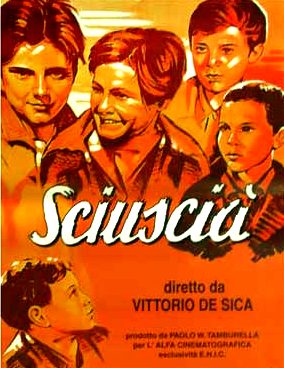
Behind the film
- Year
- 1946
- Director
- Vittorio De Sica
- Writers
- Sergio Amidei, Adolfo Franci, Cesare Giulio Viola, Cesare Zavattini
- Runtime
- 93 minutes
- Genres
- Crime, Drama, Coming-of-age, Prison
- Country
- Italy
- Cast
- Franco Interlenghi, Rinaldo Smordoni, Aniello Mele, Bruno Ortensi, Emilio Cigoli
About the film
Contains story spoilers, including the ending.
Shoeshine follows Pasquale and Giuseppe through a Rome where American soldiers supply customers for their work and the black market offers another way to make money. Vittorio De Sica's 1946 film, also known as Sciuscià, begins with the boys' delight in riding a horse. They want to own one together, a wish that briefly carries them beyond the need to earn enough for the day. Franco Interlenghi plays Pasquale and Rinaldo Smordoni plays Giuseppe. Once a criminal scheme sends them to a reformatory, their shared dream becomes something they remember from behind locked doors. The film moves quickly from the open space of their rides to crowded confinement, where other boys, guards and interrogators decide when they can speak, meet or leave. The friendship that helped them face the streets now has to survive separation and pressure from people with power over them.
Giuseppe's older brother Attilio and his associate Panza arrange for the boys to sell blankets to a fortune-teller. The men then arrive pretending to be police, using the visit to rob her. Their payment lets Pasquale and Giuseppe buy the horse, but the next day the woman identifies them and they are arrested. They try to protect the adults involved and are sent to a juvenile prison while the case is investigated. Separate cells deprive them of each other's immediate support. During questioning, Pasquale is made to believe that Giuseppe is being beaten in another room. He gives information to stop the apparent punishment. Giuseppe does not know why his friend talked and treats the disclosure as betrayal. An act meant to protect him becomes the reason the two cannot easily trust one another.
The reformatory gives Giuseppe another companion and protector, Arcangeli, while the friendship with Pasquale deteriorates. Giuseppe joins an escape that takes advantage of a small fire and leaves the building with other prisoners. Pasquale helps the authorities find him, knowing that the fugitives will return to the horse. The boys meet on a bridge. In their confrontation Giuseppe loses his balance and falls to his death. Pasquale is left grieving beside him as the horse moves away. Their purchase has brought no lasting freedom: the animal they wanted to share is present at the moment they are finally separated. The ending leaves the surviving boy with the consequence of an angry encounter, after adults have repeatedly used fear and suspicion to divide the friends.
David Forgacs's account of the film describes how its prison combines a real location with deliberately shaped studio space. The entrance belongs to San Michele a Ripa Grande in Rome, but the cells, hall and other interiors were built at Scalera's studios. Designer Ivo Battelli adapted the hall's tiers of arches and added a spiral staircase. Shadows of bars cross walls, floors and faces, with cinematographer Anchise Brizzi's lighting deepening the sense of enclosure. Forgacs connects the bright outdoor opening to the dark final scene in which the pale horse stands out. Both leading boys were new to acting. Their faces and physical closeness make the change in their relationship legible even before an accusation is spoken. The reconstructed rooms concentrate the pressure around those performances, giving the guards' entrances and the distance between cells a visible force.
De Sica's recollections, reproduced by Cineteca di Bologna, trace the horse to two real shoeshiners he knew as Cappellone and Scimmietta. They would work quickly, collect enough money and hurry to Villa Borghese to rent a horse. He remembered their rides as the starting point that Zavattini developed into the film's shared ambition. The children he encountered had different family circumstances, and he described their lives as evidence of the country's damage after war. That experience supplied an impulse for a fictional story rather than a documentary record of the two boys. De Sica also explained that choosing nonprofessional performers was never an inflexible rule for him. Some characters needed trained actors; others required a particular face he believed could only be found in everyday life. His casting decisions belonged to the needs of the individual role.
The writing passed through several hands before the film reached the screen. The national edition of Cesare Zavattini's work describes surviving story drafts and letters about the project's origins, alongside different recollections of how quickly he wrote his contribution. A letter treats the horse as the starting point for the emotional events, while another recollection places the writing within a much longer exchange of ideas and revisions. De Sica, producer Paolo William Tamburella and the writers had already considered other approaches. Zavattini returned to the project shortly before filming, and the finished credits name Sergio Amidei, Adolfo Franci, Cesare Giulio Viola and Zavattini. The horse joins the different parts of that developed story: earning money on the street, the crime that pays for the purchase, the boys' thoughts in prison and the encounter after the escape. Its place in their friendship continues beyond the brief freedom of the opening ride.