
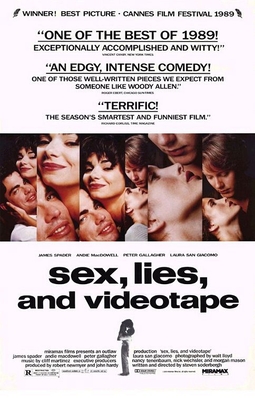
Behind the film
- Year
- 1989
- Director
- Steven Soderbergh
- Writers
- Steven Soderbergh
- Genres
- Drama
- Production
- Outlaw Productions
- Country
- United States
- Cast
- James Spader, Andie MacDowell, Peter Gallagher, Laura San Giacomo, Ron Vawter, Steven Brill
About the film
Contains story spoilers.
In Baton Rouge, Ann's lawyer husband John is having an affair with her sister Cynthia. His college friend Graham arrives carrying videotaped interviews with women about their intimate lives. Ann recoils from the collection; Cynthia volunteers to be recorded. Finding Cynthia's pearl earring in her bedroom confirms Ann's suspicions. She asks for a divorce and insists Graham interview her. Ann turns the camera on him, challenging his withdrawal from others. John attacks Graham and watches Ann's tape, which ends as she and Graham kiss. He then reveals his own past affair with Graham's former girlfriend Elizabeth. Graham destroys his tapes. John loses a client and faces his boss's summons. Ann and Cynthia begin reconnecting; Ann later joins Graham on his porch, where they hold hands as rain falls.
Steven Soderbergh built the opening around voices that continue across changes of picture. In his 2018 Filmmaker interview, he traced this separation of sound and image to The Graduate and said the overlaps were specifically scripted. Carnal Knowledge suggested a contained story organised around four people, although he wanted the women to have more space throughout his film. Ann's experience became its centre. For the light and colour, he imagined an afternoon beginning to change into evening. Conversations with a friend in her living room supplied the feeling he wanted: two people talking as though nobody else existed. That intimacy guided staging, dialogue and lighting.
Andie MacDowell found Ann's reserve in women she had known while growing up in the South. Speaking to Terry Gross for Fresh Air, she recalled knowing women who had been taught to feel ashamed of their sexuality. Playing that inhibition gave her something that could affect every scene, including moments when Ann was simply listening. The lunch with Graham supplied a small physical detail: Ann fiddles with a wine glass as they talk. MacDowell adapted it from her own nervous appearance on David Letterman's show at twenty-three. Letterman had handed her a collapsible cup, which she repeatedly opened and closed while concentrating on their conversation. She only realised what her hands were doing afterwards, then shut the cup and handed it back. She remembered the incident and brought the same distracted movement into Ann's lunch. In her account, Ann is absorbed by Graham and their conversation while her hand plays with the glass.
Soderbergh adjusted his manner to each performer. In his Directors Guild of America interview, he explained that some actors wanted extensive discussion of the work, others preferred talking about unrelated things, and some needed little conversation. Making shorts and knowing people connected with Louisiana State University's drama department had already made him comfortable around actors. His task was to learn how each person wanted to be approached. The thirty-day shoot let him work with those different needs within the same small cast. Rehearsal began with several readings of the whole script, followed by work in pairs. Soderbergh incorporated additions that sounded natural to the actors. Dialogue changed to fit them without changing what the scenes contained, and he chose camera positions after seeing them play.
The camera's closeness was also a practical choice. In his 1989 Positif interview, Soderbergh said he and cinematographer Walt Lloyd decided against telephoto lenses: to get nearer a character, they moved the camera nearer the actor. They avoided extreme close-ups filling the screen with faces or eyes. Video transitions were scripted, giving Graham a way to keep his distance from other people. Soderbergh wanted conversations to have room to breathe and viewers to make connections between scenes. Three screenplay versions changed the tone more than the structure. The first left the characters apart with no way forward. He replaced that ending because he wanted movement, while remaining uncertain about what would happen to Ann and Graham afterwards.
Cliff Martinez's introduction to Soderbergh came through a demo cassette containing electronic music and material for Pee-Wee. As Martinez told the British Film Institute, a friend working in post-production sound passed it to his boss, leading to work on Alien Nation. The friend's roommate was Soderbergh, who offered Martinez his film. Once Martinez saw Sex, Lies, and Videotape, he questioned whether the Pee-Wee music would fit. Soderbergh agreed they would make something different. The director wanted discreet music that strengthened the atmosphere, particularly during Ann and Graham's climactic conversation on the couch.
For the 2018 remaster, Soderbergh and Larry Blake returned to the original edited dialogue tracks after years spent locating them. Modern noise reduction let Blake remove generator noise without changing the voices. Intimacy had shaped the original mix too: Soderbergh deliberately left telephone voices unfiltered so that the person offscreen felt as close as the speaker in view. Two small visual corrections accompanied the sound work. A rental-car decal lost the place name Kenner, and a neighbouring videotape label was changed because it duplicated the date of Ann's interview. These were later remaster alterations.