
Behind the film
- Year
- 1927
- Director
- Frank Borzage
- Writers
- Benjamin Glazer, Joseph Austin Strong
- Genres
- Drama, Silent, Romance, War
- Production
- 20th Century Studios
- Country
- United States
- Cast
- Janet Gaynor, Charles Farrell, Ben Bard, George E. Stone, David Butler, Marie Mosquini, Émile Chautard, Gladys Brockwell
About the film
Contains story spoilers, including the ending.
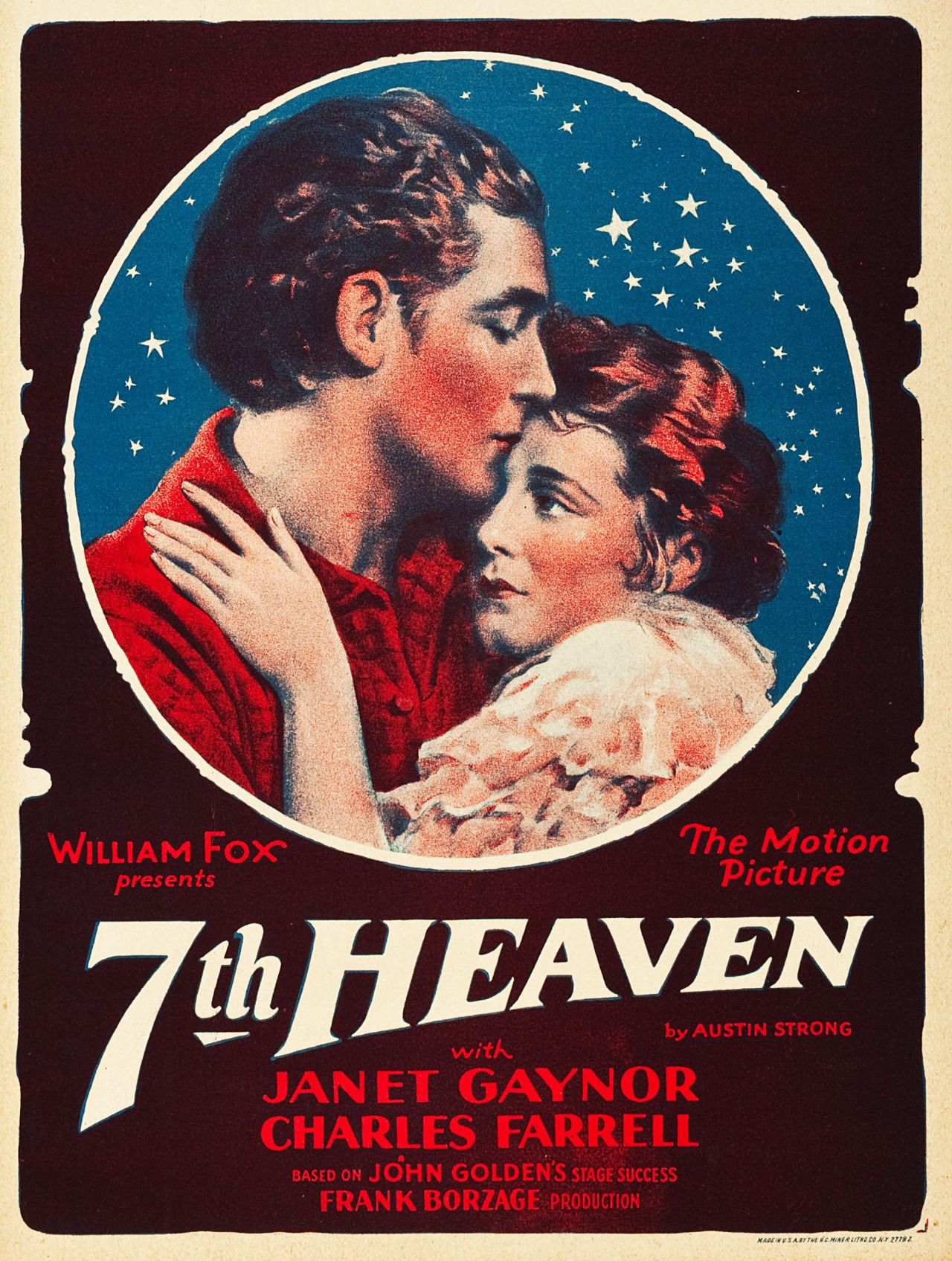
Seventh Heaven follows Chico and Diane through poverty, an improvised marriage and the First World War. Charles Farrell plays Chico and Janet Gaynor plays Diane in Frank Borzage's 1927 film, adapted from Austin Strong's play by Benjamin Glazer. Diane lives with Nana, her abusive sister. When wealthy relatives refuse to take them in after Diane cannot assure them of their respectability, Nana turns on her. Chico intervenes and tells the police that Diane is his wife. To make that claim believable when officers investigate, she moves into his home. After the police accept their story, Chico asks Diane to remain. Their shelter is an attic overlooking a Paris neighbourhood recreated at Fox. Chico's work begins beneath the streets, and his ambition is to become a street cleaner. Moving upwards through the city gives the couple a home above the slum where Diane has been beaten.
Love grows out of Chico's protection of Diane. His prayers had included finding a wife as well as escaping the sewers, but disappointment had left him bitter towards God. When the pair are finally ready to marry, war interrupts their plans and Chico is called away to fight. The couple hold an unofficial wedding in the apartment, with God as their witness. After Chico leaves, Nana tries to attack Diane again. Diane now fights back and drives her out, drawing courage from the support Chico has given her. While they are apart, the lovers promise to visit each other in spirit at eleven every morning. That daily appointment links the attic to Chico's life at the front. Diane works in a munitions factory during his absence. After the Armistice, she receives word that he has died, destroying the faith that has sustained her. The report is wrong: Chico returns alive, although he has lost his sight. Their reunion restores Diane's faith and their love.
The attic and streets were built around Borzage's idea of the lovers' Paris. In her San Francisco Silent Film Festival essay, Farran Smith Nehme describes the director visiting Paris before choosing to create the city on the studio lot. Art director Harry Oliver gave Chico's apartment uneven walls and surfaces, while the streets suggested an older city. The sustained ascent to the apartment carries Diane and Chico through the shabby building towards the home he places near the stars. Nehme also reports later recollections about the camera following Nana's pursuit of Diane: cinematographer Ernest Palmer said eight men carried a platform supporting the camera and tripod. Gaynor remembered Borzage talking to her during scenes, encouraging her to continue an emotion rather than finish the moment. These reported memories connect the moving camera and performance to the characters' flight from violence and their growing ease together. Nehme reports Gaynor remembering the height of the attic and nearby rooftop sets as a real source of fear during Diane's scenes at the edge.
Borzage and Palmer's preparation included six weeks in France studying Paris before the war, especially its street life. Historian Aubrey Solomon's Library of Congress essay places that research before filming in Los Angeles during the first months of 1927. The production cost more than $692,000, making it one of Fox's expensive films that year, although it relied on two young leads. Solomon describes Fox casting Gaynor while Sunrise was still in post-production, before audiences could see her performance in that film. Her role as Diane was therefore a major assignment for an actress who was still little known. Farrell was also a risk for the studio. Solomon recounts Borzage's earlier scepticism about him, followed by the supporting roles and a lead in Old Ironsides that preceded Chico. The film's production put the carefully researched Paris around actors whose screen careers were still being established.
Harry Oliver's sets and Ernest Palmer's camera work also feature in film historian Ian Christie's account of the film's visual approach. The garret provides a setting for the lovers' intimacy above the streets, while the war breaks their shared life apart. The relationship continues to organise the story even when the characters no longer occupy the same place. The setting was created in the Fox studios rather than photographed in Montmartre, giving Borzage a constructed Paris for the romance. Christie's account connects Oliver's physical surroundings to the film's treatment of enduring love, with Palmer's moving camera helping to establish the couple's world. Gaynor and Farrell continued their screen partnership as silent production gave way to talking pictures. The film first appeared as a silent release in the spring of 1927. Fox subsequently issued a version with a synchronised Movietone musical score and sound effects in September; it did not add spoken dialogue. Solomon records a May world premiere followed by major-city release later in the year with the theme song Diane in the Movietone score. The romantic story crossed into sound through musical accompaniment while preserving the performances of Gaynor and Farrell.