
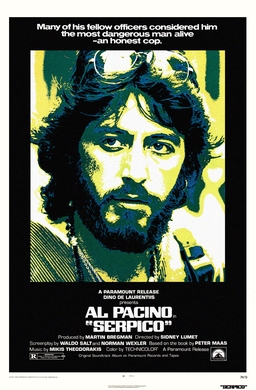
Behind the film
- Year
- 1973
- Director
- Sidney Lumet
- Writers
- Waldo Salt, Norman Wexler
- Genres
- Crime, Biographical, Drama, Action
- Production
- Columbia Pictures, Dino De Laurentiis Company
- Country
- United States, Italy
- Cast
- Al Pacino, John Randolph, Jack Kehoe, Tony Roberts, M. Emmet Walsh, James Tolkan, Kenneth McMillan, Cornelia Sharpe
About the film
Contains story spoilers.
Serpico begins with its protagonist badly wounded and being taken to hospital, before returning to the early formative days of his police career. Frank graduates from the academy expecting worthwhile work, but discovers that unofficial payments are embedded in ordinary police business. He refuses money that colleagues regard as an entitlement. His appearance and interests also separate him from the men around him: he grows his hair and beard, dresses for the street rather than the squad room, and pursues a life beyond the department. These differences help him work undercover, yet make him conspicuous among officers who expect both professional loyalty and participation in the same corrupt arrangements.
Transfers bring Frank into new precincts without solving the underlying problem. Money changes hands through an organized system, and declining his share makes other officers suspect that he will expose them. His efforts to tell superior officers what is happening repeatedly encounter reluctance to act. Bob Blair becomes an ally in pursuing the complaints outside the immediate chain of command. The film follows the accumulated cost of that process through Frank's growing anger, exhaustion and difficulty sustaining relationships. TCM's account emphasizes that the episodic story follows a man becoming progressively alienated rather than a straightforward investigation in which each discovery produces a useful response. Refusing corruption leaves him exposed without guaranteeing protection.
The opening injury eventually finds its place in the chronology. During a drug arrest, Frank is left dangerously vulnerable at a doorway and is shot in the face. He survives, but recovery cannot restore the career or sense of belonging he once wanted. His testimony before the Knapp Commission takes the struggle into public view, and the film ends with his departure from the force and from America. Its closing account of his future gives survival a different meaning from professional vindication. TCM describes Pacino's Serpico as a reluctant whistleblower whose anger comes from believing in the job: the institution he challenges is also the institution he had wanted to serve.
The adaptation developed through competing ideas about that emphasis. Producer Martin Bregman wanted the story centered on Frank rather than on political hearings, and Sidney Lumet replaced the initially hired director, John Avildsen. TCM records differing explanations for that earlier disagreement, including character emphasis, budgets and locations. Lumet inherited Waldo Salt's substantial screenplay and Norman Wexler's restructuring, describing the finished approach as Salt's language within Wexler's organization. The film compressed the real chronology and changed personal details and names; Bob Blair was a partly fictionalized counterpart to fellow whistleblower David Durk. Those decisions made a long public scandal manageable as a character narrative, while preventing the film from serving as a literal record of every participant's contribution.
Making that narrative involved a large logistical operation at speed. TCM's production history records 107 speaking parts and 104 New York locations across every borough except Staten Island. Lesser-known actors helped avoid the distracting associations that familiar stars might bring to supporting roles. Lumet's first shooting day moved between three widely separated locations, establishing a pace that initially surprised Pacino after The Godfather. Shooting began shortly after Independence Day, with release intended for Christmas. Editing proceeded during production: material reached Dede Allen quickly enough for cuts to return within roughly two days. Lumet treated that urgency as an acting advantage as well as a practical demand, because the performers had little opportunity to let the characters' tension dissipate between setups.
Lumet later explained the visual strategy through costume rather than through conspicuous camera flourishes. In his Museum of the Moving Image discussion, he credited Anna Hill Johnstone with making the clothing progressively darker until a courtroom scene placed everyone in black. He valued the fact that audiences could absorb the change without noticing a device being announced. In the same discussion he resisted the assumption that every deepening shadow represented a planned lighting progression: exterior work remained dependent on weather. His preference was to find locations that already offered the right qualities instead of remaking them extensively. The resulting approach connected a carefully shaped dramatic trajectory with the textures and practical limits of working streets and buildings.
Pacino's preparation also involved close contact with the person behind the story. He spent time with Frank before filming, observing his behavior and discussing his experiences. Lumet recalled that keeping the real Serpico away from rehearsal and shooting was painful but necessary, because his presence would make the actors self-conscious. The director's account of acting was equally direct: he regarded Pacino's choices as the actor's own work, with the filmmaker responsible for giving those choices room. Film at Lincoln Center identifies Mikis Theodorakis's score and the four-borough location work as central ingredients of the finished portrait. Its account places the personal struggle within a specifically New York story of intimidation, testimony and police corruption.