
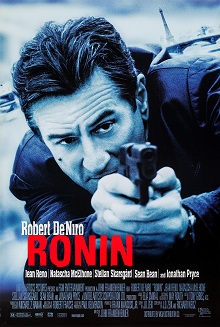
Behind the film
- Year
- 1998
- Director
- John Frankenheimer
- Writers
- David Mamet, J. D. Zeik
- Runtime
- 2h 2m
- Genres
- Heist, Action, Spy, Thriller
- Production
- United Artists
- Country
- United States, United Kingdom, France
- Cast
- Robert De Niro, Jean Reno, Natascha McElhone, Stellan Skarsgård, Sean Bean, Michael Lonsdale, Jonathan Pryce, Katarina Witt
About the film
Contains story spoilers.
Ronin opens in a Montmartre bistro, where Sam, an American, meets Deirdre, an Irish operative assembling a team for a case-retrieval job. The other freelancers are Vincent, a French fixer; Gregor, a German electronics specialist with a KGB past; Larry, an American driver and weapons expert; and Spence, an Englishman who claims to have served in the SAS. Their employer gives them little background and asks them to take a large metal case from a heavily guarded convoy before Russian bidders can acquire it. The object stays sealed and unexplained throughout the film. The crew’s practical skills are more visible than their histories, and Sam’s measured questions quickly make him seem like the person testing whether the others can be trusted.
The operation is set in motion through preparation as much as gunfire. The team’s attempt to buy weapons beside the Seine turns into an ambush, and Sam notices that Spence’s military stories do not match his ability. Deirdre dismisses him before the job, reducing the group by one and showing how quickly this crew treats a colleague as expendable. The remaining members plan an attack on the convoy near Nice, mapping its route and timing a diversion around the escort. They chase the surviving guards into Nice, where the assault spills through public streets and nearby traffic, making the city's ordinary movement part of the danger. Their attack succeeds, but the case changes hands during the confusion: Gregor takes it, leaves a bomb-filled decoy for the others, and tries to sell the real one to Russian mobster Mikhi. The team’s first victory therefore becomes a hunt for its own missing prize.
At Arles, the attempt to recover the case leaves Sam wounded, Larry dead and Gregor captured by Deirdre’s handler, Seamus. Vincent takes Sam to his friend Jean-Pierre’s villa to recover. Jean-Pierre’s miniature battlefield accompanies his account of the forty-seven ronin, masterless samurai whose story echoes the film’s hired professionals. The scene briefly replaces the crew’s calculations with a question about loyalty: what remains of a person’s obligations after an employer or institution has ceased to provide direction?
Seamus and Deirdre force Gregor to retrieve the case from a Paris post office, but another chase ends in a crash and Gregor escapes with it. The rival buyers eventually converge at a skating performance. Gregor’s threat against Mikhi’s girlfriend Natacha fails to protect him: Mikhi kills Gregor, Natacha is shot, and Seamus takes advantage of the panic to seize the case. The people who treat the exchange as a controllable bargain keep discovering another participant prepared to break its terms.
Outside the arena, Sam tells Deirdre he is still CIA and has been pursuing Seamus rather than the case. She leaves. Vincent saves Sam by shooting Seamus, and the two survivors later meet at the original bistro. A radio report connects Seamus’s death with a political settlement. Sam watches the entrance, but Deirdre never returns; asked about the case’s contents, he says he does not remember. The film leaves that object unidentified while resolving the target behind Sam’s apparent mercenary assignment.
Frankenheimer builds action out of controlled geography. The opening bistro sequence introduces Sam through the route he surveys before entering, while the bar interior—a studio set—contrasts with the real exterior steps. The director said he avoided long exposition scenes and preferred to let actions carry context. For the chases, he described advance planning with the art department, expert racing drivers, mounted cameras and closed roads, with no special effects. The routes were worked out before shooting, then assembled with editor Tony Gibbs. That preparation makes movement legible: viewers can track which car has gained ground, what traffic blocks it and where an exit remains. Frankenheimer said road closures and the racing crew let the production control every approach and swerve, with close shots made using cameras in and on cars. He described the setup as dangerous and said second-unit filming lasted several weeks. The method gives the Nice streets and Paris tunnels a consistent, navigable shape across cuts.
Re-recording mixer Rick Alexander described how the sound mix preserves the chase’s momentum. Editor Tony Gibbs alternated interior views, hood-mounted angles and distant shots; Alexander and Richard Rogers carried engine acceleration across those changes so that a cut did not reset the movement. Their material included cars recorded with altered exhausts at a racetrack, alongside horns, tyres and impacts. Frankenheimer kept the score out of the chase passages, leaving the vehicles to supply much of their rhythm. He even rejected an elaborate rolling-hubcap effect because the hubcap had come off unintentionally: the picture remains, but its sound is subdued. The quieter warehouse conversations required another kind of control. Raising the low dialogue also raised ambient noise, so the mixers used reduction and filters to bring speech forward. Alexander and Rogers shared both dialogue and effects work during the five-week mix, rather than treating those responsibilities as isolated departments. The same attention to transitions links the conspirators’ hushed negotiations with the noisy consequences on the road.