
Behind the film
- Year
- 1996
- Director
- Baz Luhrmann
- Writers
- Craig Pearce, Baz Luhrmann
- Runtime
- 1h 53m
- Genres
- Romance, Drama, Teen, Action
- Production
- 20th Century Studios, Bazmark
- Country
- United States, Mexico, Australia, Canada
- Cast
- Leonardo DiCaprio, Claire Danes, Brian Dennehy, John Leguizamo, Pete Postlethwaite, Paul Sorvino, Diane Venora, Harold Perrineau
About the film
Contains story spoilers.
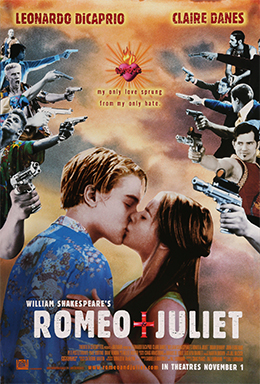
Romeo + Juliet places Shakespeare’s language in a present-day Verona Beach, a fictional American city where the Montagues and Capulets operate like rival dynasties. Their feud spills into streets, petrol stations and public squares, turning every ordinary encounter into a possible confrontation. The film preserves the play’s verse while changing what the audience sees around it: swords become guns, news reports frame the violence, and family status is displayed through cars, uniforms and weapons. The result is a setting that feels recognizably modern but still shaped by ritual, inherited names and public performance.
Romeo Montague begins in a restless mood after the opening gas-station fight between the Montague and Capulet gangs; he was not part of that confrontation. His friends Mercutio and Benvolio persuade him to come along to the Capulets’ masked party, where he meets Juliet. Their attraction is immediate, but neither knows the other’s identity until after they have kissed and spoken privately. Juliet is the daughter of a household already arranging her marriage to Paris; Romeo is a member of the family her relatives hate. The party’s masks briefly let them speak without those labels. Once the names are revealed, the romance has to contend with the world that gave those names their force.
The lovers choose secrecy rather than retreat. Friar Laurence agrees to marry them, hoping that their union might end the feud. Juliet’s Nurse helps carry messages, giving the secret relationship a practical link between households that would otherwise never meet peacefully. The young couple’s private vows unfold against a city that is increasingly unable to separate family loyalty from public violence. When Tybalt challenges Romeo, Romeo refuses to fight because Tybalt is now his kinsman by marriage, though he cannot explain why. Mercutio interprets the refusal as cowardice, takes up the challenge himself and is fatally wounded in the ensuing fight.
Romeo responds by killing Tybalt, and the authorities exile him from Verona Beach. He and Juliet spend one night together before he must flee. At home, Juliet’s parents press her to marry Paris, unaware that she is already married. When she asks Father Laurence for help, he gives her a potion that will make her appear dead, hoping she can escape the marriage and reunite with Romeo. The plan depends on a message reaching Romeo in time, but the message fails. Balthasar finds Romeo first and tells him Juliet is dead. Romeo buys poison and returns to Verona Beach, entering the Capulet vault where he finds Juliet’s body laid out beneath flowers and candles. The missed message leaves him acting on false information, and the film moves directly from that mistake to his decision to die beside her.
At the tomb, Romeo finds Juliet apparently lifeless and drinks the poison before the failed rescue plan can be put right. Juliet wakes while the poison is taking hold. They see one another, and she tries to stop him, but he has already swallowed too much to be saved. After he dies, she takes his gun and kills herself. Their deaths finally bring the two families together, but reconciliation arrives too late to save either young person. This brief change in timing makes the failure visible to both lovers: Juliet understands what is happening while Romeo is still there, yet cannot reverse his choice.
Luhrmann described his aim as imagining how Shakespeare might have addressed a film if he were alive today. That idea shapes the way the movie uses setting and image to make the verse legible: a television bulletin introduces the feud as a current civic crisis, while the lovers meet across an aquarium that briefly draws their attention away from the rival family names. Luhrmann also explained that water gives Romeo and Juliet a pocket of silence when the surrounding world becomes too loud. Their submerged moments are brief, but sound and movement settle there in a way the streets do not. This quiet recurs in the pool scene, where the lovers can speak and kiss below the surface before the city’s conflict closes around them again. The shifts from news, noise and violence to these water scenes make their private relationship visible without changing the play’s language.
The film’s costumes make the family divide visible before anyone speaks: the Montagues wear tropical shirts, while the Capulets favor tailored cowboy clothes. Religious ornament appears on the weapons, putting devotional images beside the instruments of the feud. Luhrmann also approached the script as something that had to be translated into pictures. He explained that he cut lines describing things the camera could show, rather than asking actors to narrate visible action. The preserved verse therefore sits within a film that moves between broad comedy, music and sudden violence. The familiar tragedy is delivered through changing forms, and the final television report returns the lovers’ intensely private loss to the public spectacle that opened the story.