
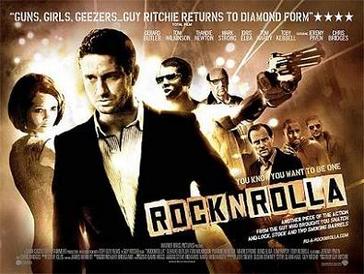
Behind the film
- Year
- 2008
- Director
- Guy Ritchie
- Writers
- Guy Ritchie
- Genres
- Crime, Action, Comedy
- Production
- Warner Bros. Entertainment, Dark Castle Entertainment, StudioCanal
- Country
- United Kingdom, France, United States
- Cast
- Gerard Butler, Tom Wilkinson, Mark Strong, Toby Kebbell, Tom Hardy, Idris Elba, Karel Roden, Thandiwe Newton
About the film
Contains story spoilers, including the ending.
RocknRolla puts a property deal at the centre of a London crime comedy. Guy Ritchie's 2008 film follows Gerard Butler's One-Two and the Wild Bunch as they collide with Lenny Cole, the older gangster played by Tom Wilkinson. Lenny's arrangement with a wealthy Russian businessman involves a valuable painting, lent as a sign of trust. When it disappears, his enforcer Archy starts looking for answers. The thief is closer to Lenny than he knows: his stepson Johnny Quid, a musician who has allowed the world to believe he is dead. Johnny's managers are pulled into the search, while the businessman's accountant sees an opportunity to make money herself. The deal joins people who have very different amounts of power, but who all expect someone else to bear the cost.
Accountant Stella hires the Wild Bunch to rob the money intended for Lenny. The painting travels separately, stolen from Johnny's hideout and eventually reaching One-Two, who gives it to Stella. Uri discovers it at her home, disbelieves her explanation and orders her death. Meanwhile, Handsome Bob has obtained documents identifying a police informant. When Lenny gathers the Wild Bunch and Johnny at his warehouse and orders them killed, Bob gives Archy the paperwork. Archy recognises Lenny's alias and realises his employer has spent years sending associates, including Archy himself, to prison. He frees the Wild Bunch and has Lenny drowned and fed to crayfish. Johnny escapes his own execution with managers Mickey and Roman, killing the men sent after them. Later, Archy meets Johnny as he leaves rehabilitation and returns the painting to him. Johnny announces his intention to become a real RocknRolla, now free of both addiction and his stepfather. The ending removes Lenny's authority while leaving Johnny with the object that helped cause the trouble. A scene after the credits also fulfils Bob's earlier request for a dance with One-Two.
Idris Elba described Mumbles as a clever London hustler in a very small gang caught in a much larger caper. Returning to the city where he grew up made the shoot familiar, and he could perform in his own British accent. He also described a disciplined set where the ensemble pushed one another to work well, and a role with substantial physical action. His account places Mumbles at street level, beside One-Two, while the property deal carries them into the affairs of richer and more powerful people. The differences in status also appear in their surroundings and clothes. Production designer Richard Bridgland described a more deliberately styled film, with a smooth contemporary London. One-Two has a spare apartment filled with technology, while Uri's wardrobe is understated. Costume designer Suzie Harman dressed Stella in Valentino and used tweed for the men's suits. Their appearance belongs to a city where criminal ambition and expensive taste readily meet.
Archy also tells the story. Ritchie explained that narration was necessary to guide an audience through so many competing strands, and that the editing revealed how difficult it would be to make them join up. Archy's voice places a participant in charge of explaining the world even while he is serving Lenny. The director distinguished the problem of managing those stories from directing the actors, who he felt fitted their parts naturally. Most of the comedy came from the script. Ritchie allowed circumstances on set to suggest changes, but said there was little improvisation. Music could change more substantially: he would try between ten and twenty songs against a scene before settling on one. For the attack on One-Two at home, he had originally tried salsa before choosing the 22-20s. The scene's musical direction emerged from trying alternatives against the action.
The locations make the property business visible around the characters. Ritchie wanted a modernising London, and cinematographer David Higgs described an East End transformed since Lock, Stock and Two Smoking Barrels. Bridgland looked for large spaces and areas being rebuilt. Uri's office overlooks the field at Wembley, giving a property magnate a view on a scale that a conventional office would struggle to provide. Battersea Power Station supplied interiors for the Wild Bunch's private club and a vast turbine hall used for Lenny's dealings with informants. Middlesex Hospital provided several other settings: rooms became Johnny's drug den, a library and Lenny's well-appointed office. These different levels of comfort and control could be built within the same abandoned building. Location manager Claire Tovey described seeking a balance between new landmarks and places visibly undergoing redevelopment, keeping the changing city present in the criminal transactions.
Some of that London had to be assembled through visual effects. Jonathan Privett supervised Rushes' work on 173 shots, aiming for effects that would pass unnoticed. The six-week location shoot and the actors' schedules meant many car scenes needed green-screen photography. Cars were mounted on turntables to introduce movement, while David Higgs took time with the lighting. Background footage was then matched to the edited shots, with unsuitable sections replaced before the final composites. Stella smoking from a car window was one example of the approach. A yacht shot required a more extensive construction because the production lacked both a yacht and a usable location image. A daytime photograph from the south of France became part of a night view of Docklands, with added water and silhouettes. These additions kept the story moving through a large city without requiring every element to be photographed together.