
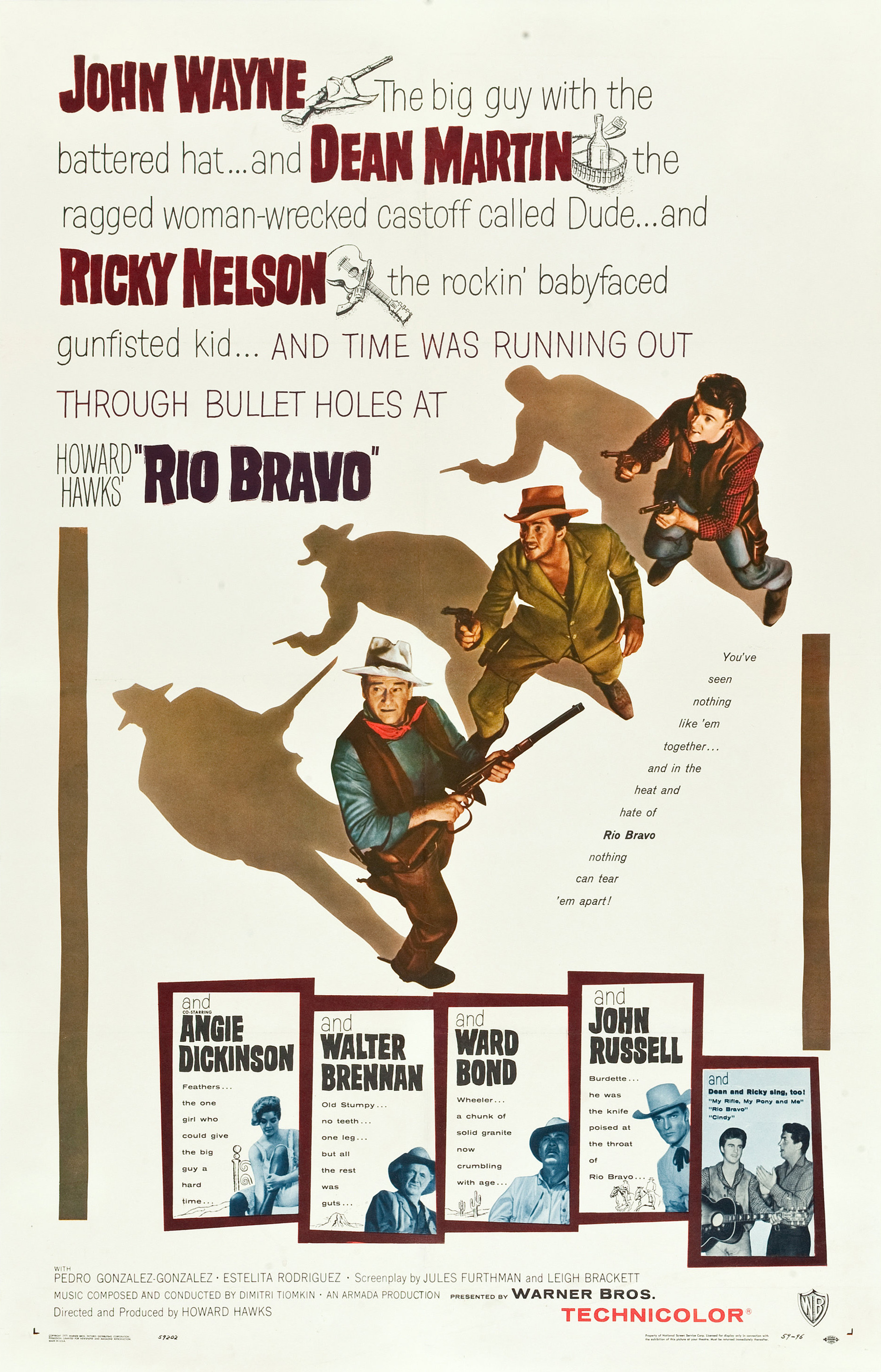
Behind the film
- Year
- 1959
- Director
- Howard Hawks, Paul Helmick
- Writers
- Leigh Brackett, Jules Furthman
- Runtime
- 2h 16m
- Genres
- Buddy, Western, Romance
- Production
- Warner Bros. Entertainment
- Country
- United States
- Cast
- John Wayne, Dean Martin, Ricky Nelson, Angie Dickinson, Walter Brennan, Ward Bond, John Russell, Claude Akins
About the film
Contains story spoilers, including the ending.
Rio Bravo puts a small group under pressure and gives its members time to discover how much they can depend on one another. Howard Hawks's 1959 Western brings John Wayne's Sheriff Chance together with Dean Martin's Dude, Walter Brennan's Stumpy and Ricky Nelson's Colorado. The threatened jail supplies a simple situation, while the characters' vulnerabilities complicate their ability to manage it. Chance may possess authority, but his companions must repeatedly prove useful in ways his initial assessment of them does not fully allow.
Joe Burdette kills an unarmed man, and Chance arrests him. Joe's brother Nathan hires gunmen to keep the prisoner from reaching trial. Chance refuses Pat Wheeler's offer of help because he will not endanger amateurs, leaving Dude and Stumpy as his immediate support. Colorado initially declines to join them, but later intervenes with Feathers to save Chance and Dude from attackers. Dude's struggle to regain steadiness makes his return to duty uncertain, though he eventually refuses a drink and takes his place beside the others. Nathan's men later capture Dude and demand Joe in exchange. At the meeting, Dude tackles Joe and a gunfight begins. Stumpy arrives despite being told to remain behind, stops men moving around the defenders and brings dynamite from a nearby wagon. He throws the sticks while Chance detonates them with gunshots, destroying the shelter used by Nathan's men. Nathan surrenders. Their victory gives each defender a necessary part: Chance's orders alone could not have produced it, and Stumpy's decision to leave the jail helps make the ending possible.
Hawks said he made Rio Bravo partly in reaction to High Noon, rejecting its image of a sheriff seeking assistance around town. His preferred lawman would ask whether a potential helper could handle the danger; an unprepared civilian might simply become another person to protect. That reasoning explains Chance's refusal of Wheeler without removing the need for allies. Hawks also objected to another Western's prisoner unnerving the sheriff with threats about his friends. He wanted the lawman to turn that threat back on the prisoner. His account connects the siege to the problem of how professional confidence should appear under pressure. It also leaves room for comedy. Hawks described beginning with a serious dramatic sequence before letting humour enter, rather than announcing from the titles that the audience should laugh. The opening violence establishes the risk before the relationships have time to become familiar. The lighter exchanges belong to people continuing their work inside that risk.
The relationship between Chance and Dude could be expressed through a task as small as rolling a cigarette. Hawks recalled Martin trying to roll one while his fingers shook, with Wayne watching and then doing it for him. The director found the gesture effective enough to repeat it. Assistance becomes visible without requiring a speech about loyalty or dependence. Hawks also gave Martin a specific physical suggestion for a hangover scene, describing a man who would pound his leg to try to feel something in it. Martin recognised the behaviour and could use that idea in performance. These actions make Dude's difficulty concrete while giving Chance opportunities to respond. The shaking hands matter because steadiness is something the deputy needs for his work as well as his dignity.
Angie Dickinson saw Feathers as an exception to the limited parts often given to women in Westerns. Instead of waiting to wave a man away or welcome him back, she could hold her ground among the men. Dickinson associated that strength with Hawks's interest in assertive female characters. Her favourite scene to perform came at the end, when Chance encounters Feathers dressed to sing downstairs and objects to her revealing outfit. She takes his protest as the admission of affection he has avoided making directly. The exchange lets her interpret the sheriff's words more confidently than he does. Dickinson's account emphasises how Feathers can direct the romantic conversation while Chance struggles to say what he feels. The relationship gives the lawman another kind of negotiation alongside the jail's demands. He can issue an order, but Feathers does not have to accept his explanation of what that order means.
Music gives the waiting men another way to occupy the jail together. Dude and Colorado sing, with Stumpy joining them, while Chance listens. The shared performance places their companionship inside an ordinary pause in the siege. My Rifle, My Pony and Me adapts Tiomkin's earlier Red River theme with lyrics; elsewhere the threatening Deguello signals that the attackers will offer no quarter. Peter Bogdanovich later recalled Hawks explaining that television viewers returned for familiar people more than for the story. That observation helped him make Rio Bravo around its characters, leaving the central conflict deliberately simple: someone is in jail and others want him released. Bogdanovich's recollection describes why conversation and shared time can occupy so much of a film about an armed standoff. The threat continues, but the group needs a life together while it waits, as well as a plan for the next attack.