
Behind the film
- Year
- 1988
- Director
- Walter Hill
- Writers
- Harry Kleiner, Walter Hill, Troy Kennedy Martin
- Runtime
- 1h 43m
- Genres
- Buddy cop, Action, Buddy
- Production
- TriStar Pictures, Carolco Pictures
- Country
- United States
- Cast
- Arnold Schwarzenegger, Jim Belushi, Peter Boyle, Ed O'Ross, Laurence Fishburne, Gina Gershon, Richard Bright, Brion James
About the film
Contains story spoilers.
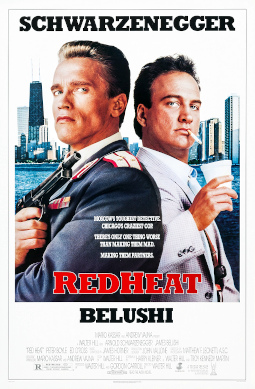
Red Heat brings a Moscow policeman into a Chicago investigation and builds its action around the friction with his local escort. Arnold Schwarzenegger plays Captain Ivan Danko, while James Belushi plays Detective Art Ridzik. Walter Hill directed the 1988 film and shares its screenplay credit with Harry Kleiner and Troy Kennedy Martin. The combination puts a disciplined visiting officer beside a talkative American detective in pursuit of a Soviet drug smuggler. The basic assignment supplies both the crime story and the culture clash: catching the same man does not mean approaching the job in the same way. Their partnership belongs to the film's action-comedy premise, with Chicago providing the unfamiliar territory through which Danko must continue his pursuit.
The pursuit begins when Georgian drug lord Viktor Rostavili escapes Danko in Moscow, killing his partner Yuri Ogarkov before fleeing to America. A traffic arrest in Chicago appears to offer a straightforward opportunity to bring him home. Danko is told not to disclose the reasons for the extradition, and takes a suspicious key from the prisoner's possessions. An ambush kills American officer Gallagher and frees Rostavili, leaving Danko determined to stay and complete the job. The resulting partnership grows out of a failed transfer rather than a planned international operation. The production's geography was similarly more complicated than the Moscow-to-Chicago itinerary suggests. Budapest stood in for Moscow, with further filming in Chicago and Los Angeles. The filmmakers also obtained permission to work in Red Square after a six-month wait, but could use only one camera and no sound equipment. The finished Soviet setting thus combines substitute locations with restricted access to the landmark itself.
Rostavili's key becomes the practical thread connecting the investigation to his shipment. Danko and Ridzik discover a network intended to move cocaine into the Soviet Union, while their encounters with suspects lead to further ambushes and killings. Commander Donnelly takes Danko's weapon because he cannot legally carry it in America; Ridzik privately supplies a replacement. After an attack at Danko's hotel, Rostavili recovers the key. A locksmith helps the policemen identify its connection to bus-terminal lockers, bringing them to the drug shipment and then to a chase involving two buses. Rostavili's vehicle crashes into a freight train. He emerges alive, kills the engineer and is then shot dead by Danko. The quieter farewell follows at the airport, where the officers exchange watches. Their respect has been earned through the case, and Danko's return to Moscow closes the journey without suggesting that the countries themselves have solved their differences.
Before the American partnership begins, the film establishes Danko in an environment of bodily force and extreme temperatures. The opening Russian-language sequence takes him into a bathhouse, where the exposed bodies, steam and stone leave little room for concealed strength. The fight breaks out through a window into the snow. James Horner's synthesizer music accompanies this introduction, before the move to Chicago replaces the familiar surroundings with hotels, local police and consumer distractions. Danko's military background and experiences of violence travel with him. Even a television in his hotel room becomes an encounter with an unfamiliar commercial culture when he finds pornography on it. These details place the visiting policeman outside his own habits well before the bus chase: his physical confidence remains obvious, but knowing how to hit someone does not make the new city intelligible.
Hill developed that foreignness around Schwarzenegger rather than asking him to disappear into an ordinary American role. In a 1988 interview with Robert Horton, the director explained that he wanted to work with the actor and devised the Soviet policeman partly because Schwarzenegger's accent would make a conventional American hometown difficult to sell. The script was written after the actors were in place, allowing their existing screen identities to shape it. Hill also wondered whether American audiences would accept a Soviet protagonist who remained committed to his own country. Danko therefore arrives with his identity intact. A change of clothing cannot erase it: when he swaps his uniform for an ill-fitting blue suit and announces that he is undercover, his conspicuous appearance keeps the joke visible. Another misunderstanding greets him at a rundown hotel, where the clerk hears his name as an expression of thanks. The comedy repeatedly puts a man accustomed to giving direct answers into situations where even introducing himself can go wrong.
The smaller roles had room for similarly deliberate character choices. Brion James, who plays a street informant, described his contribution in a 1999 interview with Louis Paul. He had worked with Hill before and credited Southern Comfort with establishing him as a film actor. For Red Heat, he was willing to accept even a brief appearance because of that working relationship. He recalled shaping the informant through his processed hair and shoes, bringing the director ideas rather than treating the part as an anonymous delivery of information. Hill allowed him to develop those choices. The recollection gives a practical view of how this criminal world was populated: alongside the two heavily contrasted stars, an actor with one substantial scene could use dress, grooming and behaviour to suggest a person already living in the streets they were investigating.