
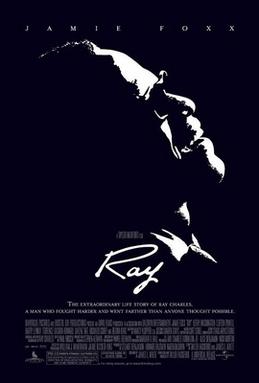
Behind the film
- Year
- 2004
- Director
- Taylor Hackford
- Writers
- Jimmy White, Taylor Hackford, James L. White
- Runtime
- 2h 32m
- Genres
- Biographical, Musical, Drama
- Production
- Bristol Bay Productions
- Country
- United States
- Cast
- Jamie Foxx, Kerry Washington, Clifton Powell, Harry Lennix, Terrence Howard, Larenz Tate, Richard Schiff, Regina King
About the film
Contains story spoilers.
Taylor Hackford’s Ray, with Jamie Foxx as Ray Charles, joins the adult musician's career to childhood memories that do not stay neatly in the past. In northern Florida, young Ray watches his little brother George drown in a washbasin, and the film returns to that image as the adult Ray plays, travels and tries to keep his life moving. His sight fades soon afterward. Aretha, his mother, insists that blindness will not make him helpless; she teaches him to find his way around their home and eventually sends him to a school for blind children. The film's later flashbacks connect that training to the self-reliance that becomes part of Ray's public manner. The guilt attached to George is presented as Ray's burden inside this dramatized story, rather than as a claim that the film reproduces every fact of Charles's childhood.
As a young musician, Ray leaves Florida and takes work in a white country band, using sunglasses and a made-up war story to conceal his blindness from audiences. The film then moves him to Seattle, where nightclub leader Gossie McKee provides a first foothold but keeps control of his pay and career. Ray recognizes that the arrangement makes him dependent, leaves and begins leading his own group. On the Chitlin' Circuit, he learns the realities of touring Black venues across a segregated country and, on the road, first encounters heroin. He leaves managers who see his talent as something they can use and insists on directing his own career. The new career opens opportunity and exposes him to the pressures that follow him through the film.
Atlantic Records changes the scale of the story. Ahmet Ertegun hears Ray's playing, signs him, and encourages a sound that lets gospel phrasing run into rhythm and blues. Songs such as 'Mess Around' and 'I Got a Woman' bring audiences and arguments: the gospel influence that feels natural to Ray also troubles people who hear sacred language redirected toward romantic desire. Ray and Della meet in Houston, marry, and start a family, while his touring schedule makes home life difficult to hold together. When Della discovers his hidden drug kit while pregnant, the argument makes clear that the cost of his music is already arriving in the household.
Ray's personal life gets harder as his fame grows. He has an affair with blues singer Mary Ann Fisher, then falls for Margie Hendricks, a Raelette whose voice is part of the group's sound. Their relationship ties his working life to his private choices: she is not an audience member he can leave behind after a show, and her presence lets the band see the way his promises to Della and his actions on the road diverge. The film's decisive hotel sequence gathers that conflict around the making of 'Hit the Road Jack.' Margie tells him she is pregnant and wants him to leave his family; Ray refuses, but she points out he has already abandoned them by living and working with her. He turns the fight into a performance, channeling its heat into the song while the scene cuts between their room, a supper club and the record company.
The musical story also includes the earlier onstage birth of 'What’d I Say,' improvised when a club asks the band to fill time, and Ray’s move to ABC Records, where he negotiates ownership of his master recordings. Commercial advances run alongside the relationship conflicts, rather than resolving them. As more success arrives, he also becomes a demanding employer, cutting loose his longtime manager Jeff Brown and alienating band members when he suspects them of taking advantage of him. The film shows his business instincts as part of the same independence his mother taught him, though the habit of deciding who can be trusted leaves other people carrying the cost. Outside the music business, he refuses to play an Augusta venue that segregates its audience and is punished for cancelling; later, police arrest him for heroin possession after another concert incident. His fame protects the career better than it protects the man.
Eventually, another heroin arrest and Della's insistence that he face the addiction bring Ray to treatment. Withdrawal is shown as an ordeal, not a tidy turn toward health: he sweats through nightmares and returns to the childhood images that have followed him for years. In a vision, his mother and George release him from the guilt he has carried, while also making him confront what dependence has done to the life he built. The movie then jumps to 1979, when Georgia's governor apologizes for the earlier concert ban and names 'Georgia on My Mind' the state song. This dramatized coda closes the film’s chosen period; its concert-ban storyline should be understood as part of the adaptation rather than a precise historical record. The structure helps join songs to memories: editor Paul Hirsch describes spreading the childhood flashbacks through the present-day story, while Hackford says he changed camera movement as Ray lost his sight and became more untethered to heroin.