
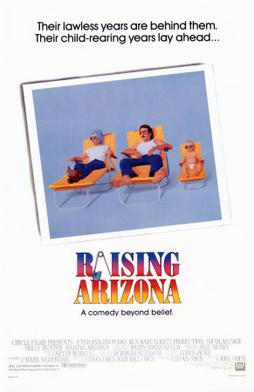
Behind the film
- Year
- 1987
- Director
- Joel Coen, Ethan Coen
- Writers
- Joel Coen, Ethan Coen
- Genres
- Comedy, Action, Crime, Black comedy
- Country
- United States
- Cast
- Holly Hunter, Trey Wilson, John Goodman, William Forsythe, Sam McMurray, Frances McDormand, Randall Cobb, Nicolas Cage
About the film
Contains story spoilers, including the ending.
H.I. McDunnough has spent years drifting between convenience-store robberies, prison and parole when he falls in love with Ed, the police officer who photographs and fingerprints him after each arrest. Nicolas Cage plays the would-be reformed outlaw, with Holly Hunter as his determined partner. Marriage gives H.I. a home and a job, but the couple cannot have children, and his record prevents adoption. News that furniture salesman Nathan Arizona and his wife have had quintuplets supplies an appalling solution: they will take one baby, reasoning that the parents have more than they need. Their longing for an ordinary family produces another criminal enterprise before parenthood has even begun.
Bringing Nathan Junior home puts the couple at the center of a widening scramble for the child. H.I.'s escaped prison friends Gale and Evelle Snoats arrive, while his boss Glen and Glen's wife Dot bring their own intrusive ideas about family life. The baby becomes something each adult wants to claim, protect or exploit. H.I.'s attempt to steal diapers turns into a chase involving armed pursuers and dogs, making his promises of respectable behavior increasingly difficult to believe. Beyond this suburban confusion rides Leonard Smalls, a motorcycle bounty hunter whose violence turns the pursuit into a threat to the child's life. The desert landscape surrounds the domestic mess with the scale of a Western.
The Snoats brothers carry Nathan Junior away, and the struggle to recover him brings H.I. into a showdown with Smalls. H.I. defeats the bounty hunter and retrieves the baby, but keeping Nathan is no longer a defensible version of being a father. He and Ed take him back to the Arizona household, where Nathan's father recognizes who they are and allows them to leave. Their own marriage remains uncertain. H.I.'s closing narration imagines the brothers returning to prison, the child growing up and a future of family gatherings for himself and Ed. These images belong to a dream, leaving the couple's eventual life open rather than confirming that their wishes have come true.
Joel and Ethan Coen signed a four-picture agreement with Circle Films after their debut, choosing independence despite interest from larger companies. The more expensive Hudsucker Proxy was postponed, and they wrote this smaller project instead. Twentieth Century Fox became distributor after guaranteeing final-cut autonomy. That arrangement helps place the film's elaborate absurdity in its production setting: the brothers could pursue a carefully specified comic world while reaching beyond the audience available to their first feature.
Production designer Jane Musky described that world through the collision of Arizona's lingering Wild West identity and its newly wealthy households. In her recollection, she exaggerated styles already present around Phoenix rather than inventing an entirely detached fantasy. Designing the Arizona family's home and the baby's crib helped establish how far the humor could go. The Coens' scripts supplied precise action, dialogue and character descriptions, while allowing designers freedom within those boundaries. Musky's account explains how ordinary furnishings could become part of the joke: the film's imagined prosperity comes furnished with conspicuous surfaces and objects, giving the desire for a better life a physical setting.
Carter Burwell's score builds its comic scale from deliberately unlikely materials. On his own project page, the composer recalls first trying a sampled Spanish rock opera for the biker, then seeking a vocal sound that would fit the film's American West. A Polish singer's yodeling proved too Eastern European for the intended effect, and John Crowder supplied the final vocals. Burwell also enlisted musicians who worked with homemade instruments. Their percussion for the trailer wrestling scene included objects such as vacuum-cleaner hoses, hubcaps and jars. The sounds belong to a world in which limited resources can become extravagantly expressive; musical menace and slapstick need not require a conventional full orchestra.
In a separate discussion of his work, Burwell connected the score to the characters' ornate, storybook speech. Their circumstances are humble and contemporary, but their language gives their aspirations the romance of an older Western. Banjo, voice, spoons and whistling were his equivalent of that contrast. He described the singing as suggesting a cowboy's exuberance even while the action follows people through suburban streets. The diaper chase also links different musical spaces: a background-music version in the convenience store anticipates the material heard over the pursuit. Music consequently participates in the construction of the sequence, connecting the everyday retail environment to the much larger comic adventure that erupts outside it.
Richard Gilmore's chapter on the film reads its central aspiration as a problem of self-improvement. H.I. wants to move from outlaw freedom into family responsibility, yet initially treats that change as something he can achieve through the same habits of taking what he wants. Gilmore connects the Southwestern setting, the brothers' dusters and the climactic showdown to Western ideas of identity at the border between law and lawlessness. His interpretation also preserves the uncertainty of the ending: a hopeful dream can express a changed aspiration without proving a successful future. The resulting tension gives the title two related tasks, naming the stolen child's upbringing while asking whether the adults themselves can grow.