
Behind the film
- Year
- 1951
- Director
- Mervyn LeRoy
- Writers
- S. N. Behrman, John Lee Mahin, Sonya Levien, Henryk Sienkiewicz
- Runtime
- 2h 51m
- Genres
- Drama, Sword-and-sandal
- Production
- Metro-Goldwyn-Mayer
- Country
- United States
- Cast
- Robert Taylor, Deborah Kerr, Peter Ustinov, Leo Genn, Patricia Laffan, Finlay Currie, Felix Aylmer, Abraham Sofaer
About the film
Contains story spoilers.
Quo Vadis follows Marcus Vinicius, a Roman commander returning to the capital after military service. He expects to resume a life shaped by status and command, and asks his uncle Petronius to help him win Lygia. She is a hostage from the Lygian people, living in Rome under imperial power, and refuses to be treated as a prize. Her faith and her connection to the Christian community place her at a distance from the court's appetite for spectacle. Marcus is attracted to her, but at first he sees the problem as one he can solve through rank and persistence.
Petronius uses his influence with Emperor Nero to have Lygia taken from Plautius's household and given to Marcus. She is brought to Nero's palace festivities and, later, escorted toward Marcus's quarters. Ursus attacks the guards along the way, allowing her to escape. Marcus searches for her and gradually learns that she is part of a Christian community whose mutual care challenges the values of the court. His pursuit begins as an attempt to recover a woman he thinks should belong to him; her escape forces him to confront the difference between desire and consent.
The Christian community becomes the film's alternative centre of authority. Marcus meets Peter, whose teaching contrasts sharply with Nero's rule, and begins to understand why Lygia's allegiance cannot be separated from her beliefs. Petronius remains close to the emperor but sees the danger in Nero's vanity and volatility. At court, Poppaea is drawn to Marcus and resents his attachment to Lygia. The relationships therefore cross two different worlds: the public culture of Rome, where power decides who may speak and act, and the Christians' smaller network of refuge, where Marcus must learn to ask rather than command.
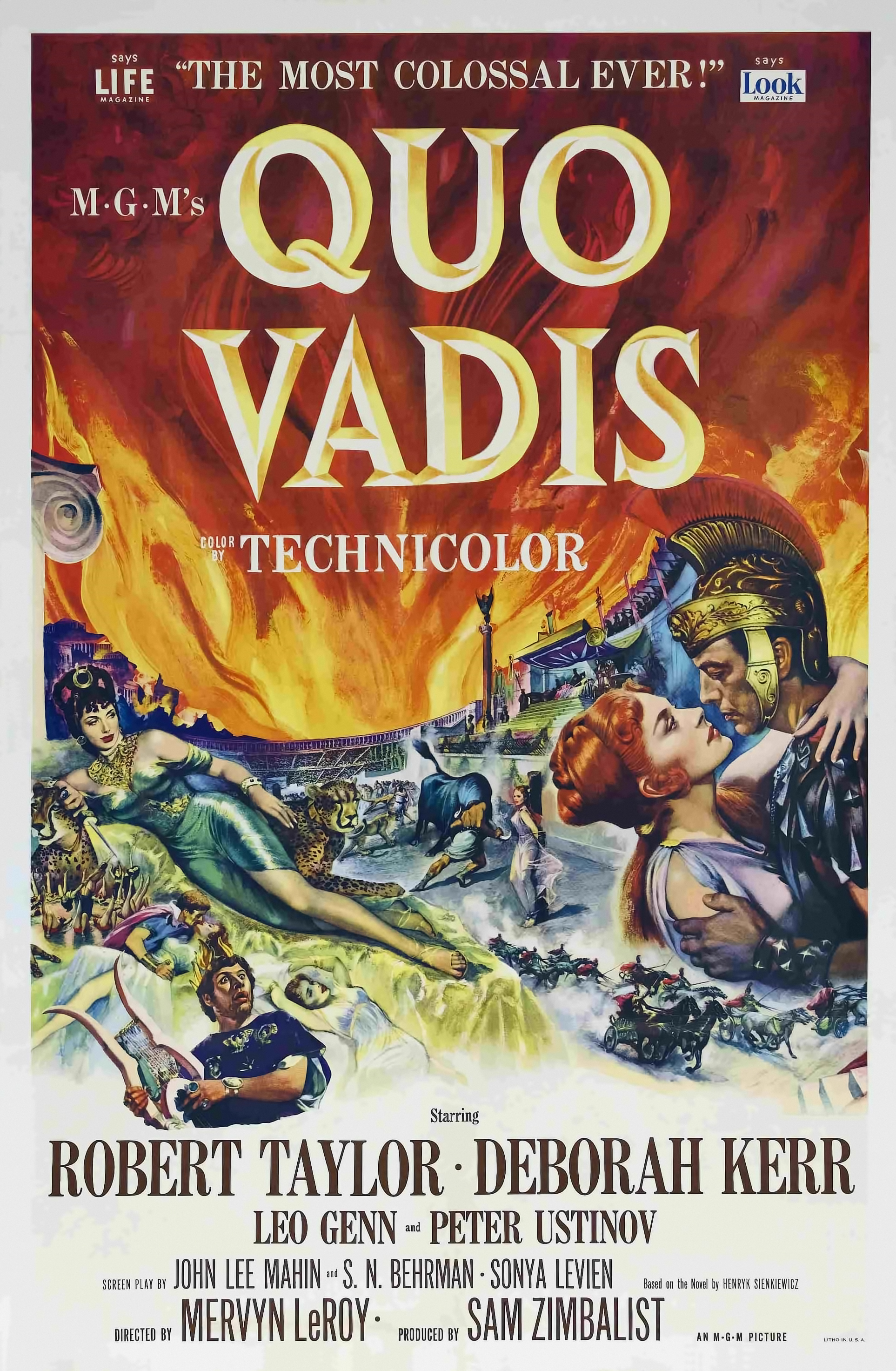
Nero's rule grows more unstable as he pursues his artistic ambitions and demands admiration from those around him. When a fire devastates Rome, the emperor shifts blame onto the Christians, turning an already vulnerable group into a public enemy. Marcus now has reasons to protect Lygia beyond his desire to possess her. The state hunts the people who have sheltered her, and the conflict reaches the arena, where Christians are forced into violent spectacle for the crowd. The film frames this persecution through the choices of individuals close to Marcus, making imperial cruelty tangible in the threatened lives of people he has come to know.
Petronius tries to navigate Nero's court without surrendering every person he cares about. His intelligence and wit can delay danger, but they cannot make the emperor safe to oppose. Poppaea's interest in Marcus adds another threat to Lygia, while Nero treats human suffering as material for his own performance. The contrast makes Petronius's position precarious: he understands the rules of court life and can speak their language, yet he knows that usefulness to Nero offers no lasting protection. His loyalty to Marcus and his own sense of dignity eventually matter more than the temporary security of remaining in favour.
Marcus's change becomes clearest when he is no longer trying to bring Lygia back by force. He chooses to stand with her community, even as that decision places him against the emperor. Lygia and Ursus are caught in the arena's violence, where Ursus's strength gives her a chance to survive. Marcus's military skill and social position do not erase the danger, but they help him act on the side he has chosen. His relationship with Lygia is now bound to a wider decision about what kind of Roman he wants to be and whether he will keep serving a ruler who treats people as props.
The collapse of Nero's authority brings the story to its final separation between the old court and the life Marcus and Lygia hope to build. Nero's actions against those closest to him, including Poppaea, leave him increasingly isolated; when political support disappears, he dies by suicide with Acte's help. Marcus and Lygia leave Rome as a new emperor is acclaimed, escaping with the people who remain beside them. Their departure is presented as a beginning rather than a complete account of what follows. The film closes its romance and political upheaval by sending the couple away from the city whose power once seemed impossible to resist.
The film adapts Henryk Sienkiewicz's novel as a historical spectacle, setting private choices among imperial crowds, palaces and arenas. The story is a screen dramatization rather than a documentary account of Nero's Rome. Mervyn LeRoy's production used Rome and Cinecittà as its base; thousands of extras and large constructed sets give the city a scale beyond the central cast. The burning of Rome and the arena sequences place individual characters inside public events, then return attention to their faces and decisions. Robert Taylor's Marcus moves from confident command toward uncertainty, while Peter Ustinov's Nero makes performance part of his rule. Miklós Rózsa's score and the broad compositions support the epic frame, but the romance keeps the political story anchored in two people trying to leave Rome together.