
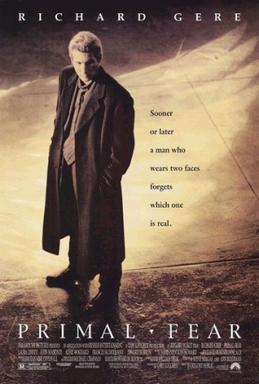
Behind the film
- Year
- 1996
- Director
- Gregory Hoblit
- Writers
- Ann Biderman, Steve Shagan
- Runtime
- 2h 9m
- Genres
- Crime, Neo-noir, Trial, Drama
- Production
- Paramount Pictures
- Country
- United States
- Cast
- Richard Gere, Laura Linney, John Mahoney, Alfre Woodard, Frances McDormand, Edward Norton, Terry O'Quinn, Andre Braugher
About the film
Contains story spoilers.
Martin Vail has built a public career out of defending people most Chicago residents would rather see convicted. He leaves the prosecutor’s office, keeps mob clients such as Joey Piñero, and knows that a famous case can bring the attention he wants. When Archbishop Richard Rushman is found stabbed to death, a young altar boy named Aaron Stampler is caught fleeing in bloodied clothes. Aaron says he cannot remember the killing. Vail offers to defend him, partly because the case looks like a difficult courtroom puzzle and partly because a high-profile client suits his own ambitions. The early evidence makes Aaron an obvious suspect, but his account of missing time leaves Vail room to argue that the prosecution has mistaken presence for a complete explanation.
The case brings Vail back against Janet Venable, a former colleague who was also his lover. She seeks the death penalty, while state attorney John Shaughnessy assigns her the prosecution and supports Rushman’s public legacy. Vail’s investigator Tommy Goodman follows leads beyond the crime scene, and what they uncover changes the shape of the case: Rushman abused boys in his care, and church property sits at the centre of a development deal involving Shaughnessy and other powerful figures. A videotape records the abuse, but Vail has obtained it outside a clean chain of evidence. The tape could give Aaron a motive and expose the men protecting the archbishop’s reputation; it could also be excluded or used to make Aaron look more dangerous. The trial’s legal fight therefore carries a political one inside it.
Psychiatrist Molly Arrington listens as Aaron describes childhood abuse, blackouts he calls “losing time,” and a missing girl named Linda. In a private meeting with Vail, Aaron’s shy manner abruptly changes. As Roy, he is hostile, physically threatening, and says he killed Rushman; then Aaron returns without seeming to remember the exchange. Molly sees the behaviour as evidence of a dissociative condition, giving Vail a defence that could spare his client execution. It also puts Vail in a bind: the more convincingly he presents Roy, the more he makes the case about whether Aaron controlled his actions. He tries to control how much of the abuse and the tape reaches court, while Janet and Shaughnessy challenge the defence and the credibility of its evidence.
The pressure widens when Piñero is murdered. Vail turns the hearing toward Shaughnessy, arguing that the failed land deal and the concealed abuse give the state attorney a reason to protect Rushman. Judge Miriam Shoat has little patience for Vail’s performance and fines him for using the proceedings to pursue a vendetta. She limits Molly’s testimony, so Vail changes tactics and puts Aaron on the stand. Under questioning, Roy appears before the court and attacks Janet. With the jury removed, Shoat finds Aaron not guilty by reason of insanity. Vail expects the ruling to lead to psychiatric treatment and eventual release, believing he has won by persuading the court that Aaron cannot control Roy. In the holding cell, however, Aaron’s concern about Janet’s injured neck reveals that he remembers the attack.
Edward Norton later described the casting as part of the film’s mechanism. He said Gregory Hoblit and casting director Deborah Aquila wanted an unfamiliar face, so viewers could accept Aaron’s vulnerable first impression as Vail does. Norton recalled that Paramount’s casting director had seen him in New York plays and brought him in among many actors auditioning for Hoblit. He described the role as a story of first impressions, deception and acting within acting. Years later, Norton contrasted this role with Fight Club: Primal Fear was about somebody acting, while Fight Club dealt with a character actually going insane. That distinction fits the final reversal. The film trains Vail and viewers to read Aaron’s stammer, lowered gaze and fear as signs of a divided self, then reveals that the shy altar boy was a part Roy had invented. Its deception rests on a performance Vail mistakes for a symptom, and the actor’s unfamiliar face lets the audience make the same mistake with him.
In their last conversation, Aaron admits that he remembers Roy’s violence and confesses to killing both Rushman and Linda. He reveals that the shy Aaron was an invented role, and that the remorseless Roy has been directing the deception all along. The reveal makes the trial’s apparent solution another piece of theatre staged for Vail. The lawyer has won the verdict he pursued, but his confidence in reading people has helped secure psychiatric treatment for the killer. His exit through a back corridor closes the case without giving him the public victory he expected. The final unease comes from the gap between what Vail can prove and what he now understands: the evidence, diagnosis and courtroom strategy all seemed to describe a divided client, while Roy had been using that description to steer the defence from the start.