
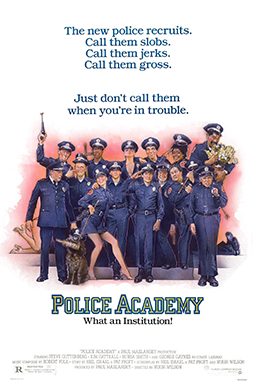
Behind the film
- Year
- 1984
- Director
- Hugh Wilson
- Writers
- Neal Israel, Pat Proft, Hugh Wilson
- Runtime
- 1h 36m
- Genres
- Comedy, Crime
- Production
- The Ladd Company
- Country
- United States
- Cast
- Steve Guttenberg, Kim Cattrall, Bubba Smith, David Graf, George Gaynes, Michael Winslow, G. W. Bailey, Donovan Scott
About the film
Contains story spoilers.
A newly elected mayor removes the old limits on who may apply to the city’s police academy, and the opening brings in recruits of different ages, backgrounds and abilities. Carey Mahoney has no interest in joining them. After he wrecks a customer’s car, Captain Reed gives him a choice between the academy and jail, with the condition that he cannot quit on his own. Mahoney tries to get dismissed almost at once, first by pretending to be a drill instructor and harassing fellow recruit Karen Thompson. Lieutenant Harris tells him to fall back in line instead of giving him the exit he wants. Mahoney is also allowed to bring Larvell Jones, a man he met in custody whose sound effects can imitate everything from gunfire to machinery.
The police chief wants the new class gone and orders Commandant Lassard and Harris to make the recruits resign. Lassard does not share Harris’s enthusiasm for the plan, but Harris recruits Kyle Blankes and Chad Copeland as squad leaders and uses them to make training miserable. The cadets struggle with runs, obstacle courses, classroom drills and the firing range. Mahoney answers Harris’s pressure with pranks, including shoe polish on the instructor’s megaphone, while Jones turns his sound effects into a running nuisance for the staff. The script was rewritten to include Michael Winslow's sound-effect role as Jones. The other cadets bring their own problems: Eugene Tackleberry treats firearms with intense seriousness, Douglas Fackler is accident-prone, and Laverne Hooks is so quiet that Harris can barely get an answer from her. Former florist Moses Hightower is physically imposing but uneasy about driving.
Mahoney’s plan changes when he starts to care what happens to the group. He and Karen begin a tentative romance, and the recruits find room to enjoy themselves on their first leave. Mahoney sends Blankes and Copeland to the Blue Oyster, a leather bar, by misleading them about where the cadets are meeting. The prank fits the loose, escalating pattern of the training scenes: one cadet’s gag becomes another cadet’s humiliation, and the instructors are often caught in the middle. A separate attempt by Blankes and Copeland to get Leslie Barbara expelled goes wrong when Mahoney hides a prostitute in the lectern before a visit from Lassard. The commandant unknowingly uses it during his speech; Mahoney is discovered afterward.
As the course continues, the recruits take part in role-play and ride-alongs, where their classroom weaknesses become public. On one patrol, Harris and Mahoney are delayed by an accident involving farm animals. Hightower privately tells Mahoney he cannot drive, so the two take Copeland’s small car out at night and remove its front seats to make space. Hightower learns quickly and passes the test, but the moment becomes a setback when Copeland uses a racial slur against Hooks. Hightower flips Copeland’s police car over, and Harris expels him. Later, Blankes and Copeland provoke a cafeteria fight. Barbara hits Copeland with a tray, and Mahoney takes the blame when Harris looks for someone to punish. Harris finally gets the dismissal he wanted and sends Mahoney packing.
The recruits’ problems move from the academy to the city when Fackler throws an apple from a patrol car and accidentally sparks a fight that grows into a riot. The cadets are sent to help, and Lassard’s directions place them in the worst of it. Mahoney hides among the officers’ equipment so he can rejoin the group after being expelled. Jones uses a microphone to imitate machine-gun fire and help the cadets escape a surrounded car. A gunman takes control of a building and holds Harris at gunpoint while Karen is trapped in the street. Mahoney reaches the roof and drops his weapon rather than risk Harris’s life. Hightower arrives from his flower shop, distracts the gunman and knocks him down the stairs, where Hooks is able to arrest him. The training disasters have left the cadets uneven, but the crisis gives each of them a useful part to play.
The rescue earns Mahoney and Hightower awards and a place back in the graduating class. Their success does not come from suddenly becoming polished recruits: Jones’s noises, Hooks’s nerve, Hightower’s strength and Mahoney’s willingness to break rules all matter because the riot tests habits the earlier scenes have established. The ensemble moves from short comic situations at the academy into a larger public emergency, then returns to the graduation ceremony for one last exchange of pranks. Guttenberg recalled winning a screen test and working largely from Hugh Wilson’s fixed script, with limited improvisation. That account fits the film’s built-up payoffs: its recurring jokes depend on a cadet’s recognizable way of reacting, not on stopping the story for an unrelated sketch. Writer Pat Proft described visual comedy as his strength, while Neal Israel concentrated on story and verbal jokes. Proft connected the film to the silent-era Keystone Kops: people in uniform failing spectacularly, with the supposed losers turning against authority and eventually winning as a team. His account puts the cadets’ distinct personalities and physical mishaps at the centre of the comedy. At graduation, Lassard’s lectern gag shows that the commandant can now answer Mahoney in his own language.