
Behind the film
- Year
- 1957
- Director
- Ed Wood
- Writers
- Ed Wood
- Runtime
- 1h 19m
- Genres
- Action, Science fiction, Horror, Zombie
- Production
- RKO Pictures
- Country
- United States
- Cast
- Tom Keene, Tor Johnson, Bunny Breckinridge, Maila Nurmi, Bela Lugosi, Tom Mason, Ed Wood, Gregory Walcott
About the film
Contains story spoilers.
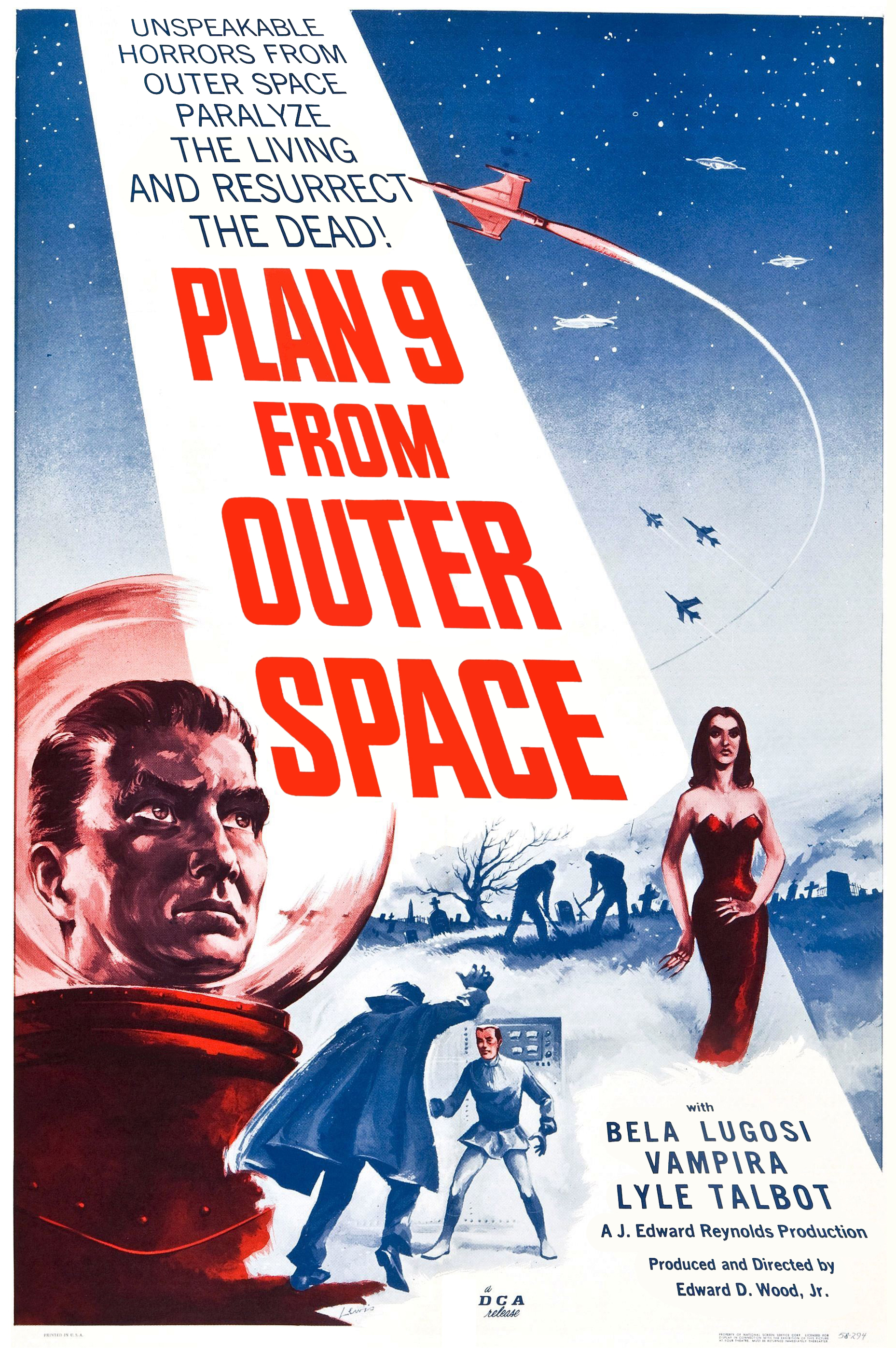
An airline crew encounters a flying saucer above California, while a nearby cemetery becomes the centre of a stranger disturbance. A recently buried woman rises and attacks the gravediggers. Her widower also returns after his death, and Inspector Clay is killed while investigating the cemetery. Pilot Jeff Trent lives close enough for the trouble to enter his domestic life. Military orders prevent him from speaking freely about the saucer, leaving his wife Paula with only part of the explanation for what is happening around their house. When the resurrected widower enters her bedroom, she runs into the cemetery, where the dead woman and the revived Clay join the pursuit. The story moves between the Trents, police investigators and military personnel, gradually connecting these apparently separate incidents to the occupants of the spacecraft. Ordinary routines, including Jeff going to work, continue alongside the extraordinary threat.
The aliens Eros and Tanna are following orders to use resurrected bodies against the living. Their aim is to compel recognition of their superior power and stop humanity developing a weapon called Solaronite, which they believe could ignite a catastrophe beyond Earth. The aliens have already failed to make Earth’s governments acknowledge their presence. The military already knows more about the visitors than its public position suggests: General Roberts admits that messages have been received and translated. Colonel Edwards, Jeff and Lieutenant Harper eventually enter the saucer, where Eros explains the danger and threatens Paula through the reanimated Clay. Outside, the police overcome Clay and rescue her. A fight aboard the ship damages equipment and starts a fire; the humans escape before the burning saucer rises and explodes. Clay collapses into bones when the mechanism controlling him fails. The solution is physical and immediate, even though the aliens have framed the dispute in terms of humanity’s future and the safety of the universe.
Bela Lugosi’s presence gives the film a production history that is visible within the finished images. Wood incorporated footage made before the actor’s death for another project, then continued the role with a much taller double who concealed his face behind a cloak. The changes in stature make the substitution noticeable rather than seamless. A character who belongs to the story also becomes a record of how that story was assembled from available material. Lugosi’s appearance is therefore different from a conventional completed star performance: earlier footage has been given a new narrative setting, with replacement shots supplying the actions the original material could not provide.
Criswell’s narration binds together scenes that jump among domestic drama, police investigation and interplanetary confrontation. His solemn delivery presents the events as a disclosure of extraordinary information. That insistence on importance persists even when the words become repetitive or the images struggle to match their scale. Elaborate warnings and speeches promise a vast emergency, while the action is staged through a handful of people and limited spaces. The narrator’s certainty gives the account a fixed tone despite its unstable progression. His address to the audience also places the impossible story inside the familiar form of a confident broadcast.
The mixture of flying saucers and cemetery ghouls brings two familiar screen traditions into the same small world. Space visitors supply the technological explanation, while the walking dead supply the immediate horror imagery. The transition between them is rarely smoothed over by elaborate effects or a consistently convincing physical environment. Instead, mismatched elements remain conspicuous: recycled Lugosi shots, disparate performances and erratic continuity sit together within the finished construction. The film’s form makes its assembly unusually apparent. Its continuing fascination rests partly in that exposure of the work of filmmaking, with the intended illusion constantly interrupted by the means used to create it.
The cockpit and cemetery illustrate the gap between the film’s ambitions and its resources. A curtain and seated actors stand in for an airliner’s working interior, while lightweight grave markers fail to sustain a solid landscape. Daylight and darkness change across sequences without a convincing passage of time. These discontinuities affect how a chase or investigation can be followed: spatial and temporal connections have to be supplied across incompatible shots. The sets identify the required locations through basic signs rather than a densely realised environment.
The film’s later life has extended beyond circulation in rough video copies and screenings built around its reputation. In 2026 the British Film Institute’s National Archive created a new 35mm print from preserved original elements for its Trash! season. Presenting it in that context places the production alongside other unconventional American cinema and makes the surviving monochrome images available as an archival object. Preservation gives a different dimension to the familiar discussion of technical mistakes. The props, performances and photographic textures belong to a particular completed film whose materials can be conserved, projected and examined, even when its reputation has often encouraged audiences to treat it chiefly as a collection of comic incidents.
Wood’s low-budget filmmaking eventually became the subject of its own cultural history. The Golden Turkey Awards renewed attention to his work in 1980, and Rudolph Grey’s biography Nightmare of Ecstasy preceded Tim Burton’s Ed Wood, released in 1994. Those later accounts helped place Plan 9 within the story of its maker and his eccentric collaborators. The cemetery invasion consequently has a double identity: it remains a science-fiction horror narrative about a nuclear threat, while also serving as a surviving example of Wood’s unusual production methods and screen imagination.