
Behind the film
- Year
- 2013
- Director
- Taylor Hackford
- Writers
- John J. McLaughlin
- Runtime
- 1h 58m
- Genres
- Heist, Thriller, Action
- Country
- United States
- Cast
- Jason Statham, Jennifer Lopez, Michael Chiklis, Nick Nolte, Clifton Collins, Daniel Bernhardt, Emma Booth, Kirk Baltz
About the film
Contains story spoilers, including the ending.
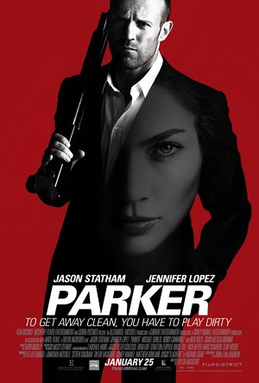
Parker sends Jason Statham's professional thief into Palm Beach under the disguise of a wealthy Texan. His former crew believes it has left him dead, and is preparing a much larger robbery among the resort's rich residents. Jennifer Lopez plays Leslie, the local woman who joins his plan to take their score. Her ambition meets his determination to punish the betrayal. The trouble begins at the Ohio State Fair. Hardwicke changes the robbery plan, causing a fire and a death, and Parker refuses the crew's next job. Melander wants Parker's share to fund it and has him shot. A farming family saves him. Parker's mentor Hurley urges him to walk away, partly because revenge will expose Hurley's daughter Claire, Parker's girlfriend, to a Chicago crime boss. Parker keeps going.
Leslie discovers that the rich Texan's identity is false and offers to help him instead of exposing him. An assassin attacks Parker at his hotel, leaving him injured before the final confrontation. Melander's men steal the auction jewels, but Parker has already entered their hideout, hidden weapons and damaged their guns. Leslie follows him there and is captured, turning his ambush into a fight to keep both of them alive. They defeat the crew and leave with the jewels. Parker later kills the Chicago boss Danzinger, sends Leslie her share and rewards the farmers who rescued him. The closing payments put his revenge and his obligations on the same account.
Leslie has reasons of her own to take such a risk. She sells homes in Palm Beach that she cannot afford to live in, then returns across the bridge to the mother she has moved back in with. Divorce has left her trapped financially. Hackford described her as a desperate amateur who sees an opening in Parker's criminal work before understanding how dangerous it is. Their partnership puts someone still hoping for a way out beside a man thoroughly committed to his trade. Claire remains important to his life, and producer Les Alexander pointed to Parker's loyalty to her as one reason for choosing Flashfire from Donald Westlake's novels. Nick Nolte's Hurley knows the thief from another direction: he arranges jobs and understands him well enough to see what the betrayal will provoke. Nolte described Hurley's desire to straighten things out after the fair robbery goes wrong. These relationships give Parker people to answer to even when he refuses to change his course.
Hackford's explanation of the character makes the distinction between a code and goodness fairly plain. Parker is a criminal who wants to steal and feels no remorse about his profession. The director regarded his rules as practical measures that help him survive and stay out of prison. Yet those same rules become an obstacle to self-preservation when another thief breaks the agreement. Parker cannot simply take an easier exit, because accepting the betrayal would mean abandoning something he regards as fixed. Hackford wanted that stubborn reasoning to be visible without narration. In Westlake's books the reader can follow the thoughts inside a largely silent man's head. On screen, the audience has to recognise his intelligence through attention and purposeful actions. The director also described a camera style with small amounts of movement rather than constant jolting. His interest was in revealing behaviour through the actors. The tension comes from watching Parker think through his next move while knowing that his refusal to let go may make it worse.
Statham saw Parker's moral limits as a question for the audience rather than a complete defence of the man. In a conversation about the adaptation, he pointed to the thief's refusal to take money from people who cannot afford the loss, then questioned whether that makes him good. Hackford likewise stressed that the character is capable of being hurt. When casting, the director felt Statham could embody Parker even though the actor was English and the character American. They met and committed to the film together. Michael Chiklis, playing Melander, also acknowledged that both criminals could justify their conduct to themselves. The conflict is between men who each make their own case for taking what they want.
The hotel fight makes Parker's vulnerability hard to miss. Hackford storyboarded the encounter and discussed it with Statham before filming. Daniel Bernhardt played his opponent, allowing the director to keep several movements together in the frame because both actors could perform the action. Hackford contrasted that opportunity with cutting rapidly to conceal a replacement performer. He also wanted the injuries to persist. After the fight, the story takes Parker to Leslie's house, where having his hand treated hurts even though he tries to control his reaction. Hackford described him as someone who needs recovery time, rather than a man who can simply shrug off a beating. That leaves the last robbery with a practical problem as well as a personal one: his plans may be precise, but the body carrying them out is already damaged.