
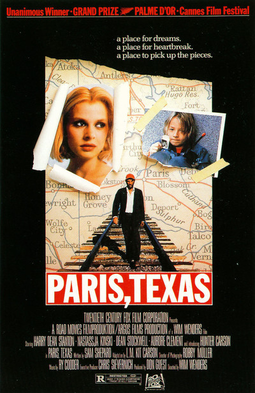
Behind the film
- Year
- 1984
- Director
- Wim Wenders
- Writers
- Sam Shepard, L. M. Kit Carson
- Runtime
- 2h 27m
- Genres
- Drama
- Production
- Film4 Productions, Argos Films
- Country
- France, Germany
- Cast
- Harry Dean Stanton, Nastassja Kinski, Dean Stockwell, Aurore Clément, Bernhard Wicki, John Lurie, Hunter Carson, Viva
About the film
Contains story spoilers, including the ending.
Travis Henderson enters Paris, Texas as a man who can barely remain among other people. He walks out of the desert, collapses and is collected by his brother Walt, who has heard nothing from him for four years. Walt and his wife Anne have been raising Travis's son Hunter in Los Angeles. Reaching their home does not restore a family automatically: Hunter scarcely remembers his father, and Travis has to become someone the boy can approach. After Anne reveals that Hunter's mother Jane sends regular money through a Houston bank, Travis leaves with his son to find her. They watch the bank, follow Jane's car and discover that she works in a peep show. The search moves from a vast open landscape to a room in which the person Travis wants to reach is only a few feet away, separated from him by glass.
Images repeatedly offer the characters something they cannot possess directly. Travis carries a photograph of land in Paris, Texas, the place he believes his parents conceived him. The vacant lot promises a home without supplying one, and the film never takes him there. Walt, a billboard artist, lives near Hollywood, while a home movie offers Hunter a mother whose screen image is different from her presence. Travis also has to construct an image of himself as a father. He gets help with his clothes and manner before he and Hunter begin to imitate one another while walking on opposite sides of a street. Their distance can become a game, but it remains visible. Robby Müller's bright photography gives these photographs, roads and surfaces a definite physical presence while the family relationships behind them remain difficult to grasp.
The encounter with Jane turns the film's long search into a problem of speaking and listening. A customer can look through the peep-show mirror while the performer sees her own reflection, and a telephone carries their voices across the barrier. Travis initially questions Jane and leaves; returning, he tells their history as though describing another couple. His account reveals drinking, jealousy and confinement: he caught her trying to leave and tied her to the stove. The story's damaged family therefore cannot be explained solely by his mysterious disappearance. Jane recognizes the speaker, and lowering the light on her side allows her to see him. Travis gives her the location of Hunter's hotel room. She goes to their son, while Travis remains outside their reunion and departs. Bringing mother and child together does not establish that he can safely resume his place beside them.
Wim Wenders initially imagined a much wider American journey, taking in Alaska, the Midwest, California and Texas. Sam Shepard persuaded him that Texas alone could supply the range of places he needed. Wenders traveled there for months and organized the film's movement through settlements of different scales: an isolated gas station, small towns, Los Angeles seen largely as suburbia and, finally, Houston as a city. That progression gives Travis's return to inhabited life a geographical form. Wenders found the opening landscape after a helicopter pilot directed him toward the Devil's Graveyard, beyond the area he had expected to use. The desert does not function simply as an attractive setting for a traveler. It is where the film first presents a man apart from the domestic and urban environments that will gradually make demands upon him.
The peep-show ending grew out of places Wenders found while scouting. At Port Arthur he encountered the Keyhole Klub, which suggested the kind of setting the film could use; the eventual room was built rather than simply filmed there. Wenders and Shepard had deliberately written only the story's first half, expecting the writer to travel with the production and discover the rest alongside it. When that arrangement failed, filming reached Travis and Hunter's departure from Los Angeles without a completed second half. During a three-week break, Wenders worked through possibilities with Claire Denis and Kit Carson, then sent Shepard a short outline. Shepard dictated the finished material over the telephone. The actors had three days to learn it, and Allison Anders helped Harry Dean Stanton rehearse while others rested.
The film was shot in narrative order, allowing the production to develop around each successive place. Wenders's European collaborators included Müller behind the camera, assisted by Agnès Godard, and Denis as assistant director. Shepard supplied the screenplay, with L. M. Kit Carson contributing to the writing. Stanton's Travis, Dean Stockwell's Walt, Aurore Clément's Anne and Hunter Carson's Hunter establish the household from which the second journey begins; Nastassja Kinski's Jane enters a story already shaped by her absence. Financial difficulties also contributed to the interruption in production. That practical uncertainty accompanied a film whose destination was still being worked out. Its final room demanded a different kind of staging from the early landscapes: two actors, glass, changing light and sustained speech had to carry the family's history without a conventional flashback.