
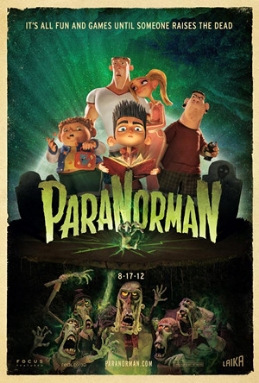
Behind the film
- Year
- 2012
- Director
- Sam Fell, Chris Butler
- Writers
- Chris Butler
- Genres
- Comedy, Zombie comedy, Fantasy, Comedy horror
- Production
- Laika
- Country
- United States
About the film
Contains story spoilers, including the ending.
ParaNorman follows Norman Babcock, an eleven-year-old who speaks to ghosts in Blithe Hollow, Massachusetts. His family doubts him, and schoolmates bully him. After his great-uncle dies, Norman inherits the duty of reading from a book to keep an old witch's curse at bay. He fails to complete the ritual before sunset, and seven zombies rise as a supernatural storm gathers over the town.
The supposed witch was Aggie, a child medium wrongly condemned by the town council. The zombies are her judges, cursed for killing her. Norman reaches her grave and explains that he understands her isolation, but revenge is making her like those who hurt her. Remembering her mother's love, Aggie finds peace and crosses over. The storm ends, and the council's spirits fade. The town begins repairing the damage and celebrates Norman. Back home, he watches a horror film with his more accepting family and his grandmother's ghost.
Chris Butler built the story around the fears of being a child who does not fit in. Speaking with Sam Fell to STARBURST, he explained that a neighbourhood bully can seem more frightening to an eleven-year-old than a zombie in a film. Zombies let him put that everyday fear into a horror adventure. He compared the original idea to dropping the young people of The Breakfast Club into The Fog, bringing John Hughes's school drama together with John Carpenter's horror. Fell described the scary material as a covering for a story about tolerance. Butler wanted viewers to make assumptions about witches, zombies and cheerleaders, then discover that those assumptions were wrong. The principle also includes Mitch, whose mention of a boyfriend arrives late in the film. Discussing that reveal, the directors treated his sexuality as an ordinary part of a contemporary character. Butler wanted the audience to understand it within the film's wider concern with accepting others. Fell pointed out that it was not the main thing about Mitch. Their comments connect the final joke to the same question Norman and Aggie face: how other people respond to someone who differs from them.
That concern had to survive the noisy group adventure around Norman. In a separate SlashFilm set interview, Butler described wanting recognisable children in extraordinary situations. The group travelling in the van includes a bully, a cheerleader and a jock; he thought they would bicker rather than agree cheerfully on everything. Quick, overlapping dialogue was part of the live-action feeling he wanted. Fell described trying to free the camera and give it something of a handheld quality, photographing the characters within their surroundings. The directors also used humour to puncture frightening moments, so a scare could lead somewhere unexpected. This approach grew from a screenplay with a complete ending before production began. Butler said he had often worked on animated projects without a settled third act and wanted to know what this story was aiming for. He and Fell developed the film together rather than dividing it into separate halves. They met to edit and discuss staging and lighting, then went out to speak with the crew. If something changed, they came back together to reconsider it. Their shared preparation allowed the different departments to work toward the same performances and tone.
Blithe Hollow's uneven streets give those performances somewhere recognisable to happen. In Focus Features' production account, designer Nelson Lowry described combining a street from Weymouth, a power station from Concord and witch statuary from Salem into a single fictional town. He sometimes took photographs on his hands and knees to get a child's view. Butler and Fell's Massachusetts trip with Lowry supplied thousands of reference photographs, while William Eggleston's attention to overlooked places informed their interest in worn paint and small scraps caught on fences. Character designer Heidi Smith's rough pencil drawings helped establish the slightly crooked shapes across both people and buildings. Cinematographer Tristan Oliver worked closely with Lowry on surface finishes and colour. He wanted the puppets to seem photographed in their environment, allowing shots in which their faces were not always visible. The wider frame and stereoscopic photography gave him room to work with distance, atmosphere and shallow focus. Oliver also drew on early photographs made on glass for the ghosts. The town could feel familiar before the supernatural events disrupted it, while its damaged edges belonged to the same visual world as its oddly shaped inhabitants.
Digital effects extended that physical world. fxguide reported that the work included removing support rigs and facial seams, enlarging sets, adding crowds and creating ghostly atmosphere. LAIKA technology director Jeff Stringer explained that digital lighting could be used to match a texture or effect already made on the stage. Clouds, for example, might need to look as though they were made from gauze or cotton. He saw the slower pace of stop-motion as an advantage for effects work, giving the team more time and control over what happened on stage.