
Behind the film
- Year
- 2007
- Director
- Oren Peli
- Writers
- Oren Peli
- Runtime
- 1h 27m
- Genres
- Horror, Found footage, Thriller
- Production
- Paramount Pictures, DreamWorks
- Country
- United States
- Cast
- Katie Featherston, Micah Sloat
About the film
Contains story spoilers.
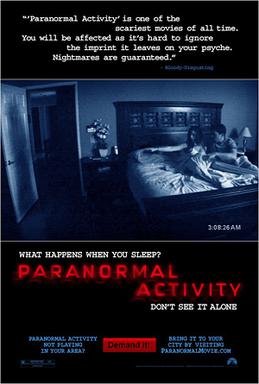
Paranormal Activity follows Katie and Micah, a couple living together in a San Diego house. Katie says that a presence has troubled her since childhood and believes it may be behind the noises and disturbances in their home. Micah buys a camera and sets it up in the bedroom, hoping to capture what happens after they go to sleep. That decision gives the film its central point of view: ordinary daytime arguments and routines are followed by a fixed camera watching a room in darkness.
The early nights offer small changes rather than a clear apparition. A door moves, a noise comes from elsewhere in the house, and the couple wakes without an explanation. Micah reviews the footage as if it were evidence, while Katie is increasingly wary of turning the presence into a subject for experiments. Their disagreement matters because the camera is not neutral: Micah’s wish to prove the haunting also leads him to test and provoke it. Katie asks for help from a psychic, Dr. Fredrichs, who believes the presence is a demon attached to her, not simply a spirit haunting the house. He urges them not to communicate with it and recommends a demonologist.
Micah treats that advice as a challenge. He brings home a Ouija board despite Katie’s objection, and when they leave the house, the camera records its planchette moving before the board catches fire. The image does not settle the couple’s arguments; it makes the mismatch between them harder to ignore. Katie wants the danger taken seriously, while Micah keeps trying to obtain proof on his terms. The nighttime recordings become more disturbing as the disturbances move from subtle noises and shifting doors to thuds and forceful slams.
The most unsettling footage involves Katie herself. One night she gets out of bed in a trance, stands beside Micah for hours, and later has no memory of doing it. Micah had been recording the room, but the evidence now points back toward Katie rather than toward a separate figure in the house. Another night, he scatters baby powder in the hallway; the next morning, footprints lead toward an open attic hatch. In the attic he finds a charred photograph of Katie as a child, a picture she thought had been destroyed in a fire years earlier. The film connects the haunting to her past without giving the couple a reliable explanation or a way to control it.
When Katie asks for the demonologist, she learns that he is away. Dr. Fredrichs returns, but the atmosphere in the house frightens him enough that he leaves rather than intervene. Soon after, an unseen force drags Katie from the bed and leaves her with a bite mark. Micah decides they should leave, but Katie’s behavior changes and she insists on staying. Their house has become a trap partly because of what the presence can do and partly because neither partner can agree on what action will make them safer. Micah’s recording has captured a crisis, but it has not given him the understanding or control he wanted from it.
The theatrical version ends on the twenty-first night. Katie rises from bed in a trance and remains beside Micah for hours before going downstairs. She calls for him; he hurries after her, and the recording catches loud impacts and his cries. His body is suddenly thrown back into the bedroom, while Katie appears in the doorway with blood on her shirt. She crawls toward him, studies his body, then turns toward the camera and lunges with a demonic expression. The final image leaves the recording itself as the target of her attention. An epilogue says police later found Micah’s body and that Katie’s whereabouts are unknown.
Oren Peli wrote and directed the film, starring Katie Featherston, Micah Sloat and Mark Fredrichs. Peli developed a story treatment without scripted dialogue, leaving the actors to improvise their conversations. That method gives the couple’s exchanges an unsettled rhythm: jokes, irritation and attempts to negotiate belong to the same domestic life the camera has been observing. Their disagreements are not detached scenes between scares. Micah’s effort to turn the haunting into something he can prove puts pressure on Katie, who wants him to take her fear seriously and stop making the presence worse.
Peli based the camera setup on the idea of someone recording a house to prove or disprove a haunting. He shot in his own home and kept the camera mostly stationary, so the room remains familiar even as its empty spaces become harder for Katie and Micah to trust. The recordings direct attention to a door, a sound or the time passing while they sleep, rather than showing an entity on demand. Micah’s equipment starts as a way to investigate, but it cannot tell the couple what to do when the nightly footage points toward Katie herself. The fixed view makes the gap between recording and understanding part of the story.