
Behind the film
- Year
- 1995
- Director
- Wolfgang Petersen
- Writers
- Robert Roy Pool, Laurence Dworet
- Runtime
- 2h 8m
- Genres
- Drama, Thriller, Disaster
- Country
- United States
- Cast
- Dustin Hoffman, Rene Russo, Morgan Freeman, Cuba Gooding Jr., Patrick Dempsey, Donald Sutherland, Kevin Spacey, Benito Martinez
About the film
Contains story spoilers, including the ending.
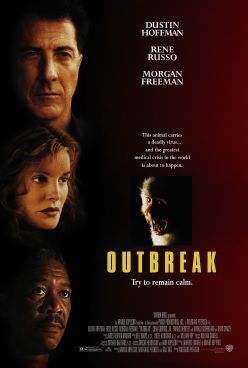
Outbreak begins with a military response that conceals a disaster instead of explaining it. In 1967, an American operation destroys a camp in Zaire after a lethal fever spreads among its occupants. Nearly three decades later, Army researcher Sam Daniels encounters another outbreak in the region and returns home fearing that the danger will travel farther. Dustin Hoffman plays Daniels alongside Rene Russo as Robby Keough, his former wife and a scientist at the Centers for Disease Control. Kevin Spacey’s Casey Schuler and Cuba Gooding Jr.’s Major Salt complete the medical team. The film follows their investigation across laboratories, command rooms and a California town, with Morgan Freeman’s General Ford standing between Daniels and an increasingly hostile military hierarchy.
The route into America begins with an infected monkey, stolen by animal-laboratory worker Jimbo Scott. He tries to sell it to pet-shop owner Rudy Alvarez, then releases it when the sale fails. Both men become infected, and Jimbo passes the illness to his girlfriend in Boston. Robby investigates those cases while another chain of exposure develops in Cedar Creek, California. A broken sample of Alvarez’s blood infects a hospital technician, and the disease subsequently spreads through a crowded cinema. What appeared to require direct contact has become airborne. The researchers now face two linked problems: finding the animal that carried the virus and understanding a changed strain that has escaped their initial assumptions about transmission.
Daniels goes to Cedar Creek against orders and joins Robby as the Army seals off the town. Their work becomes personal when Casey’s protective suit tears and Robby accidentally sticks herself with an infected needle. Ford supplies a serum that works against the original strain, exposing a secret: military officers already knew about Motaba. General McClintock wants to preserve the original virus as a weapon and conceal the mutation. Operation Clean Sweep would bomb the town, killing its residents along with the infection. The quarantine therefore traps people between a biological threat and a government response that may destroy them. Daniels’s search for a treatment becomes a challenge to the authority that controls his access to the patients.
Daniels and Salt reach the ship that transported the monkey, obtain its photograph and circulate it through the media. A mother recognises the animal playing with her daughter near Palisades; it is there, rather than aboard the ship, that they recover Betsy. Salt combines her antibodies with the existing serum, saving Robby, but McClintock resumes the bombing plan. Daniels and Salt put their helicopter in the bomber’s path and appeal to its crew. With Ford’s help, they persuade the pilots to release the weapon over water. Ford then removes McClintock from command and orders his arrest. The immediate crisis ends with treatment reaching the town and Daniels and Robby reconciling.
The opening destruction was assembled from several kinds of effects rather than filmed as one enormous blast. Visual-effects supervisor Jim Rygiel’s surviving production images show Boss Film Studios using quarter-scale miniatures, smoke, fuller's earth and air mortars. A performer photographed against greenscreen was combined with the destruction through digital techniques, while a miniature tower supplied another part of the camp. Helicopter material also used a cockpit section photographed against greenscreen at Warner Bros. The combination gives the prologue physical structures to demolish while allowing the completed image to exceed what could be staged around an actor. It establishes the military’s capacity to erase a place before the later story asks whether the same response will be turned on an American community.
The laboratory introduction creates a different kind of scale. A long moving shot passes through the military research institute’s virology section, taking the viewer across doors, corridors and safety checks into progressively more restricted areas. Instead of showing the institution through a series of disconnected rooms, the camera makes its layers part of one continuous journey. People moving on cue and doors opening at the right moment keep the route legible while the sequence approaches increasingly dangerous material. Michael Ballhaus photographed the film, with Mark Emery Moore operating this shot; Nina Saxon Film Design handled the titles. The movement introduces containment as an arrangement of physical barriers. Later, when damaged protection and airborne transmission undermine those barriers, the danger has a geography the viewer has already begun to understand.
That concern with space continues in tracking shots through different contamination levels and hospital ventilation. The camera can show a route the virus might take even when the organism itself remains invisible. Elsewhere, the film turns to helicopters, a threatened air strike and direct confrontations between officers, joining medical detection to an action thriller. Hoffman described the production as a genre film and said he and Petersen worked to soften parts of the script under pressure. The resulting structure gives Daniels both an impersonal enemy and a human antagonist. A laboratory result may identify the treatment, but stopping the catastrophe also requires changing an order, reaching a crew and convincing people to act before time runs out.