
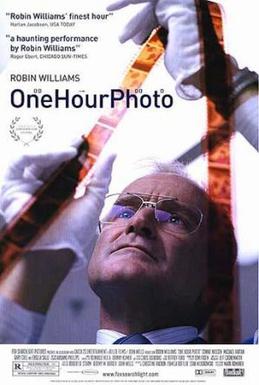
Behind the film
- Year
- 2002
- Director
- Mark Romanek
- Writers
- Mark Romanek
- Genres
- Neo-noir, Mystery, Thriller, Drama
- Production
- Searchlight Pictures, Killer Films
- Country
- United States
- Cast
- Robin Williams, Michael Vartan, Connie Nielsen, Dylan Smith, Gary Cole, Eriq La Salle, Erin Daniels, Clark Gregg
About the film
Contains story spoilers.
Sy Parrish keeps secret copies of the Yorkins’ photographs. An audit reveals the excess prints and costs him his SavMart job. He discovers Will’s affair with Maya and slips their photographs into Nina’s order. Photographs Sy takes of his manager’s daughter bring the police into the case. He confronts Will and Maya at a hotel, where they are left shaken but physically unharmed. After his arrest, a detective shows him the developed hotel film: it contains furnishings, with no pictures of the couple. The final image places a smiling Sy beside Nina, Jake and Will in a family photograph. Will has his arms around Nina and Sy. The film closes on this image of belonging, leaving its meaning open.
Romanek traced the screenplay’s beginning to two things he had noticed in ordinary American life. He found giant discount stores visually striking, with their bright lighting and overfilled shelves. A clerk at his local photo shop in West Hollywood supplied the other spark: a man who seemed to perform for his customers, working hard to appear charming and familiar. Romanek began imagining what it would mean for someone like that to handle photographs of lives richer in family affection and holidays than his own. In a later Fresh Air interview, he explained that he wanted the audience’s feelings about Sy to shift. His behaviour crosses boundaries, yet his loneliness invites sympathy. Romanek wanted that uncertainty to remain active, so that concern for Sy could coexist with concern about what he might do to the people whose lives he envies.
The film’s production notes place Romanek’s approach within a particular strand of 1970s cinema: stories centred on isolated men. He named The Conversation, The Tenant, Taxi Driver and The Passenger as influences on his desire to make a contemporary film in that mode. The same notes describe Sy as someone who treasures photographed moments even more than the people who experienced them. Preserving an ideal family image becomes, in his mind, a responsibility to correct whatever disturbs it. Production designer Tom Foden helped build the carefully ordered world surrounding him, while Arianne Phillips designed the characters’ costumes. That order belongs to Sy’s conception of life: the family he wants to join is something he has assembled from selected moments, rather than a relationship its members have offered him.
Williams described Romanek’s attention to detail as central to finding Sy. The director watched the store and the Yorkins’ house closely, giving the actor a precisely defined setting for a man whose inner life had grown around other people’s photographs. Williams returned to his formal acting training to construct the character and his severely ordinary daily existence. He described that world through the comparison of a stark Arbus photograph, where the viewer’s attention has little room to wander. The role demanded immersion while he was working, but he deliberately stepped away from it afterwards. He did not want to bring Sy’s troubled emotional life home to his children.
At Sundance, Williams explained that One Hour Photo had arrived first among three dark roles after he asked his representative to find him one. Death to Smoochy and Insomnia followed. He made a practical distinction between the performances: the character in Smoochy could release his feelings through explosive behaviour, while Sy kept his feelings inside. Playing the photo technician meant holding that energy back. The contrast concerned how the characters behaved, rather than simply placing all three parts under the same description of a dark role.
For Williams, the work also involved learning the ordinary task around which Sy had built his identity. He studied with a woman who taught him to operate the photo-processing machine, although he later admitted that he had forgotten the technique. Makeup supervisor Cheri Minns thinned and lightened his hair and made his skin pale. Together with deliberately bland clothing, the transformation helped him blend into the store. Williams connected the story’s photographs with memories of his own family: looking again at an old picture could recover a very specific moment, and the loss of a relative could alter its emotional weight. He also pointed out the selection involved in a family album. Attractive, happy occasions survive in the pictures, while ugly behaviour often goes unrecorded or gets deleted. Sy receives that flattering selection as if it were the family’s whole life.
Williams gave Sy’s customer manner a distinct boundary. Behind the counter, he can put on a pleasant, helpful face and manage a familiar exchange about someone’s photographs. Once the customers leave, the actor said, Sy almost shuts down. The ability to perform the job does not carry over into an ease with other people. His private attachment to the Yorkins fills that gap: the photographs cover a wall at home, and he imagines an uncle’s place in their household.