
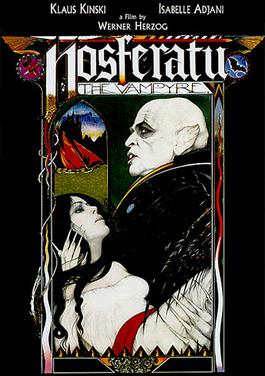
Behind the film
- Year
- 1979
- Director
- Werner Herzog
- Writers
- Werner Herzog
- Genres
- Vampire, Drama
- Production
- Werner Herzog Filmproduktion, ZDF
- Country
- France, Germany
- Cast
- Klaus Kinski, Isabelle Adjani, Bruno Ganz, Roland Topor, Walter Ladengast
About the film
Contains story spoilers, including the ending.
Nosferatu the Vampyre begins with Jonathan Harker travelling from Wismar to Transylvania to arrange Count Dracula's purchase of a house. Werner Herzog's 1979 film casts Bruno Ganz as the visitor, Klaus Kinski as his host and Isabelle Adjani as Jonathan's wife, Lucy. The castle separates Jonathan from the familiar surroundings of his home and his marriage. A night there leaves small red marks on his neck, exposing the danger in what began as business. His host is a vampire, and the sale gives Dracula a destination in the town Jonathan has left behind. The journey therefore connects the isolated castle with a community that has no understanding of the visitor it will receive.
Dracula becomes interested in Lucy when he sees her portrait during Jonathan's visit. He travels by sea with coffins of earth while Jonathan struggles home after a dangerous escape. The sick man barely seems to recognise his wife and becomes sensitive to sunlight. Renfield, Jonathan's employer, is confined to an asylum before escaping to carry the threat north towards Riga. Lucy discovers that she must hold Dracula's attention until dawn at the cost of her own life. She scatters consecrated bread around Jonathan's chair and in Dracula's resting places before luring the count into her bedroom. He drinks her blood and remains until daylight kills him. Van Helsing finds Lucy dead and drives a stake through Dracula's heart. Jonathan orders the doctor arrested for murder and has the bread swept away, freeing himself to leave. Now a vampire himself, he rides away on horseback wearing black. Lucy has destroyed Dracula, but cannot prevent her husband from taking his place.
Herzog carries particular objects and compositions over from F. W. Murnau's silent Nosferatu. A cat playing with Lucy's medallion and a clock with a mechanical figure of Death reappear alongside larger images: Lucy waits on a dune among crosses, and the death ship glides into an empty harbour. The familiar imagery changes when plague overtakes the town. Coffin bearers cross the deserted marketplace, while elsewhere the dying inhabitants gather at tables for a feast. Pigs, goats, sheep and rats surround the revellers, and the rats devour the food. People who know they are infected invite Lucy to join them, treating each remaining day as another occasion to celebrate. The meal makes the breakdown visible through ordinary communal behaviour. Instead of organising a defence, the townspeople drink together while the animals occupy their streets and tables.
Kinski's Dracula was conceived as a suffering creature as well as a source of terror. Herzog wanted to give him solitude and a longing for love, making his inability to die part of his anguish. He described Kinski as playing against the pointed ears and long fingernails, bringing human feeling into the conspicuously inhuman body. The character's desire for Lucy follows that intention: he wants a share of the love she gives Jonathan, yet can only approach her through the threat he represents. Adjani had to hold two responses together, according to Herzog, showing Lucy frightened of Dracula while also attracted to him. Their encounter therefore required more than a straightforward division between a pursuer and a recoiling victim. The count's wish for intimacy and Lucy's conflicting reactions gave the actors different demands from those made by the outward appearance of a monster.
The town's ordered appearance was central to Herzog's choice of Delft as a filming location. He wanted to show an apparently secure bourgeois community losing its structure under an anonymous fear. Rats made that invasion visible, but filming with them met strong local resistance. An account from the set describes a production adapting around permissions, weather and difficult logistics rather than working in a closed studio environment. The visual design also depended on regular collaborators, including cinematographer Jörg Schmidt-Reitwein, production designer Henning von Gierke and costume designer Gisela Storch. Schmidt-Reitwein sought soft pastel colours and resisted bright accents, down to changing a red flower to yellow in a window box. Kinski's transformation involved false ears and teeth, long fingernails and elevated boots. These choices put an artificial, conspicuous body inside carefully composed surroundings. Herzog's work with the performers placed particular weight on their pace and movement, asking them to take time within scenes whose atmosphere could be disturbed by a sharp gesture. The film's colour, costume and tempo emerged from that close collaboration around the camera. Locations in the High Tatra supplied the mountainous approach to Dracula's remote world.
Herzog later explained his return to Murnau as a search for a connection with an earlier German cinema. He described his own generation as having grown up without artistic fathers to learn from: some had fled, some had been driven out and others had supported the Nazi regime. Looking further back brought him to Murnau and Fritz Lang. Making Nosferatu allowed him to establish a relationship with those predecessors through a film of his own. This was a personal account of why the older vampire story mattered to him, rather than simply a reason to repeat its events. The homage joined a living filmmaker to an interrupted tradition, with familiar images available for a new story whose ending could take a different course.