
Behind the film
- Year
- 1939
- Director
- Ernst Lubitsch
- Writers
- Billy Wilder, Walter Reisch, Charles Brackett, Melchior Lengyel
- Genres
- Romantic comedy
- Production
- Metro-Goldwyn-Mayer
- Country
- United States
- Cast
- Greta Garbo, Bela Lugosi, Melvyn Douglas, Ina Claire, Sig Ruman, Ernst Lubitsch, Felix Bressart, Rolfe Sedan
About the film
Contains story spoilers, including the ending.
Ninotchka sends a determined Soviet envoy into a Paris where everyone has a reason to delay her work. Iranoff, Buljanoff and Kopalski have been sent to sell jewels confiscated from Grand Duchess Swana, but the three comrades are enjoying their luxurious hotel rather too much. Swana's lover, Count Leon d'Algout, encourages their pleasures while securing a legal challenge to the sale. Ninotchka arrives to put the assignment back on course. Her chance meeting with Leon briefly allows them to approach each other without knowing they are opponents. She treats his flirtation as an opportunity to study Western behaviour; his attraction becomes harder to separate from the business he is conducting for Swana. The dispute over property gives their courtship a practical obstacle from the beginning. Each has obligations that the other threatens, even before affection makes those obligations painful.
Swana eventually finds a way to make Ninotchka choose between love and her assignment. After a night of champagne and romance, Ninotchka learns that the jewels have been stolen by Rakonin, a former nobleman working as a waiter. Swana has them and offers to return them if Ninotchka leaves France. The envoy accepts, allowing the sale to proceed and returning to Moscow without a farewell to Leon. Her departure proves that enjoying Paris has not erased her sense of responsibility. In Moscow, she entertains the comrades in her communal apartment, where they reminisce about Paris. A letter from Leon arrives censored, turning an intimate connection into something the state can interrupt. The three comrades later create another problem on an assignment in Constantinople, bringing Ninotchka out of Russia again. They have opened a restaurant, following a plan devised by Leon. Unable to enter Russia himself, he has arranged another meeting abroad. Ninotchka agrees to stay with him. The reunion depends on the same troublesome trio whose earlier failure brought the lovers together.
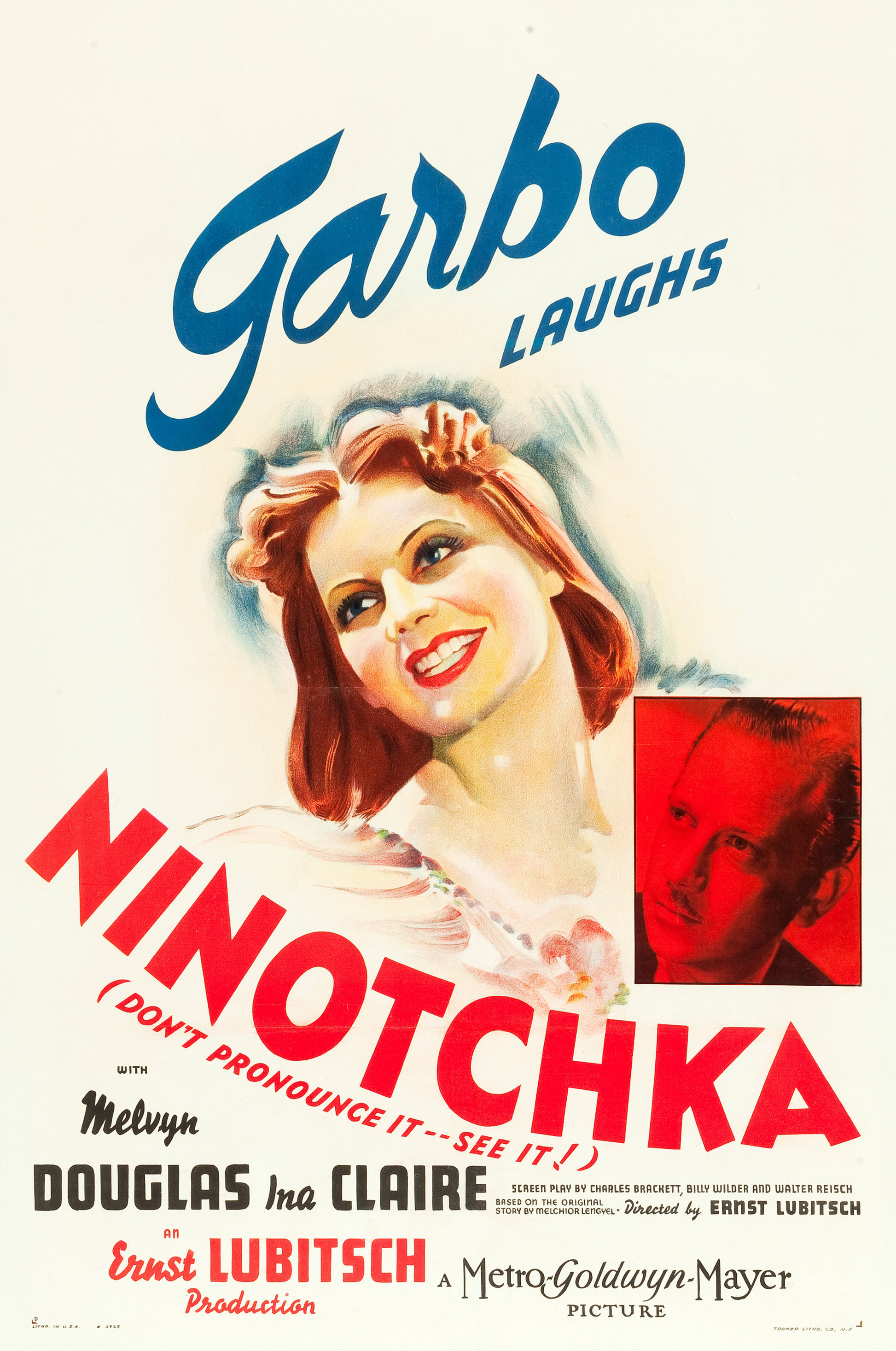
Greta Garbo plays Ninotchka opposite Melvyn Douglas as Leon, with Ina Claire as Swana. Ernst Lubitsch's 1939 comedy gave Garbo a conspicuous change from dramatic roles such as Anna Karenina and Camille. Its advertising made her laughter the attraction, recalling the campaign that had introduced her speaking voice in Anna Christie. The restaurant scene gives that promise a precise situation: Leon's prepared jokes cannot move the stern envoy, but his accidental fall from a chair breaks through. His loss of composure succeeds where his deliberate performance fails. Garbo also had to play Ninotchka drunk, a scene she found embarrassing, according to accounts of the production. The role asks her to move between a woman's strict public manner and the behaviour that escapes it. Her intelligence and authority remain part of the character even as the romance draws her into pleasures she has trained herself to distrust.
Walter Reisch remembered the screenplay as a problem of construction before it became a finished comedy. In his account, Lubitsch had a treatment by Melchior Lengyel that supplied a beginning without a satisfactory middle or ending. A conversation at the director's home led to Reisch being assigned to the picture. He recalled spending five weeks building the story with Lubitsch, then suggesting Charles Brackett and Billy Wilder when the director's preferred dialogue writer was unavailable. The intended dialogue writer was Samson Raphaelson, whose work on a play in New York kept him from joining the picture. Reisch credited Wilder's gift for detail and gags and Brackett's command of language. He also described the four men working together in Lubitsch's office, with Brackett bringing a calming presence to the room. His recollection places the plot's shape, the comic incidents and the wording inside a shared writing process. Reisch said the completed script was filmed as written. That is his retrospective account of a collaboration whose participants brought different strengths to the same scenes and whose director stayed closely involved in developing them.
Billy Wilder's memory of the writing centres on a smaller question: how could the audience see Ninotchka falling in love before she was willing to acknowledge it? He recalled pages of explanation failing to satisfy Lubitsch, who proposed using a hat. Early in Paris, Ninotchka regards extravagant headwear as evidence of a foolish civilisation. Later, alone in her room, she takes out a hat and tries it on before the mirror. The object makes a change visible without requiring her to announce a new philosophy. It also allows a private action to carry something she would resist saying in public. Wilder described the solution as replacing laborious writing with a brief piece of behaviour. The hat's return matters because her earlier contempt has given it a meaning. Wearing it is a small surrender, separate from an official negotiation or an argument with Leon. Ninotchka can still speak the language of duty while her actions reveal a desire she has begun to welcome.