
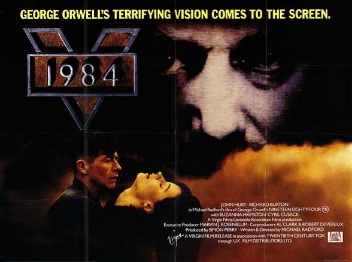
Behind the film
- Year
- 1984
- Director
- Michael Radford
- Writers
- Michael Radford
- Genres
- Dystopian, Political drama, Independent, Science fiction
- Production
- Virgin Produced
- Country
- United Kingdom
- Cast
- John Hurt, Richard Burton, Suzanna Hamilton, Cyril Cusack, Gregor Fisher, James Walker, Roger Lloyd-Pack
About the film
Contains story spoilers.
Winston Smith rewrites history for Oceania's Party while secretly keeping a diary. His forbidden relationship with Julia offers meetings in the countryside and a rented room above Charrington's shop. A hidden telescreen exposes them, and Charrington is revealed as a member of the Thought Police. At the Ministry of Love, O'Brien, whom Winston had mistaken for an ally, interrogates him and teaches doublethink, the acceptance of contradictory beliefs. In Room 101, the threat of rats makes Winston betray Julia. Released, he meets her at the Chestnut Tree Café, where they acknowledge having betrayed each other. After Julia leaves, a telescreen shows Winston's confession. His final words, 'I love you', accompany images of Big Brother and his look towards Julia's departure.
Michael Radford approached George Orwell's novel as science fiction imagined from 1948. He told Simon Brew that he wrote the screenplay in three weeks while producer Simon Perry sought financing from Richard Branson. Rights holder Marvin Rosenblum agreed to join them, and the project moved into production before O'Brien had been cast. Radford considered John Hurt essential to Winston: he told the actor he could not imagine making the film without him. Richard Burton joined after other possibilities for O'Brien fell through. Much of the world required building, including the Ministry of Truth, but Beckton Gasworks already offered partly collapsed buildings stripped of their steel. Its damaged exteriors supplied a physical setting for the city. Radford also recalled a potential distributor asking for a happier ending, a suggestion he rejected.
Roger Deakins and Radford wanted black-and-white photography, but their producers opposed it. Joshua Rothkopf's account for the British Film Institute describes the bleach-bypass process used instead, producing muted blues and silvery blacks. The looming telescreens were created in camera. Rothkopf singles out a tracking shot behind Winston through a dark corridor: a doorway opens onto a green landscape in his imagination. The colour shift gives that imagined space a different appearance from the rooms and streets around him. Deakins told Film and Digital Times that several specific zooms began over a shoulder and closed in as though entering a character's point of view.
Hurt described other ways that Radford kept the experience inside Winston's head. Speaking to Fiona Kieni for Metro, he said he might have placed more emphasis on the lovers' emotional connection, while Radford wanted to avoid sentimentality. The Ministry of Truth also needed a particular sound: its noises were added individually rather than letting it resemble an ordinary typing pool. Hurt pointed to a daily ritual with the broken lift. Winston and a neighbour wait in front of it and chat before turning to the stairs, although they know it will not work. Their conduct keeps up the required appearance of conformity. Hurt said Radford welcomed contributions while working with the actors, then took firm control of how those contributions were assembled into the film.
Brian McFarlane's discussion of the adaptation in Inside Story follows the contrast between the desaturated city and Winston's imagined green country. Crowds gather to watch inflammatory broadcasts, with Big Brother's face dominating screens and posters. McFarlane reads the lovers' physical intimacy as making their eventual betrayals more painful. His account places Hurt's frail, furrowed Winston beside Burton's O'Brien, whose comforting manner coexists with danger. He also draws attention to the singing washerwoman played by Pam Gems, a brief presence of ordinary life within the surrounding oppression. These are separate encounters with Oceania: the collective response to a screen, the lovers together, and the woman singing as she works.
In his interview with Dominic Joyeux, Hurt described Winston as a tragic protagonist whose fall is built into the story. For the actor, the possibility of speaking despite that fate still mattered. He traced his initial identification with the character to reading the book as a teenager and recognising the wish to leave a constricting environment without knowing how. That was a way into Winston's predicament, rather than a model for a successful escape. Hurt also felt the role had reached him at the right age. His account of working with Radford centres on wanting a director who would act as an ally rather than a judge. The partnership mattered to his approach to this particular character.
A. L. Kennedy's Criterion essay examines the ordinary, vulnerable bodies of Winston and Julia, played by Hurt and Suzanna Hamilton, and Julia's practical approach to intimacy. Kennedy describes a relationship carried by small words and glances under surveillance, with uncertainty about Julia's motives persisting alongside Winston's attachment. The essay also notices the gray-brown surroundings and the clumsy technology of vacuum tubes and paperwork. The city's control of information depends on those material objects. Criterion's director-approved edition includes both the Eurythmics score and Dominic Muldowney's music, with a restoration supervised by Deakins. Radford recalled that the financiers' wish for a hit record had led to arguments about the music. Hurt, meanwhile, explicitly left the final declaration of love open: it could address Big Brother or Julia. He considered that uncertainty a difference from Orwell, allowing love and grief to occupy the same moment.