
Behind the film
- Year
- 2014
- Director
- Dan Gilroy
- Writers
- Dan Gilroy
- Runtime
- 1h 57m
- Genres
- Neo-noir, Thriller, Drama
- Production
- Bold Films
- Country
- United States
- Cast
- Ann Cusack, Bill Paxton, Jake Gyllenhaal, Kathleen York, Kevin Rahm, Rene Russo, Riz Ahmed, Michael Hyatt
About the film
Contains story spoilers.
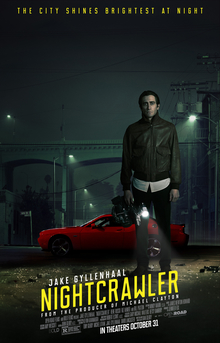
Louis Bloom survives by stealing scrap metal and selling it, but he is looking for a more profitable way to work. One night in Los Angeles, he stops at a crash scene and watches freelance cameraman Joe Loder film the rescue. Loder tells him that graphic footage sells, and Louis sees a job where he had only seen an emergency. He steals a bicycle, trades it for a camcorder and police scanner, and begins chasing accidents and violent incidents after dark. Calling himself Lou Bloom, he takes his recordings to a local television station, where news director Nina Romina is under pressure to deliver footage that will keep viewers watching and the station competitive.
Nina buys Lou’s first footage after he captures a victim at a carjacking. The sale gives him equipment, a reason to return, and a clear lesson about what the station values. Lou hires Rick, a young homeless man who answers his job advertisement, as his assistant. Rick needs money and has little power to bargain, while Lou uses management language and promises of advancement to make their arrangement sound like a career path. They drive the city with a scanner, learning which neighborhoods and emergencies produce the images Nina wants. When an accident or shooting happens, Lou measures how close he can get before police stop him, and how much the station will pay for what he brings back.
Lou’s work grows more calculated as he competes with Loder, an established cameraman who knows how to reach a scene quickly. Lou sabotages Loder’s van, leaving his rival injured and unable to cover calls. He takes the best footage to Nina and presses for better terms, even using their private dinner to demand sex as part of their business relationship. Nina is also negotiating from a weak position: KWLA’s ratings are slipping, and she wants material that can be sold in the morning broadcast. Lou understands that pressure and turns it into leverage. Their relationship becomes an extension of the newsroom’s transaction, with Nina trading access and airtime for the images she believes will attract viewers.
The most consequential footage comes when Lou arrives at a house before police and sees the aftermath of a home invasion. He records the victims and the intruders’ vehicle, then withholds the vehicle information from detectives. The footage gives him a lead on the suspects, and he uses the license plate to identify them. Rather than hand over everything he knows, he plans to follow them and film their next move. He recruits Rick for the stakeout and frames the risk as a chance to earn money from a police reward. Rick worries that an arrest at a crowded restaurant could put bystanders in danger, but Lou presses him to continue. The camera has become a tool for arranging events as much as recording them.
At the restaurant, Lou calls police and films as officers confront the men. A gunfight leaves several people dead, and one suspect escapes. Lou and Rick follow the police chase to its end. When Lou sees the suspect still alive in the wrecked vehicle, he tells Rick to approach and film a close-up. The suspect shoots Rick, who dies while Lou keeps recording. As he films the dying Rick, Lou says he could not jeopardize the business for an untrustworthy employee. Back at the station, Nina sees precisely the kind of exclusive she wants and prepares it for broadcast even as the detectives try to seize it. The newsroom has the power to decide what appears on television, but its appetite for the footage rewards Lou’s choices.
Lou had already given detectives an edited version of the home-invasion footage, concealing the gunmen he saw leaving. After the chase, Fronteiri questions him again. He now claims the men followed him and he called the police to escape them. She suspects his involvement, but lacks evidence to contradict his story. Nina learns that drugs were found at the crime scene, yet chooses to focus on the innocent victims because she believes viewers care more about them. Her decision echoes Lou’s own way of selecting details: the truth is shaped into a story that will sell. Frank, the assignment director, challenges the ethics of airing the images, but his objections do not outweigh the station’s interest in the audience they might draw.
By the end, Lou has turned his work into a company, Video Production News, with branded vans and a group of unpaid interns. He tells them they will never be asked to do anything he would not do himself, a promise that sounds fair only because the film has shown what he is willing to do. The city’s nighttime emergencies gave him a route out of poverty, but his success depends on treating other people’s worst moments as raw material and on making danger profitable for his crew. Nina has gained the footage she needs, Rick has paid the cost of Lou’s ambition, and the police have not stopped him. The final image of expansion makes clear that the business Lou built will keep moving through the night.