
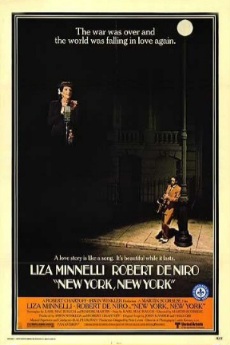
Behind the film
- Year
- 1977
- Director
- Martin Scorsese
- Writers
- Earl Mac Rauch, Mardik Martin
- Genres
- Musical, Drama, Romance, Comedy drama
- Production
- Chartoff-Winkler Productions
- Country
- United States
- Cast
- Liza Minnelli, Robert De Niro, Lionel Stander, Barry Primus, Mary Kay Place, Georgie Auld, George Memmoli, Dick Miller
About the film
Contains story spoilers, including the ending.
Jimmy Doyle and Francine Evans first get a job together because she rescues his audition. He has argued with the club owner; she starts singing, and his saxophone gives her an accompaniment. The owner hears a duet worth hiring. That moment gets to the trouble at the heart of New York, New York: they can make music together, but Jimmy keeps making it difficult to work or live beside him. Robert De Niro plays the saxophonist and Liza Minnelli the singer in Martin Scorsese's 1977 film. Their first encounter comes during the V-J Day celebrations in 1945, when Jimmy pesters Francine for her phone number. She wants nothing to do with him. Sharing a cab the next morning leads to the audition, turning his unwelcome pursuit into a professional partnership.
Francine has work waiting with Frankie Harte's touring band. Jimmy follows her, joins the orchestra and eventually takes it over when Harte wants to stop the tour. He pushes Francine into a sudden nighttime marriage, then clashes with the players in the band that now bears his name. When she becomes pregnant, she wants to return to New York. Jimmy initially insists she stay on tour. They now need to agree on a home and a child as well as the next engagement, but he keeps treating her departure as a problem for his work. She goes back to studio recording while his band continues with another singer.
Jimmy's ambitions also pull against his own musical choices. He wants the freedom of jazz while resenting the success of the big-band world, and Francine's singing finds an audience more easily. His desire for recognition becomes competition inside the marriage. The arguments grow violent, culminating in a fight in the car as Francine goes into labour. After their son is born, Jimmy leaves before she is out of hospital. The film then spends more time with Francine's performances: a recording session, a Hollywood musical and finally the title song before a club audience. Her career has continued beyond the relationship. Jimmy succeeds too, becoming a jazz musician and club owner. Their later reunion is awkward. He asks her to dinner by telephone; she agrees, then changes her mind and leaves by another route. Jimmy walks away after waiting outside. Success has brought them back into contact without repairing their marriage.
The city around them is a Hollywood construction, designed by Boris Leven and photographed by László Kovács. Scorsese wanted the changing years to resemble films made in those periods, using sets, costumes, hair and makeup to carry the difference. That carefully arranged world still had to accommodate the actors' changing scenes. Leven moved walls and altered lighting to turn one club set into different venues; he also revised designs when the dialogue and action changed. For the scene where Jimmy tries to stop a train, he had painted the train on cardboard. De Niro began playing with the attempt to prevent its departure during rehearsal, and Scorsese built the scene around that gag. It is a useful example of how Jimmy's impulsiveness could emerge inside such an artificial setting. Even the music required precise physical work: a take could need repeating because De Niro's saxophone fingering did not match what was being played.
De Niro named swing saxophonist Georgie Auld as his teacher for the role. He also challenged the proposed song associated with Jimmy. Composer John Kander remembered playing the songs for Scorsese and Minnelli with lyricist Fred Ebb, while De Niro sat nearby. The actor thought his number was too lightweight beside Minnelli's 'The World Goes Round', and Scorsese asked the writers to reconsider it. Kander and Ebb returned to Ebb's apartment irritated by the criticism, then wrote the replacement in roughly forty-five minutes. It became 'New York, New York'. In the story, that song carries both characters' work: Jimmy's instrumental becomes a hit, and Francine performs it with her lyrics when he returns to hear her sing.
The longer version also includes Francine's film within the film, 'Happy Endings'. Its eleven-minute musical sequence was removed from the original release and restored for the 1981 re-release and later home-video versions. That distinction matters: the restored film gives space to a large production number alongside the recording and club performances. Scorsese said its inspiration was 'Born in a Trunk' from the 1954 A Star Is Born. The 1977 film was also shortened again for later engagements before removed material returned. He regarded the later version, with the reel and 'Happy Endings' restored, as the picture he had made. His stated aim was to give the film the warmth and lustre of older Hollywood pictures while showing two driven, creative people trying to make a life together. Francine can have a screen musical called 'Happy Endings' without her own marriage receiving one.