
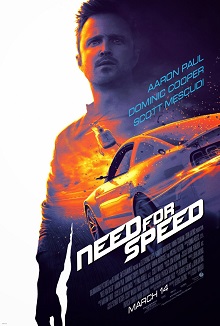
Behind the film
- Year
- 2014
- Director
- Scott Waugh
- Writers
- John Gatins, George Gatins, George Nolfi
- Runtime
- 2h 10m
- Genres
- Action, Thriller, Drama, Crime
- Production
- Touchstone Pictures
- Country
- United States, India
- Cast
- Aaron Paul, Imogen Poots, Dominic Cooper, Kid Cudi, Rami Malek, Michael Keaton, Dakota Johnson, Harrison Sloan Gilbertson
About the film
Contains story spoilers, including the ending.
Need for Speed gives Aaron Paul's Tobey Marshall a racing world built around rival drivers and dangerous stunts. Scott Waugh approached the game series as a setting for a film rather than a plot he had to transfer intact. He wanted to place a cinematic story inside that world, with Electronic Arts involved as a partner. His own background was in stunt work, and he described choosing camera positions that would put an audience close to what a driver experiences. A view attached to a moving car or looking out from behind the wheel mattered more to him than watching a collision from a distance. Casting also followed that idea of the film. Paul was initially considered for the villain, but Waugh thought his presence suited the lead. Dominic Cooper became Dino, while Imogen Poots played Julia, a character Waugh wanted to have strength and depth of her own.
Tobey's garage is struggling when Dino offers him a share of the money from completing a rare Shelby Mustang. Their business deal gives way to a race in which Pete dies and Tobey takes the blame. After two years in prison, Tobey sets out for the De Leon, the underground event that will bring him face to face with Dino again. Julia accompanies him, and the crew helps him reach the starting line. Anita eventually supplies the Koenigsegg connected to Pete's death, allowing Tobey to arrive with something Dino had hoped would stay hidden. The final contest ends with Tobey winning and then rescuing Dino from his burning wreck. Both men are arrested. Dino faces the consequences of Pete's death, while Tobey serves another sentence for illegal racing before reuniting with Julia. Saving his rival makes the finish more than a victory over another car.
The journey to the De Leon takes Tobey and Julia through a canyon pursuit before they reach California. Benny brings a military helicopter to their rescue, lifting the Mustang clear of the danger below. The race itself runs through Mendocino's forest and coastal roads, with Monarch overseeing the contest and police joining the pursuit. Tobey reaches that race in the red car Dino drove during the earlier fatal collision. The vehicle therefore carries the history of Pete's death into the confrontation Tobey has crossed the country to reach.
Waugh looked back to films such as Bullitt when describing the sound and movement he wanted. Motor noise and dialogue were part of that aim, along with a romance running through the action. He did not choose one particular Need for Speed game to reproduce, instead talking about paying tribute to several entries. The manufacturers' relationship with the games also helped the production obtain vehicle design files. Those files allowed the filmmakers to reproduce expensive supercars around structures suited to stunt work. Waugh explained that the original vehicles were made to stay upright and travel fast, rather than repeatedly flip or crash. Replicas could contain proper roll cages and the mechanisms needed to turn a planned collision into a repeatable stunt. The point was to keep the shape of the car recognisable while building something the performers could use for the action the story required.
Some shots depended on the distance between a performer and the camera being very small. Paul recalled driving a Koenigsegg toward the lens, spinning it and trying to stop close enough for his face to be visible. His first attempts finished too far away. Waugh held the camera himself, and Paul remembered completing the shot on the third take. That account explains why a close view of the driver was part of the stunt's purpose, rather than an insert added after the car had stopped. A different jump had a less tidy outcome for the equipment. Waugh said the car landed short of its intended position and destroyed three cameras. He used the frames recorded before impact. Alongside the specially built crash vehicles, those stories describe practical action as a series of planned positions, repeated attempts and physical consequences on set.
Cinematographer Shane Hurlbut's work joined that practical approach to small cameras and visual effects. The production tested nine camera formats, examining colour, skin tones, backlight and the way fast movement affected the image. Tests on the racetrack also addressed rolling shutter and the problems of mounting cameras on cars at high speed. The Canon C500 became the principal camera, with other cameras taking supporting roles. Wide lenses placed close to the actors could keep passing scenery visible beside them, giving the driving a sense of speed while staying inside the car. Stunt drivers sometimes controlled a vehicle from an attached pod so the crew could film the performers. Atomic Fiction and Cantina Creative then augmented photographed action with visual effects. The finished races combine those methods: practical stunts provided a starting point, while additional effects helped complete particular shots. Waugh's preference for physical action did not remove visual effects from the film.