
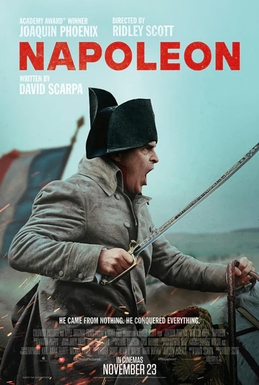
Behind the film
- Year
- 2023
- Director
- Ridley Scott
- Writers
- David Scarpa
- Runtime
- 2h 38m
- Genres
- Historical, Biographical, Epic, Adventure
- Production
- Scott Free Productions, Apple Studios
- Country
- United States, United Kingdom
- Cast
- Vanessa Kirby, Joaquin Phoenix, Tahar Rahim, Youssef Kerkour, Ludivine Sagnier, Ian McNeice, John Hollingworth, Matthew Needham
About the film
Contains story spoilers.
Ridley Scott's Napoleon opens during the French Revolution, with young artillery officer Napoleon Bonaparte watching Marie Antoinette's execution. The film then follows a deliberately selective version of his ascent, first giving him command at the Siege of Toulon, where his artillery helps drive British ships from the harbour. He becomes a figure of influence as revolutionary governments rise and fall. The story marks its jumps across decades with dates and battle names, moving from military camps into the Parisian rooms where he meets Joséphine.
That private strand begins with Napoleon's pursuit of Joséphine de Beauharnais, a widowed aristocrat he meets in Paris. Vanessa Kirby's Joséphine has social confidence and a life beyond him; Joaquin Phoenix's Napoleon is at once a successful commander and a needy, jealous husband. Their courtship and marriage are shown through awkward humour, possessive letters, sexual scenes and arguments. At their first encounters, he invokes his victory at Toulon to impress her; she sees in his ambition the prospect of protection and social advancement. His authority over soldiers gives him little assurance in her company.
In the film's account, Napoleon's campaign in Egypt includes victory at the Battle of the Pyramids, but the news that Joséphine has taken a lover draws him back to Paris. He reproaches her, then turns the political crisis into an opportunity: with allies including Talleyrand and Fouché, he overthrows the Directory and takes power as First Consul. At his 1804 coronation, Napoleon places the crown on his own head and crowns Joséphine as empress. The coronation recreates the ceremonial arrangement of Jacques-Louis David’s painting, giving the scene the stillness and ordered grandeur of an imperial portrait.
Military triumphs dominate the next stretch. At Austerlitz, Napoleon's forces confront the Austrian and Russian armies in a snowbound battle that culminates in retreat across frozen water under artillery fire. The scene presents the victory as both strategic achievement and mass death. At home, the couple's inability to produce an heir becomes a political matter as well as a source of personal hurt. Napoleon divorces Joséphine and marries Marie Louise of Austria, who gives birth to a son. Yet Joséphine remains present in letters and in Napoleon's memory, so the separation does not close the emotional thread the film has followed from their first encounter.
The Russian campaign brings the scale of his ambition into collision with a retreat he cannot control. Napoleon enters Russia after a diplomatic rupture, fights through Borodino, and reaches Moscow to find the city empty and burning. The film conveys the retreat as a devastating loss of men and momentum rather than as a full account of the intervening political and military history. In 1814 the Coalition forces his abdication and sends him to Elba. His imperial titles cannot protect him from the Coalition’s terms; defeat leaves the former emperor confined to a small island.
After hearing that Joséphine is ill, Napoleon escapes Elba and returns to France. In the film, troops sent to stop him join his cause, allowing him to reclaim power for the period known as the Hundred Days; Joséphine dies before he can reach her. At Waterloo, his renewed campaign ends in defeat as British forces hold their lines and Prussian troops arrive. The movie then sends Napoleon into a second exile, this time on Saint Helena. In its closing scenes he speaks to listeners and writes memoirs that present his own version of events, before dying in 1821. A final title card tallies the deaths attributed to his wars.
Scott described choosing particular episodes from Napoleon’s life and making the relationship with Joséphine the thread between them. The film also invents staging: Napoleon was not present at Marie Antoinette’s execution, although the opening puts him in the crowd. Scott accompanies her walk to the guillotine with Edith Piaf singing “Ça Ira,” a recording from a much later era. His preparations joined sound and image from the storyboard stage. For Waterloo, he imagined a Corsican shepherd’s voice as the basis of Napoleon’s musical theme, introducing it around a pause on the commander’s face amid the battlefield chaos. Scott also drew the confrontation with Wellington through their telescopes without claiming that exchange as a documented event. These choices create a subjective, sometimes deliberately incongruous portrait within the historical sequence.
Production designer Arthur Max and set decorator Elli Griff used English palaces to recreate the interiors of imperial France. Blenheim’s connected staterooms became different locations through rapid changes of furniture and decoration: while a scene was filmed in one room, the team prepared another nearby. The same corridor could serve a diplomatic encounter and Napoleon’s visit to a woman chosen to test whether he could father a child. On battle locations, Max planned the ground for both the performers present and the larger armies to be added digitally, constructing cannon trenches and redoubts within the landscape. Scott told ABC that the practical soldiers provided the foreground and visual-effects supervisor Charley Henley extended their ranks into the distance. His multiple-camera approach included handheld views among the combatants, placing some shots close to the bodies and mud instead of surveying every movement from above.