
Behind the film
- Year
- 2011
- Director
- Simon Curtis
- Writers
- Adrian Hodges
- Runtime
- 1h 39m
- Genres
- Biographical, Drama
- Production
- The Weinstein Company, BBC Film
- Country
- United Kingdom, United States
- Cast
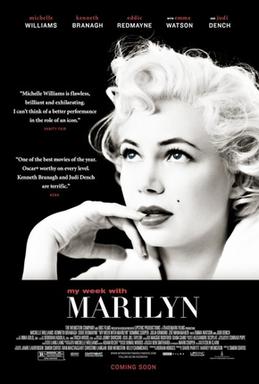
- Michelle Williams, Kenneth Branagh, Eddie Redmayne, Emma Watson, Judi Dench, Dominic Cooper, Dougray Scott, Julia Ormond
About the film
Contains story spoilers.
Fresh from Oxford, Colin Clark asks Laurence Olivier for work on The Prince and the Showgirl. Vivien Leigh persuades her husband to give him a chance, and Colin starts as a third assistant director, running errands rather than directing. When Marilyn Monroe and Arthur Miller arrive, Colin finds a replacement house after reporters expose the first one. The solution earns him the trust of Olivier and publicist Arthur Jacobs, and he is assigned to help the production manage its star. His access begins as a job: he is the junior worker expected to solve practical problems around a film set whose schedule is already under pressure.
Monroe comes to England with Miller, business partner Milton Greene and acting coach Paula Strasberg. Photographers follow her from the airport to the studio. Olivier wants a prompt, orderly shoot; Monroe relies on Paula's guidance to find the character of Elsie. During a read-through, Paula quietly coaches her while Olivier waits and the British cast watches. Dame Sybil Thorndike responds gently, but Olivier grows frustrated with missed cues, lateness and repeated takes. The disagreement is about more than punctuality: Olivier expects a director's instructions to settle a scene, while Monroe's process gives Paula a central role and leaves him unsure how to reach his actor.
Colin dates Lucy, a wardrobe assistant, as tensions grow on the set. Monroe leaves after another difficult session, and Colin challenges Olivier before visiting her at Parkside House. She has found Miller's notebook and fears a new play is about her. Colin listens, but his place in the production remains that of a junior employee who has become her confidant for a short time. The shift is visible in the change from errands and call times to private visits; it does not erase the difference between a young assistant's fascination and the pressures surrounding Monroe's marriage, work and public image.
After Miller returns to the United States, Monroe misses work and asks Colin to come to Parkside. Later, she dances through a scene without dialogue, and the crew watches as the take changes the room's mood. Greene warns Colin that Monroe breaks hearts; Colin has already been neglecting Lucy, who ends their relationship. The film sets these two connections against one another through Colin's work: he can enter Monroe's guarded circle because the production sends him to help, then reads that access as personal devotion. His growing attachment is part of the story, but the film does not make it proof that he understands Monroe.
Colin and Monroe slip away from the studio for a day at Windsor Castle and Eton, then swim in the Thames and kiss. The outing gives Monroe time outside the press and the set, while Colin's family connections provide the route. Its brightness is temporary: the production still needs her, and she has a husband in Miller. Curtis later said he was drawn to the pattern of two people entering each other's orbit for an intense experience before going separate ways, a shape that fits the excursion without turning it into a promise of a shared future. Colin can accompany her for a day; he cannot decide what follows.
When Monroe locks herself in her bedroom after taking sleeping pills, Colin is called to Parkside and stays nearby. The next evening she wakes in pain and tells him she thinks she is having a miscarriage; a doctor examines her, but the film does not independently confirm a pregnancy. Monroe says Miller is returning and that she wants to try again as his wife. That decision closes the private opening Colin has mistaken for a future. He can be present through a frightening night, but her marriage and next choice remain hers. The scene keeps the episode within what Colin is told rather than claiming knowledge beyond his point of view.
Monroe returns to work, completes the film and receives praise from Olivier, who tells Colin that the experience has ended his wish to direct again. Lucy asks whether Monroe broke his heart; Colin says, a little. At the pub, Monroe thanks him, kisses him goodbye and leaves for the airport with her bodyguard. The production design keeps the romance inside a working film set: Curtis said the shoot used Pinewood, Shepperton, Twickenham and Ealing to find the period studio's different nooks and corners. He also recalled Jenny Shircore working with Michelle Williams on the makeup that helped her become Monroe. Curtis described Olivier as used to getting his way and thought he should have gone further toward Monroe's needs. He said his own instinct was to approach a character through psychology and inner life, a useful contrast to the directing conflict staged on the set. The film adapts Colin Clark's two memoirs and deliberately follows his version, so its intimate scenes show a young assistant's perspective rather than establish Monroe's full inner life.