
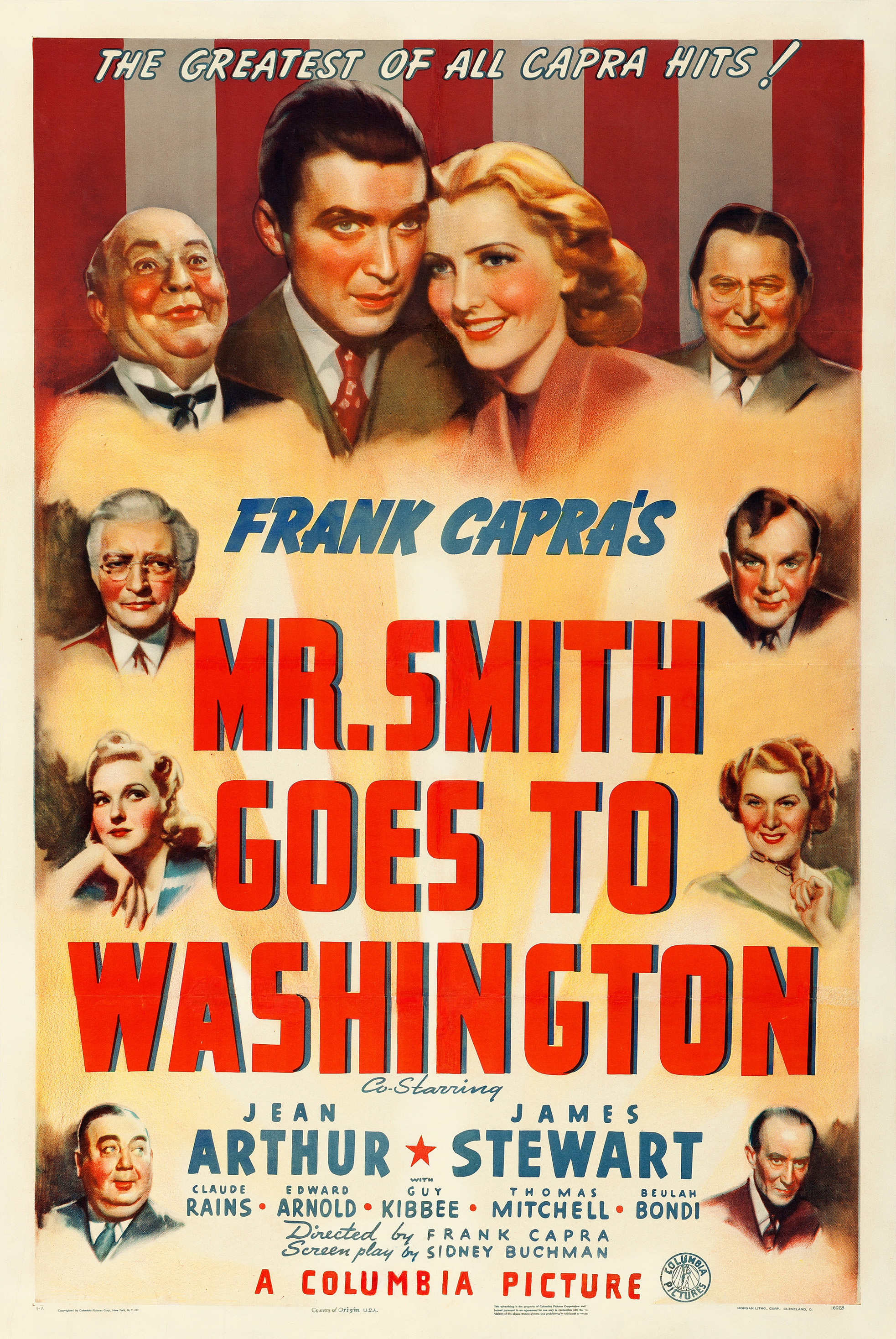
Behind the film
- Year
- 1939
- Director
- Frank Capra
- Writers
- Sidney Buchman, Lewis R. Foster
- Runtime
- 2h 9m
- Genres
- Comedy, Political, Drama
- Production
- Columbia Pictures
- Country
- United States
- Cast
- James Stewart, Jean Arthur, Claude Rains, Edward Arnold, Charles Lane, Thomas Mitchell, Harry Carey, Eugene Pallette
About the film
Contains story spoilers.
When a senator from an unnamed state dies, political boss Jim Taylor needs the governor to appoint someone who will support a profitable dam project at Willet Creek. Governor Hopper is pressured by Taylor and the local citizen committees, but his sons suggest Jefferson Smith, a popular leader of the Boy Rangers. Smith is inexperienced, which makes him seem easy to manage. Senator Joseph Paine, the state’s senior senator and Smith’s childhood hero, backs the appointment. Paine has known Smith’s late father, a crusading newspaper editor, so Jeff arrives believing he has found a worthy guide into public life.
Smith is overwhelmed by Washington. He wanders away from the welcoming group to see the Capitol and eventually reaches the Senate office, where his secretary Clarissa Saunders and her friend, reporter Diz Moore, are waiting. Saunders is sharp, cynical and familiar with the way business gets done; Smith’s excitement about public service seems naïve to her. The press turns his arrival into a joke, and when Smith loses his temper with the reporters, the reporters dismiss him as an honorary stooge. Paine advises him to sponsor a bill for a national Boy Ranger camp, giving the new senator a concrete project to work on and a reason to learn procedure with Saunders.
Smith and Saunders spend a night shaping the bill, and the young senator presents it in the Senate with visible nerves. His proposal wins interest until Paine realizes that the camp would use the same Willet Creek land Taylor wants for his dam. Paine tries to distract Smith with his socialite daughter Susan, who gives the newcomer an alluring glimpse of a different Washington. Saunders sees that Jeff is being steered away from the bill and, after a drunken night with Diz, tells him about the arrangement between Paine and Taylor. The story’s central betrayal lands personally: Smith has built his trust in Paine partly on the man’s friendship with his dead father.
Smith confronts Paine and Taylor, but Taylor makes clear that he controls the governor, the press and the state political machine. When Smith attempts to speak against the dam bill in the Senate, he yields the floor by mistake and Paine uses the moment to accuse him of using the Boy Ranger project for personal gain. A committee hearing follows, where Paine and Hopper present false evidence that Smith secretly owns the land planned for the camp. The senator is too stunned to defend himself. Believing the whole institution has rejected him, he decides to leave Washington rather than continue as a public disgrace.
At the Lincoln Memorial, Saunders finds Smith and urges him to stay and fight. Her change from amused skepticism to belief in him does not make her forget how Washington works; she teaches him that the rules can still give him time to reach the public. Smith begins a filibuster, speaking for nearly twenty-four hours so the vote can be delayed while he tries to get the truth back to his state. Paine continues to attack him, and Taylor controls local newspapers, filling them with accusations. Saunders and Diz help Smith’s cause, while back home his mother and the Boy Rangers print their own small newspaper to counter the smear campaign.
Taylor’s men seize the children’s papers and injure some of the boys. The Senate floor becomes an exhausting contest between Smith’s failing body and the machine’s ability to manufacture apparent public opinion. Paine produces 50,000 telegrams organized by Taylor, demanding that Smith quit. Smith nearly collapses, but he keeps speaking, telling Paine that their shared state has to hear what was done in its name. Saunders signals from the gallery and helps him hold the floor under the chamber’s rules. The spectacle attracts the press and senators, turning an obscure procedural maneuver into a visible fight over who controls the story of Willet Creek.
Smith’s stamina finally gives out. He collapses after his long speech, and Paine breaks under the weight of his own actions. After trying to kill himself outside the chamber, the senior senator returns and admits that Smith’s charges are true, asking the Senate to expel him instead. The chamber erupts. The confession clears Smith’s name and undoes Taylor’s immediate effort to force the dam through, though the political boss’s power to manipulate local news and intimidate opponents has not been fully confronted. Paine’s last-minute turn gives the ending its relief, while the events that led to Smith’s collapse show how much damage the machine could do before anyone challenged it.
Frank Capra gives the political fight a comic entry point through Smith’s bewilderment: the wrong turn onto a tour bus, the awkward press conference and his first encounters with Senate protocol. The jokes make his inexperience visible, while the Boy Ranger bill gives his hopes a practical conflict. Capra and his crew studied Washington and recreated the Senate chamber at full scale on the Columbia lot, with former Senate press-gallery superintendent James D. Preston advising on procedure. The chamber makes the filibuster a public ordeal, and cuts to press and home state show how information is controlled while Smith speaks.