
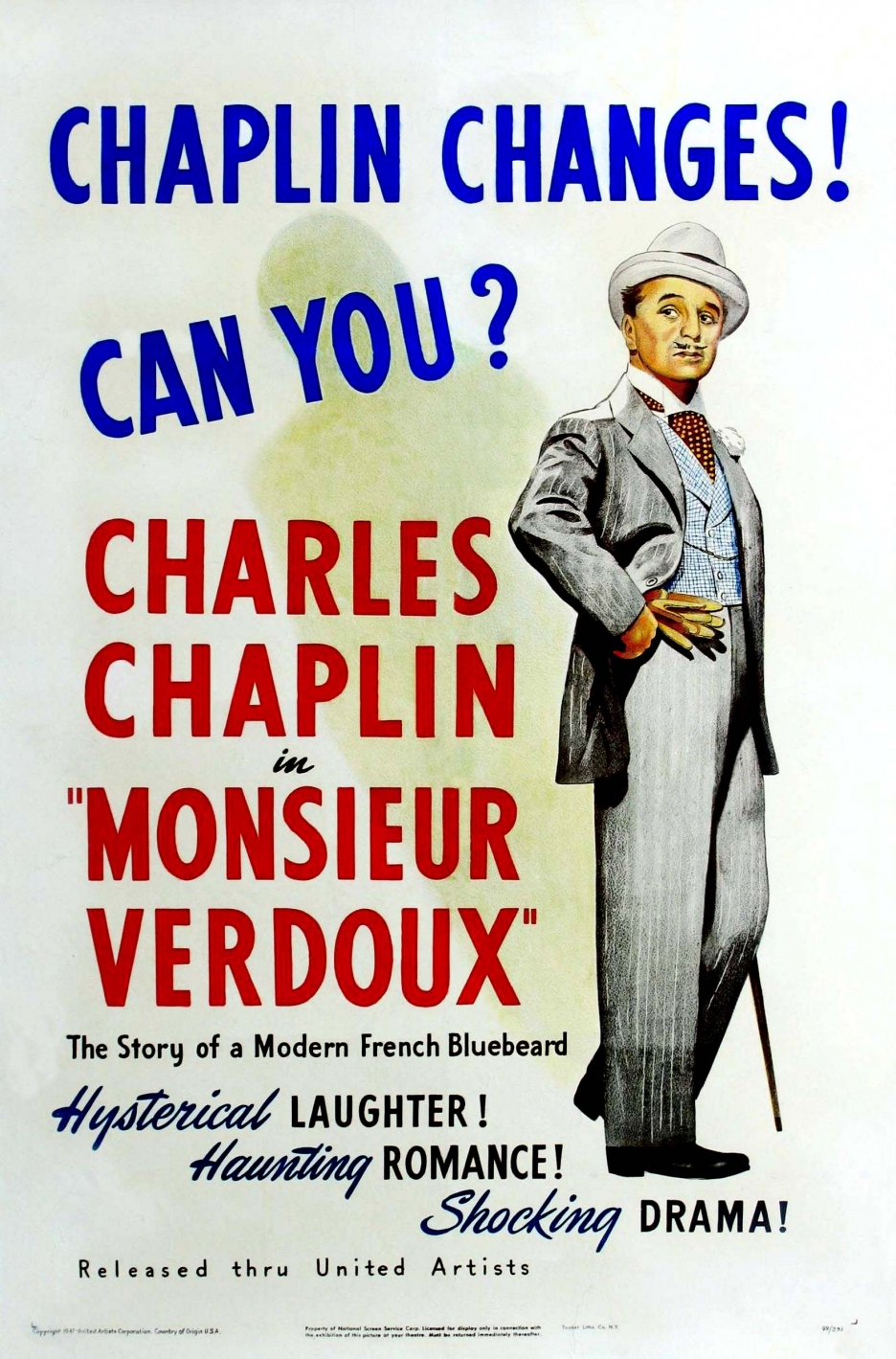
Behind the film
- Year
- 1947
- Director
- Charles Chaplin
- Writers
- Charles Chaplin
- Genres
- Comedy drama, Comedy
- Country
- United States
- Cast
- Charles Chaplin, Mady Correll, Allison Roddan, Martha Raye, Isobel Elsom, Marilyn Nash
About the film
Contains story spoilers, including the ending.
Monsieur Verdoux begins with its murderer already dead, speaking from beyond the grave before the story returns to the women whose money supported his respectable life. Charlie Chaplin plays Henri Verdoux, a man whose careful manners and affection for flowers coexist with an efficient interest in other people's savings. The 1947 comedy follows his schemes through a France of villas, banks, railway journeys and investment worries. His gentleness is selective: he can spare a small creature in his garden while treating the disappearance of a wife as a completed business transaction. The opening smoke from an incinerator makes the cost of that transaction apparent before his next courtship begins. His courtesy gives him access to households where his victims expect companionship rather than a calculation of their assets.
Verdoux's wife Mona and their son Peter know little of the business that keeps him travelling. Elsewhere he uses other names and marriages to obtain money, then invests the proceeds. He persuades Lydia Floray to withdraw her savings by warning of a financial crisis and kills her. Annabella Bonheur, a lottery winner who believes he is a sea captain, repeatedly survives his plans. A young woman newly out of prison seems suitable for an experiment with poison until she speaks about her love for her late husband. Verdoux feeds her, gives her money and lets her leave. His mercy does not end the killing: the detective pursuing him drinks the poison and dies. Verdoux's pursuit of Marie Grosnay reaches a wedding, but Annabella's unexpected presence forces him to flee. Each household offers him a different cover story; bringing two of them together threatens the entire arrangement.
The stock-market collapse takes away the wealth Verdoux has accumulated. Years later, he meets the young woman he spared and tells her he has lost his family as well as his fortune. She has become prosperous through a relationship with a munitions manufacturer, placing her good fortune beside the trade in weapons. Relatives of an earlier victim recognise Verdoux, and he gives himself up. At his trial he argues that organised mass killing makes his own crimes look small. That argument does not save him: he is condemned and goes to the guillotine. The ending returns to the death announced at the beginning, after his marriages, investments and attempts to avoid discovery have all failed. The contrast with the woman's changed circumstances leaves the arms business prospering while the individual murderer faces punishment.
Annabella interrupts the controlled behaviour on which Verdoux depends. Martha Raye plays a woman who talks loudly, pursues impulses and frustrates plans she does not know exist. Michael Feingold's account of the film describes how her lottery wealth and enthusiasm for dubious investments alarm her supposed husband, who wants to protect money he hopes to steal. His attempts to poison and drown her repeatedly go wrong. Around Marie, played by Isobel Elsom, he becomes extravagant with flowers and courtship; the large wedding supplies exactly the public gathering he needs to avoid. Feingold also points to Mona's wish for the simpler life they had when Verdoux was home more often. The comfortable house he provides cannot give her the company his secret business keeps taking away.
Chaplin's performance gives Verdoux a separate physical vocabulary from the Tramp. Ignatiy Vishnevetsky's Criterion essay draws attention to his upright bows, affected walk and delicate handling of flowers and poison, alongside the speed with which he counts money. The same hands can perform courtship or business without an obvious change of temperament. Vishnevetsky also describes camera movements timed to Chaplin's actions, including the kitchen scene in which Verdoux prepares breakfast before remembering that his companion is dead. Much of the killing stays outside the frame, while headlines, montages and title cards carry the chronology forward. The final walk is filmed from behind. These choices let the film move between the smooth routine Verdoux presents to others and moments when his conduct exposes what that routine conceals.
The character grew from an idea Orson Welles brought to Chaplin about the French killer Henri Désiré Landru. Chaplin bought the idea, but made a fictional comedy rather than a biography. David Robinson's production history on the official Chaplin site also identifies the English criminal Thomas Wainwright as an inspiration. Robinson describes a more thoroughly planned shoot than Chaplin's earlier working habits allowed: rising costs and restricted film stock made prolonged experiments expensive. A completed script, detailed drawings and a shooting schedule preceded filming. French director Robert Florey assisted with the setting. The murderer's apparently effortless movements therefore belonged to a production that had already worked out much of its action on paper, rather than discovering every exchange while the camera ran.
Edward Landler's production account in CineMontage describes Chaplin choosing Raye to carry the broadest comedy opposite Verdoux's shifts between businessman and affectionate father. The rowboat attempt on Annabella took three days at Lake Malibu, while the courtroom scene was filmed in one day, with several takes of Chaplin's speech available for the edit. Chaplin then worked with editor Willard Nico and composed the music with arranger Rudolph Schrager. The script also drew objections from the Production Code Administration, including its treatment of religion and its comparison between warfare and murder. Chaplin accepted changes during those discussions. The courtroom speech remained central to the finished story, allowing Verdoux to make his defence before the film carries him through sentencing and his final departure.