
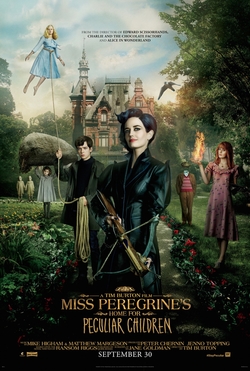
Behind the film
- Year
- 2016
- Director
- Tim Burton
- Writers
- Jane Goldman
- Genres
- Adventure, Fantasy, Time-travel
- Production
- Chernin Entertainment, Ingenious Media, Scope Pictures
- Country
- United States, United Kingdom
- Cast
- Eva Green, Asa Butterfield, Samuel L. Jackson, Judi Dench, Rupert Everett, Allison Janney, Chris O'Dowd, Terence Stamp
About the film
Contains story spoilers, including the ending.
Miss Peregrine's Home for Peculiar Children places Jake Portman between his grandfather Abe's stories and a shelter hidden in 1943. The children repeat one day under Miss Peregrine's protection; she can become a bird and reset time. Jake can see the otherwise invisible Hollows that hunt them. Barron, who has used the disguise of Jake's therapist to find the home, kidnaps Peregrine. Without her, the loop closes when a wartime bomb destroys the house. The children pursue their captor to Blackpool and rescue the imprisoned Ymbrynes. A Hollow kills Barron while he is disguised as Jake, and the real Jake kills the creature. Back in the present, Jake finds Abe alive. His grandfather gives him a map of time loops, and Jake travels through them to rejoin Emma and the children aboard their ship in 1943.
Jane Goldman adapted Ransom Riggs's novel for Tim Burton, reshaping the adventure around a more continuous antagonist. Goldman described Samuel L. Jackson's Barron as an expanded character whose presence carries through the film in a way the book's villainy does not. The children remain the centre of the story, though some ages and abilities change. Emma's fire-making gift in the novel goes to Olive in the film, while Emma controls air. Goldman said this switch did not change Emma's underlying personality. The underwater ship and the battle involving skeletons on a pier were also developed for the screen. Those scenes began with the question of what would be magical or entertaining, with their practical demands addressed afterwards. Burton's connection with stop-motion informed the fighting dolls sequence. Goldman recalled a director who settled his script and storyboards before filming and then worked steadily through them, making few changes on set. That preparation gave the new set pieces a place in the adaptation before the cameras rolled.
Eva Green approached Miss Peregrine as a protective commander. Green described a woman who runs the home with military organisation, insists that the children arrive on time and maintains her authority even as their circumstances fall apart. The strictness belongs to her responsibility for keeping everyone safe. She does not want the children to be frightened, and caring for them has become the purpose of her life. Green also resisted treating the children as strange in every part of their behaviour. They can fly or disappear, but they still play and feel happiness or sadness like other children. In her account, the island allows qualities that would attract persecution outside to be valued within the home. The physical location helped her enter that world. She recalled filming at a real house in Antwerp, with an elaborate garden and topiary shaped into creatures including elephants and dinosaurs. The house supplied a substantial setting around the performers, while the added garden shapes fitted Burton's imaginative surroundings.
Cinematographer Bruno Delbonnel used weather and light to distinguish the two periods. The present-day Welsh scenes are rainy, while the repeated day belongs to a sunny summer. The difference gives viewers a visual way to follow movement between times. Delbonnel tested a strong colour treatment inspired by two-strip Technicolor with colourist Peter Doyle, then reduced its intensity during the final grade to keep the characters approachable. He wanted an image that could be frightening while retaining a recognisable reality. His choice of a 1.85:1 frame also answered a practical character problem: the cast contains people of very different heights, and the image needed room for both them and their surroundings. Cooke lenses and an Alexa Studio camera formed the filming setup. Delbonnel preferred its optical viewfinder for judging light. He kept the recorded image relatively clean, leaving substantial colour decisions for later. His camera approach favoured actors' movement and body language, allowing a shot to change its relationship to a performer without constantly cutting between fixed sizes.
The time reset required the effects team to turn an abstract rule into visible action. Visual-effects supervisor Frazer Churchill described Peregrine stopping a bomb just before impact, then reversing the preceding day. The children were filmed on a bluescreen stage, with large lights arranged to send the changing sun and shadows around them. Double Negative rebuilt the house and grounds digitally from the Belgian location, and time-lapse photography helped establish how the light changed there. The underwater ship sequence presented a different set of physical demands. Churchill wanted the performers genuinely submerged so their swimming and hair movement would remain convincing. They worked in a tank at Pinewood with greenscreens, while Scanline created much of the surrounding wreck. A room was built for the conversation after Emma expels the water. A rotating rig took the actors out of the water with the camera attached, keeping gravity, dripping clothes and hanging hair consistent as the room became dry. The effect had to connect two bodily states within the same encounter.