
Behind the film
- Year
- 1990
- Director
- Ethan Coen, Joel Coen
- Writers
- Coen brothers, Joel Coen, Ethan Coen
- Runtime
- 1h 55m
- Genres
- Neo-noir, Crime, Drama, Film noir
- Country
- United States
- Cast
- Gabriel Byrne, Marcia Gay Harden, Albert Finney, John Turturro, Jon Polito, J. E. Freeman, Steve Buscemi, John McConnell
About the film
Contains story spoilers.
In this Prohibition-era city, Irish boss Leo O’Bannon refuses to surrender Bernie Bernbaum, a bookkeeper accused of leaking the results of Johnny Caspar’s fixed fights. Caspar wants Bernie dead; Leo says Bernie pays for protection and also loves his sister, Verna. Tom Reagan, Leo’s adviser, warns that defending Bernie risks a gang war. Tom’s advice is compromised: he is secretly seeing Verna, while she lets Leo believe their relationship can protect her brother. Leo offers to clear Tom’s gambling debt; Caspar offers money for Bernie’s whereabouts. Tom declines both offers, but Leo’s police raids on Caspar’s clubs make peace harder to preserve.
After Rug Daniels, the man Leo hired to follow Verna, is found dead, Tom suspects Verna or Bernie, though the film never confirms his accusation. Caspar’s retaliation reaches Leo’s house before Tom changes sides. Two hitmen attack as “Danny Boy” plays; Leo notices smoke under his bedroom door, escapes through the house and answers with a machine gun. Later he tells Tom he plans to marry Verna and still will not give Bernie up. Tom admits the affair to change Leo’s mind. Leo beats him and expels him. Only then does Tom approach Caspar, reveal Bernie’s location and accept a test of loyalty: he must take Bernie to Miller’s Crossing and kill him.
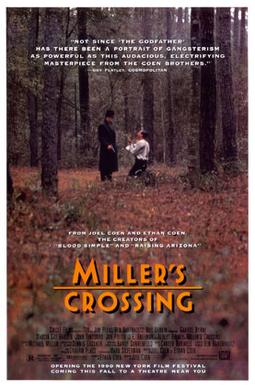
In the woods, Tom lets Bernie plead for his life, then fires two shots into the air and orders him to disappear. Bernie later returns to Tom’s apartment, alive and laughing, and threatens to expose himself unless Tom kills Caspar. When Dane takes Tom back to inspect the body, the men find a decomposing corpse with its face destroyed. It is Mink, not Bernie; Tom’s sickened fear gives way to relief as the substitution saves him. Tom follows a suspicious fixed-fight bet to Drop Johnson and learns Bernie arranged it. That clue gives him leverage, and he uses a deceptive account of Dane and Mink to turn Caspar against his enforcer.
Caspar doubts Tom’s claim that Dane and Mink were passing fixed-fight information until Dane attacks Tom; Caspar kills his own enforcer. Tom has also worked out the real chain: Bernie shot Mink at the crossing, and Mink killed Rug. He demands two thousand dollars from Bernie and sets a four o’clock deadline, naming the murders and suspicious bet to show that Bernie can no longer hide behind the confusion. Tom sends Caspar’s driver away before the gunshots. Inside, Tom finds Bernie laughing over Caspar’s corpse. He takes the gun and shoots Bernie after the same man he once spared again begs him to stop.
At Bernie’s burial, Leo offers Tom his old job back and says Verna has proposed marriage. Verna leaves without waiting for Leo, so his belief does not restore their relationship. Tom refuses the offer and stays behind as Leo walks away. The choice echoes the woods: sparing Bernie prolonged the danger, and this time Tom decides the cost is too high. But his final position is no clean victory. He helped Leo recover control of the city by manipulating Caspar’s suspicions, then rejects the place in Leo’s organization the manoeuvre was meant to preserve.
The film’s look contrasts rooms where deals are made with the woods where Tom must act without an audience. Barry Sonnenfeld and the Coens agreed on a handsome, deliberate image, using long lenses and shallow focus. In Leo’s burnished bedroom, smoke slipping under the floor becomes the clue that saves him. New Orleans streets and buildings supply the period city, while the forest lies beyond it; the contrast makes Tom’s slow walk with Bernie feel like a step away from the rules of the gang’s rooms. Carter Burwell’s score draws on Irish themes, and the opening hat image returns in Tom’s remembered dream and the last shot of him still wearing it. The pictures and music give the story a private melancholy beneath its hard talk, while the image of the hat travelling through the trees hints at a story whose outcomes keep slipping beyond Tom’s control.
The attack on Leo’s house shows how the filmmakers use a song and a small visual clue to map a complicated action scene. Leo listens to “Danny Boy,” so he misses the gunmen entering; smoke moving through cracks in the floor warns him. The sequence shifts between the raised bed, the rooms and the window, keeping the attackers’ positions legible while the song continues. Production accounts describe mattress squibs, feathers fired by an air gun and a stunt performer taking bullets outside; the impact is choreographed as a brief dance rather than random gunfire. That precise blocking sits beside the film’s dry absurdity: characters debate codes and betrayal moments before someone is beaten or killed. The steady framing and measured pauses make sudden violence legible, then return the viewer to the stillness of offices and woods. A trolley passing behind Tom becomes another sound cue that bears down before he enters a room where his loyalties will be tested.