
Behind the film
- Year
- 1988
- Director
- Martin Brest
- Writers
- George Gallo
- Runtime
- 2h 1m
- Genres
- Crime comedy, Buddy, Road movie, Action comedy
- Country
- United States
- Cast
- Robert De Niro, Charles Grodin, Yaphet Kotto, John Ashton, Dennis Farina, Joe Pantoliano, Jack Kehoe, Philip Baker Hall
About the film
Contains story spoilers.
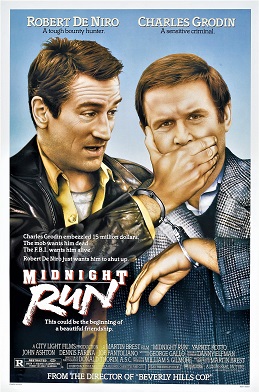
Jack Walsh agrees to deliver Jonathan Mardukas for $100,000. Mardukas gave mob money to charity, leaving Jimmy Serrano pursuing him. Walsh steals Alonzo Mosely's identification and passes himself off as a federal officer. After Mardukas disrupts their flight, the pair take to the road, with Marvin Dorfler pursuing the same bounty. Walsh eventually traps Serrano with supposed computer evidence, securing his arrest. Reaching Los Angeles, Walsh frees Mardukas and gives him his broken watch, a gift from his former wife. Mardukas hands over a belt containing $300,000, insisting it is a gift now he is free. They part; Walsh cannot get change for a taxi and continues on foot.
George Gallo traced the men's arguments to his own parents. His father was emotional, while his mother would let an argument develop before choosing her moment to strike. Speaking to Mike Fury, Gallo described Walsh and Mardukas as men who dislike each other immediately, then discover shared ideas about right and wrong. He regarded their brief attachment as a love story. The travelling mattered to that design: in his account, a long journey can reduce grown adults to childish behaviour when things go wrong. Gallo also credited Brest with keeping his ideas tied to the main story. The director's influence, he said, taught him to resist wandering into side stories, even when he had plenty of ideas for them.
Getting De Niro and Grodin together required decisions beyond the screenplay. Editor Billy Weber recalled that Brest developed Midnight Run at Paramount, with De Niro already cast and Grodin chosen over Robin Williams. In Weber's account, Paramount preferred Cher and Bruce Willis, prompting Brest to ask for the project to be sold elsewhere. Casey Silver at Universal then bought it with De Niro and Grodin attached. Weber remembered being able to make the film without studio interference. His recollection places the eventual pairing inside a change of studio: the actors Brest wanted travelled with the project, rather than being selected after Universal took it over.
The cross-country journey also meant a travelling production. Archival production records give the shoot as seventeen weeks, against an original plan of fifty shooting days. Locations included New York, Chicago, Los Angeles, Michigan, Las Vegas and Arizona, with New Zealand supplying part of the action. The plunge into the river joined a cliff filmed in Arizona to rapids filmed in New Zealand. Contemporary reporting explained that the Arizona water was too cold for the actors. Preparation for Walsh extended beyond the locations. De Niro's research materials included accounts of bounty hunters, and he applied to accompany New York police patrols. Studio production notes describe Brest and De Niro going with police on arrests and spending nights in coffee shops to understand the people and places behind the character.
De Niro described Grodin's humour as dry, sometimes leaving him uncertain whether his partner was joking. Asked by Rolling Stone about their scene at Walsh's estranged family home, he said it gave the story more weight. He resisted the suggestion that the actors were competing there. His explanation centred on different acting styles working together, with Brest responsible for choosing the material and finding the balance. De Niro trusted the director to understand what each performer brought to the scene. That discussion makes the family visit a specific problem of performance and selection, with humour still present while Walsh confronts the distance from his former life. Grodin's later recollection adds another view of their working relationship. He told the News-Times that Brest sometimes needed improvised material to make Walsh's growing affection credible. Grodin recalled that their arguments could continue off camera, with De Niro telling Brest he was getting on his nerves. Grodin welcomed repeated takes, even though he remembered crew members leaving during the shoot.
Brest described an even more extensive reshaping of the desert bar scene in his conversation with Paul Thomas Anderson. He assembled exchanges from separate improvisations, matching pieces of dialogue that had not originally belonged together. Material caught before or after a planned shot could enter the finished scene. Audience screenings then helped him adjust reaction shots by a few frames at a time. The largely chronological shoot also gave the journey a visual rule: eastward travel faced right, while westward travel faced left. In the train boxcar, Grodin had to find a way through De Niro's sustained anger and silence; a joke about chickens finally made him laugh. Their last moment together posed a separate question. Grodin proposed a take without dialogue after seventeen other takes, and Brest used it. The two scenes reached their turns through different means, one by finding a line that broke Walsh's resistance, the other by letting an exchange stand without speech. Brest's account locates these choices in work done by the performers and continued in the cutting room.