
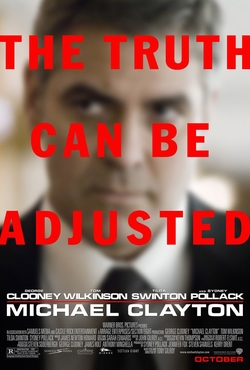
Behind the film
- Year
- 2007
- Director
- Tony Gilroy
- Writers
- Tony Gilroy
- Genres
- Thriller, Drama, Mystery, Legal thriller
- Production
- Section Eight Productions, Castle Rock Entertainment, Mirage Enterprises
- Country
- United States
- Cast
- George Clooney, Tom Wilkinson, Tilda Swinton, Sydney Pollack
About the film
Contains story spoilers, including the ending.
Michael Clayton follows George Clooney's fixer through four days of a corporate cover-up. Tom Wilkinson's Arthur Edens abandons U/North's defence after finding evidence that its pesticides contaminate farm water. Karen Crowder, the company's counsel, orders his murder; operatives make it look like suicide. Michael finds the copied report and learns that his boss, Marty Bach, suppressed it to protect the firm's fees and merger. Financially desperate after a failed bar venture, Michael accepts money and confidentiality terms. Karen nevertheless has his car bombed. He survives because he has stopped to approach horses on a hillside, then lets his attackers believe he died. At their final confrontation, Michael demands ten million dollars for silence. Karen agrees, unaware that police are listening through his phone. Officers arrive to arrest her and company head Don Jeffries. Michael leaves in a taxi, asking the driver simply to drive.
Tilda Swinton's Karen has to practise the confident manner her job demands. Gilroy described her as someone rehearsing how to be herself, trying to approximate the behaviour her boss expects. Her uncertainty coexists with the power to order Arthur's death. Arthur has spent years serving the same business, and Gilroy emphasised that his break with it does not erase the aggressive lawyer he was before. The confrontation over the report therefore involves people already shaped by their work. Michael also has a life beyond the firm, particularly his relationship with his son Henry. Gilroy connected those scenes to his own experience as a father; toys in Henry's room came from his son's desk. That personal material gives Michael someone to speak to outside the demands of clients and colleagues.
The law offices grew from Gilroy's visits to New York firms while researching The Devil's Advocate. He was struck by the amount of work hidden behind the polished meeting rooms: documents piled up in large working areas, with people still at their desks deep into the night. Michael Clayton uses that labour as the setting for its thriller. Gilroy wanted room for moments that other thrillers would cut, particularly the decisions through which somebody becomes a villain. Karen's choices belong to that interest in behaviour, rather than a final speech explaining an already completed transformation. He also named Klute, Point Blank and the work of Sidney Lumet among his influences. What interested him in those earlier films was their combination of forceful filmmaking, ambiguity and loose ends. The corporate investigation could move at the pace its people required, with time for hesitation before a decision becomes irreversible.
Gilroy wrote Michael Clayton with the intention of directing it himself. His initial pitch to Castle Rock centred on a fixer at a large New York firm, a role substantial enough for a movie star, and a death. He also promised that this film about lawyers would stay out of the courtroom. That choice places the pressure on the people managing the case outside a trial: the client, the firm's employees and the fixer brought in when an important colleague becomes a problem. Development took longer than he expected, with his work on the Bourne films consuming time. He eventually arranged his schedule so that he delivered The Bourne Ultimatum before beginning pre-production on Michael Clayton, then stopped taking writing jobs while making his first feature.
Clooney's participation changed what Gilroy could do with the rest of the cast. Gilroy said that securing the star first freed him from choosing actors according to overseas sales or studio demands. Sydney Pollack, who plays Marty, brought the backing of Mirage and experience supporting first-time directors. Gilroy also had final-cut authority, an unusual position for a debut filmmaker. Those arrangements gave him room to keep the film's pace and concentration on conversations, while Clooney carried a role built around a man being asked to repair other people's damage.
Robert Elswit's photography drew on the New York films of the 1970s, including Klute and Network. He used anamorphic lenses and Kodak film, with older Panavision lenses softening the image and adding flare. The plan had assumed overcast winter weather, but bright sunshine forced a different approach. Elswit allowed strong contrasts and natural shadow instead of filling every dark area. For Michael and Arthur's alley conversation, several cameras caught the actors together, while the surrounding buildings helped control the light. The final confrontation presented another problem: the Hilton lobby's large windows admitted less daylight than their size suggested. Elswit built a substantial lighting arrangement outside them to hold the scene's appearance through the day. The bright lobby remains visible around Michael and Karen as their private negotiation gives way to the arrival of police.
Editor John Gilroy helped plan the hillside sequence with video sketches made alongside Tony Gilroy and Elswit. They stood in for Michael, placed cardboard horses on the ridge and cut the material together with an explosion sound. Once filming began, John assembled the driving shots as they arrived, using timed title cards for missing actions so the crew knew what they still needed. Dawn and dusk allowed only brief windows for matching light. The ending required a different kind of restraint. Several cameras had covered Karen's collapse, but the chosen shot follows Michael from the front while she falls out of focus behind him. John wanted the audience to supply her disintegration without cutting away to a close view. Michael's departure stays at the centre of the frame, leaving Karen's loss of control visible in the space he has just crossed.