
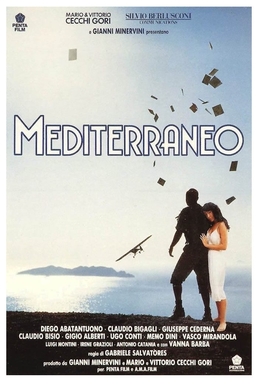
Behind the film
- Year
- 1991
- Director
- Gabriele Salvatores
- Writers
- Enzo Monteleone
- Genres
- Drama, Comedy, War, Lgbtq-related
- Production
- Medusa Film, Silvio Berlusconi Communications
- Country
- Italy
- Cast
- Claudio Bigagli, Diego Abatantuono, Giuseppe Cederna, Vanna Barba
About the film
Contains story spoilers, including the ending.
Mediterraneo sends Lieutenant Montini and seven other Italian soldiers to an apparently deserted Greek island in 1941. Montini loves painting and poetry, while Sergeant Lo Russo gives their small unit a more forceful military voice. Farina is Montini's shy attendant. Their ship is destroyed and their radio stops working, leaving the men cut off from their commanders. The islanders gradually emerge, and the occupation gives way to relationships and everyday routines. A visiting pilot eventually brings news that the war has ended. Most of the soldiers leave, but Farina stays and marries Vassilissa. Years later, Montini returns to find Farina widowed and Lo Russo living there too, disappointed by life back in Italy. The reunion brings the story beyond the soldiers' temporary wartime shelter: for two of them, the island has become the place to spend the rest of their lives.
Montini's work on the church frescoes gives his interest in art a practical outlet among the islanders. The men who arrived to capture a place begin to take part in its life, with dancing and personal attachments replacing the expectation of fighting. Time Out's reviewer SFe found this transformation too sentimental and thought the film lacked the historical or philosophical weight of a convincing anti-war statement. The review nevertheless singled out the epilogue's bitterness. That objection identifies a tension in the comedy: the pleasant island interlude takes place during a war, while the later return carries disappointment that its sunny setting cannot simply remove.
Enzo Monteleone's story reached Salvatores after several years of attempts to get it made. In an account reproduced in Fabrizio Bruni's study of Cefalonia and its screen representations, the writer recalled developing the project in 1987 for Carlo Mazzacurati. They approached prospective producers without reaching production. Salvatores contacted Monteleone in early 1990, while finishing Turné, because he wanted to follow his road films with a small production in a single place, ideally an island in southern Italy. Mediterraneo supplied a story that could keep its characters together in that confined setting. Salvatores, Abatantuono and producer Gianni Minervini responded to it, and Minervini signed the agreement. Monteleone also recalled resistance from Mario Cecchi Gori, who had served in the Greek campaign and questioned both the film's representation and its commercial prospects. The project proceeded under a tight budget. His account makes the island setting a concrete production decision as well as the place where the soldiers lose the movement and orders that had organised their lives.
Finding that place meant travelling through Greece. Diego Abatantuono recalled scouting with Salvatores, the cinematographer and members of the production team. Earlier possibilities would have required filming different parts on different islands. Kastellorizo, the final stop, offered what they needed in one location. Abatantuono remembered its small airport between the mountains, its port and the absence of roads. The space by the airport also became the location for the football scenes. His recollection connects the actors' island surroundings with a particular activity in the film, rather than treating the scenery as a background assembled elsewhere. Claudio Bigagli told La Nazione that Salvatores developed Montini collaboratively, inviting discussion and giving the character his glasses, ring and knitted cap.
Salvatores later told Vogue Italia that some islands had been too attractive or too developed for the story. Kastellorizo had war-damaged houses, few inhabitants and little that looked modern. The team stayed for no more than three months. He also recalled an earlier proposed title, Lasciateci perdere, which played on being left alone and allowing oneself to get lost. Monteleone suggested Mediterraneo instead. Salvatores connected that choice to Predrag Matvejević's Breviario Mediterraneo and its account of a sea joining the lands around it through shared culture and daily life. For a story about Italians finding a second homeland, the name fitted the relationship they formed with the island. Asked about the opening quotation on escape, the director described a spiritual withdrawal from an imposed course. He compared it to taking down a boat's sails in bad weather, when abandoning the planned route might lead somewhere unfamiliar. That explanation gives the men's separation from their command a meaning beyond the immediate convenience of avoiding combat.
Writing for FIPRESCI about a later Kastellorizo screening attended by Giuseppe Cederna, Davide Magnisi placed Mediterraneo alongside Salvatores' other stories of friends fleeing ordinary responsibilities. He credited Italo Petriccione's photography and Monteleone's screenplay, which he described as freely inspired by Renzo Biasion's Sagapò. Magnisi read Lo Russo's return as the disappointment of a dreamer confronted by political life. His interpretation puts the elderly soldiers' reunion in conversation with the hopes of a later Italian generation, rather than treating the characters as a record of an actual wartime unit. It also differs from Time Out's impatience with the idyllic middle of the film. Between those readings stands the same outcome: Farina remains where he found a partner, while Lo Russo comes back after trying the life that had once drawn him away. Montini's visit reunites men whose choices have led them to different versions of home.