
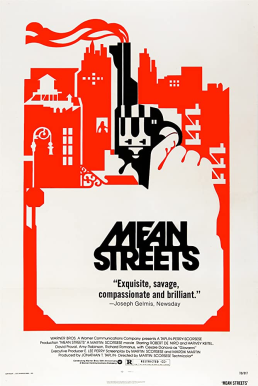
Behind the film
- Year
- 1973
- Director
- Martin Scorsese
- Writers
- Mardik Martin, Martin Scorsese
- Genres
- Drama, Crime, Crime drama, Thriller
- Production
- Taplin-Perry-Scorsese Productions
- Country
- United States
- Cast
- Robert De Niro, Richard Romanus, Harvey Keitel, Cesare Danova, David Proval, Amy Robinson, Victor Argo, George Memmoli
About the film
Contains story spoilers.
Mean Streets follows Charlie Cappa through a few restless days in New York’s Little Italy, where family, friendship, faith and neighborhood business all occupy the same streets. Charlie collects money for his uncle Giovanni, a respected crime boss, and dreams that he might one day run a restaurant of his own. He is also a devout Catholic, troubled by the feeling that confession and penance cannot simply cancel the harm he sees around him. His private bargain with God is to make his own penance, but he keeps choosing situations that make guilt harder to escape.
The sharpest test of Charlie’s judgment is Johnny Boy, his childhood friend and Teresa’s cousin. Johnny Boy gambles, borrows from several people and treats each deadline as a problem that can be talked away. Because Charlie vouched for him, Michael, a loan shark, holds Charlie responsible for the money. Charlie can see how badly Johnny Boy is behaving; he still cannot bring himself to abandon him. The film makes that loyalty feel at once tender and self-serving. Charlie calls it family, while Teresa wonders whether his rescuing Johnny Boy is really a way to keep himself close to danger and feel useful.
Charlie’s hoped-for exit from the neighborhood comes through Oscar, a restaurant owner whose business is failing. Giovanni hints that Charlie might take it over, giving him a respectable future without forcing him to sever ties with the people who raised him. At the same time, Charlie hides his relationship with Teresa from the family. Teresa is intelligent and forceful, and wants to move into her own apartment; the men around her treat her epilepsy and independence as reasons to control her. Charlie cares for her but will not commit, always postponing a choice until his position with Giovanni is secure.
That delay is part of the film’s moral trap. Charlie mediates quarrels, arranges jobs and tries to soften the damage done by Michael’s collections or Johnny Boy’s provocations. Yet he takes part in the same economy of favors and intimidation. He wants Giovanni’s restaurant and approval, accepts responsibility for Johnny Boy’s debts, and refuses Teresa’s invitation to leave. When he talks with Diane, a dancer at Tony’s club, he offers her a hostess job at the restaurant he hopes to open and asks her to meet him after her show. He stands her up because he is afraid to be seen with a Black woman, leaving Diane waiting while his own prejudice overrides the offer. The episode shows how even a seemingly generous offer can become another promise Charlie cannot honor.
The neighborhood is not a backdrop that the characters can step outside at will. Bars, a church, Giovanni’s deli, family apartments and the annual Feast of San Gennaro form a small world where everyone knows the old arguments and obligations. A shooting in Tony’s bar interrupts the men’s familiar banter with sudden violence; afterward, they slip out through a back window to avoid the police. The episode does not turn them into outsiders to crime. They return to the same places, talk about money, flirt, fight and make arrangements, as if danger were simply another part of the night.
Charlie’s relationship with Teresa makes his divided loyalties personal. They meet in secret, and their arguments are not just about whether to leave: Teresa wants an acknowledged life together, while Charlie treats the restaurant and Giovanni’s trust as prerequisites for choosing her. When Giovanni warns Charlie away from Teresa and Johnny Boy, his advice carries real authority because the family business is also Charlie’s chance at status. Charlie says he is protecting people, yet repeatedly asks them to wait while he keeps one foot in each world. The film lets those delays accumulate until a decision becomes impossible to postpone.
Martin Scorsese and co-writer Mardik Martin shaped the story from the director’s experience growing up in Little Italy, and the film’s intimacy comes from how closely it watches the men’s habits. The camera follows conversations and fights through cramped rooms, while popular songs connect the characters’ adult bravado to the music they grew up hearing. Most of the picture was made on Los Angeles sets and locations, with a shorter New York shoot; the transformations are convincing because the film cares about the texture of the neighborhood more than postcard landmarks. It feels lived in through its crowded rooms, street gatherings, music and the way a favor can become a debt.
As Johnny Boy’s debt to Michael grows, Charlie’s separate hopes begin to depend on the same unstable friendship. A missed payment, an insult and a small amount of money offered too late push the group toward an escape attempt. Charlie, Johnny Boy and Teresa drive out together, but Michael’s pursuit ends in a crash that leaves all three injured. Charlie is taken away by ambulance, looking back at Teresa as the police help her from the car. His imagined penance has not freed anyone from the consequences of the neighborhood’s rules. The ending leaves him still caught between the bonds he calls family and the choices that keep those bonds dangerous.