
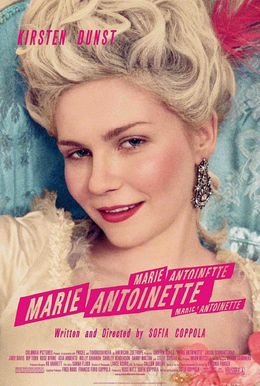
Behind the film
- Year
- 2006
- Director
- Sofia Coppola
- Writers
- Sofia Coppola, Antonia Fraser
- Genres
- Drama, Biographical
- Production
- American Zoetrope
- Country
- Japan, United States, France
- Cast
- Kirsten Dunst, Jason Schwartzman, Judy Davis, Rip Torn, Rose Byrne, Asia Argento, Molly Shannon, Shirley Henderson
About the film
Contains story spoilers, including the ending.
Marie Antoinette approaches the French queen through the tastes and feelings of a young woman growing up inside Versailles. Sofia Coppola wrote the 2006 film from Antonia Fraser's biography, with Kirsten Dunst in mind for the central role. Her stated intention was an impressionistic account from Marie's perspective, selecting an experience from a much larger life story. The design puts that choice into practice. Coppola and costume designer Milena Canonero kept recognisable eighteenth-century shapes while changing fabrics and colours. New Wave and post-punk music sits beside period compositions, connecting the court's pleasures to the director's own early interests. Count Fersen's appearance drew on Adam Ant, while a pair of Converse shoes appears among the fashionable excess of the shopping sequence. Versailles itself supplied locations, including the Petit Trianon and its grounds. The sweets came from Ladurée and the shoes from Manolo Blahnik. The result of those choices is a royal household presented through clothes, appetite, music and leisure. Its surroundings are grand, but the emphasis stays close to the person discovering how to inhabit them and finding brief pleasures within a life arranged by other people.
At the French border, Marie relinquishes her Austrian belongings before marrying Louis-Auguste. The young couple's failure to produce an heir becomes court gossip and a source of pressure from her mother. She finds companionship with Lamballe and Polignac and turns to clothes, gambling and parties. Louis XV's death makes the couple king and queen. A visit from Marie's brother Joseph helps resolve their marital difficulty, and they eventually have children. At the Petit Trianon, she develops a different social life and has an affair with Count Fersen. Public anger grows as France's finances worsen and food becomes scarce. The royal family's decision to remain at Versailles leaves them facing the crowd that forces their move to Paris. The final image is Marie's wrecked bedroom. The film stops at the loss of her Versailles world, before her later trial and execution.
Clothing repeatedly marks the movement between identities that Marie is expected to accept. Being dressed is an everyday service, yet the border ceremony makes it an instruction to become French by surrendering what belonged to her Austrian life. Later, elaborate gowns can express pleasure and still restrict the body wearing them. A scene in which she reads her mother's disappointed letter brings that pressure into the image itself. Marie's floral dress blends with the patterned wall as she slides down it, overwhelmed by the demand that she become pregnant. Her clothing and the palace's decoration make her appear almost absorbed into her surroundings. The party aftermath works differently. Creased fabric, disturbed hair and damaged finery expose what remains once the evening's arranged display has ended. The contrast is between the public costume and the person left inside it. Costume scholar Therése Andersson reads these changes as part of the film's emotional storytelling. Colour, silhouette and the condition of a garment communicate shifts that do not require a speech explaining Marie's state of mind. The clothes register strain as well as the pleasures that first made them attractive to her.
Coppola said that visiting the private apartments behind Marie's public bedroom helped her find a more human scale for the story. Their turquoise and pink floral fabrics surprised her because museum objects and court portraits had suggested a different palette. She wanted to build the film around that younger, more personal world. Dunst prepared through Fraser's biography, letters, etiquette classes and lessons in music, while trying to understand the character without passing judgment on her. She described the costumes as characters in themselves within a film with relatively little dialogue. Jason Schwartzman approached Louis's reserve from another direction. His research initially frustrated him because the king seemed to say so little. He then chose to play a man who wanted to communicate but could not manage it, giving the silence an active difficulty. Those approaches place two uncertain young people inside a marriage that already carries public expectations. Coppola's account of excluding much of the outside political world follows the same decision: the court's isolation is part of Marie's experience, and the film makes the limits of that experience part of its viewpoint. Coppola considered filming at Versailles essential and had no alternative location plan.
Canonero recalled Coppola bringing her a box of Ladurée macarons as a guide to the costumes' pastel colours. Coppola's reference boards mixed New Romantic imagery with John Galliano's eighteenth-century-inspired couture. Dunst contributed during fittings, trying fabrics and dresses as the designer worked out Marie's appearance. For the scene after her child's death, she suggested a red ribbon around the waist of a pale-blue dress, imagining the line as a wound across the body. The collaboration carried emotion through a small change in dress, alongside the larger wardrobe needed to show the court over many years.