
Behind the film
- Year
- 2005
- Director
- Luc Jacquet
- Writers
- Luc Jacquet, Michel Fessler, Jordan Roberts
- Runtime
- 1h 24m
- Genres
- Nature documentary, Documentary
- Production
- National Geographic, Bonne Pioche, Wild Bunch
- Country
- France
About the film
Contains story spoilers, including the ending.
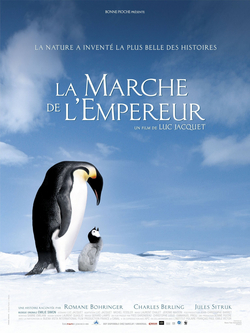
March of the Penguins is Luc Jacquet’s documentary about emperor penguins in Antarctica. Laurent Chalet and Jérôme Maison filmed its wildlife, and Sabine Emiliani edited the picture. The birds travel inland from the sea to breed on stable ice. The distance back to open water increases as winter advances, turning feeding into a long journey. A female lays one egg and passes it to her mate’s feet, where it must remain protected from the cold. The female returns to the ocean while the male stays with the egg. This division of work gives the film its alternating movements between the colony and the water.
The males huddle for warmth while incubating their eggs and going without food. When females return, they feed the chicks and allow the males to make their own journey to the sea. Storms can kill the young, and predators threaten both the chicks and the adults travelling to feed. The surviving parents continue moving between the breeding ground and the ocean to bring back food. As spring melts the ice, the journey becomes shorter. The cycle eventually reaches the point where the young must fend for themselves. The American release uses Alex Wurman’s score in place of the original French music.
The filming itself had to continue until the young could reach the sea. The International Documentary Association reports that Chalet and Maison stayed after the planned departure because the ice had delayed the chicks. Its account describes the two cinematographers working from a sequence plan while Jacquet was away from the Antarctic base. A blizzard interrupted their work and led to a rescue, followed by a period of recovery before filming resumed. The article also records a dispute over recognition: Chalet argued that his role went beyond cinematography and sought co-author credit, which producer Yves Darondeau refused. Those competing accounts concern the people making the documentary, rather than changing what the penguins did. The American distributors later re-edited the film with new narration and music. Warner Independent Pictures and National Geographic brought that version to English-speaking audiences, giving the Antarctic footage a different spoken and musical setting.
Chalet explained the camera choice in a Super 16 publication. He wanted the texture of film, but thirty-five-millimetre equipment would have been too heavy for the small crew. He and Maison were often working as a pair, so the lighter equipment gave them the mobility they needed. He also described film’s performance in the cold, saying the camera and stock had worked during the year in Antarctica, including temperatures of minus thirty degrees Celsius. His comments link the appearance of the finished images to the weight the crew had to carry and the conditions in which they worked.
Darondeau’s account of the production explains how the year-long expedition shaped the project. The French Polar Institute could accommodate only two film technicians over winter, leaving Chalet and Maison to record the breeding cycle while the base was inaccessible by boat or plane. The producer described the difficulty of arranging insurance before anyone could inspect the undeveloped footage. Television pre-sales helped the company send the crew, but financing continued to cause problems while filming was already underway. Once the images returned, the production could move further into editing and writing. Darondeau also explained a crucial aspect of the finished story: the apparent continuity does not mean the same individual penguins appear from shot to shot. Their similar appearance allowed the editors to build a continuous account from different animals. Michel Fessler joined as co-writer, and Émilie Simon composed the original music. The human account of a couple and its chick is therefore a narrative built around the birds’ behaviour, rather than a record of named animal characters followed without interruption.
Jacquet told IndieLondon that he had not set out to discover new scientific facts about emperor penguins. He wanted to give an artistic form to things he had found striking in Antarctica. He also described the need to control the crew’s impulse to intervene: approaching a distressed bird could cause panic or make it waste energy trying to escape. Editing was another challenge. He recalled six months of trying different combinations of images, with an outline prepared before filming but no ability to control the animals’ actions. He distinguished the French release’s three voices from the single narrator used in English. Romane Bohringer, Charles Berling and Jules Sitruk tell the original version’s story; Morgan Freeman narrates the American adaptation. Jacquet said Warner Independent suggested Freeman, and he accepted immediately. For the underwater scenes, he credited Maison and Patrick Marchand and stressed that the swimming images had not been sped up. Jacquet described the French voices as telling the penguins’ story, rather than literally being penguins speaking. His account keeps the film’s narration separate from the observed behaviour that supplied the footage.